
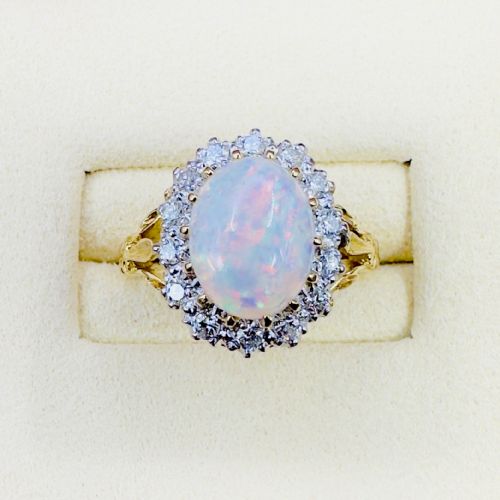


Vintage Oval Opal Ring
These vintage oval opal ring selections offer distinctive play-of-colour and historic settings desired by collectors.
Vintage Oval Opal Ring
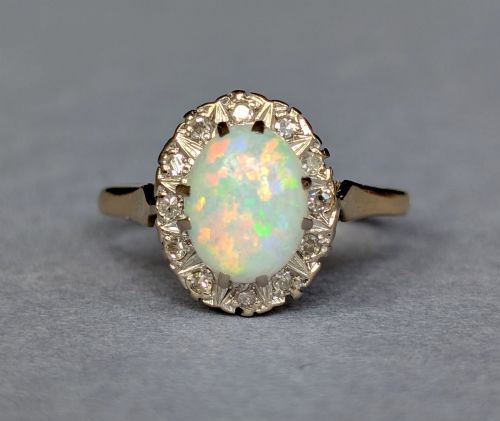
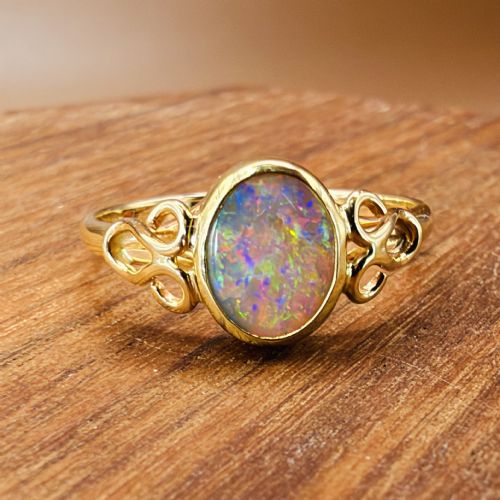
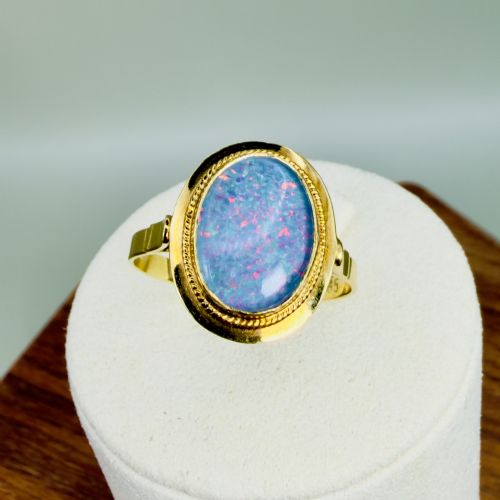
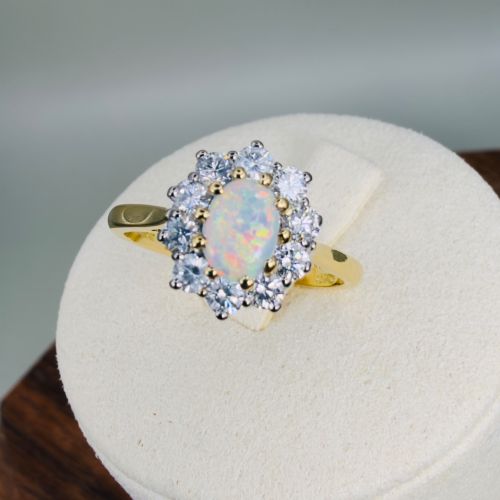
A vintage oval opal ring centres on an oval cabochon stone displaying shifting spectral hues, often paired with accompanying diamonds or sapphires. These pieces span periods from the nineteenth century through the mid-twentieth century, encompassing Victorian, Art Deco, and retro designs.
Solitaire and cluster configurations dominate the forms available here, ranging from delicate dress rings to substantial statement pieces. Most examples emerge from the Victorian, Edwardian, and mid-century eras, reflecting traditional craftsmanship of their respective decades.
Materials and construction
Goldsmiths utilised varying purities of yellow and white gold, spanning nine, fourteen, and eighteen carats, to construct durable bezel or claw settings. These precious metals securely house cabochon-cut opals, sometimes accented by brilliant-cut diamonds or deep blue sapphires.
Lapidaries shaped opals into smooth, rounded cabochons rather than faceted gems, maximising the internal flash of light characteristic of white, black, boulder, and water opals. Artisans then integrated these stones into handmade or cast mountings typical of nineteenth and twentieth-century jewellers.
Listings feature yellow and white gold in nine, fourteen, and eighteen carat purities, alongside platinum.
Judging quality in a vintage oval opal ring
Quality rests primarily upon the optical play-of-colour within the opal itself, where vibrant, directional flashes across the spectrum elevate a stone. The depth of the body colour, whether milky white, dark black, or earthy boulder matrix, also dictates the visual impact.
Setting integrity and the condition of the surrounding goldwork distinguish finer examples from standard work. Secure claw or bezel mountings that protect the softer opal without obscuring its dome represent superior goldsmithing.
The Vintage Oval Opal Ring Glossary
- Cabochon
- A gemstone shaped with a smooth, rounded surface and a flat or curved base rather than faceted planes. This style highlights the internal play-of-colour in opals.
- Play-of-colour
- The optical phenomenon where spectral colours shift and flash across the stone as the viewing angle changes. This is the primary aesthetic characteristic valued in opals.
- Solitaire
- A ring featuring a single central gemstone without secondary flanking stones. In these pieces, a single oval opal takes prominence.
- Cluster ring
- A design where a central stone is encircled by a border of smaller gems, typically diamonds or sapphires. This arrangement enhances the visual presence of the primary opal.
- Bezel setting
- A method of securing a gemstone where a thin collar of metal wraps entirely around the rim of the stone. This technique offers robust protection for softer materials like opal.
Vintage Oval Opal Ring: Frequently Asked Questions
How do I care for my opal ring?
Opals contain natural water content and possess a moderate hardness, making them sensitive to sudden temperature changes, harsh chemicals, and ultrasonic cleaners. Clean your ring gently using warm soapy water and a soft cloth.
Store the piece separately from harder gemstones like diamonds to prevent scratching the polished surface of the opal.
Are these rings suitable for daily wear?
While many owners wear these rings regularly, opals require more mindful care than harder stones such as diamonds or sapphires. Protective bezel settings offer better security for daily use than high claw mountings.
Removing the ring during heavy manual work or strenuous physical activity helps preserve the gold setting and the opal.
How can I tell the period of a ring?
Dating relies on stylistic markers such as the geometric lines of Art Deco pieces or the ornate detail of Victorian claw settings. Hallmarks stamped inside the gold band often provide assay office stamps and date letters.
Comparing the cut of accompanying diamonds and the overall construction method further helps confirm whether a piece originates from the nineteenth or twentieth century.
What is the difference between boulder opal and white opal?
White opals display their play-of-colour against a pale, milky body background. Boulder opals form naturally embedded in ironstone host rock, leaving a dark backing that intensifies the spectral flashes.
Both varieties are cut into cabochons, but boulder opals retain a portion of their natural brown matrix on the reverse.