
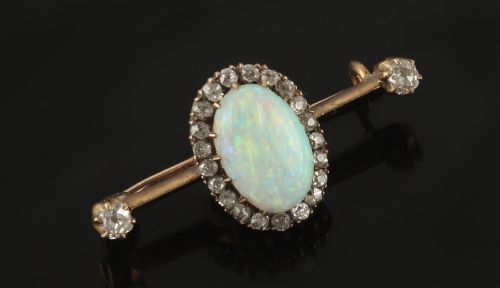


Vintage Opal Brooch
A vintage opal brooch brings together shifting play-of-colour and precious metal, offering an eye-catching piece of antique jewellery to wear daily.
Vintage Opal Brooch
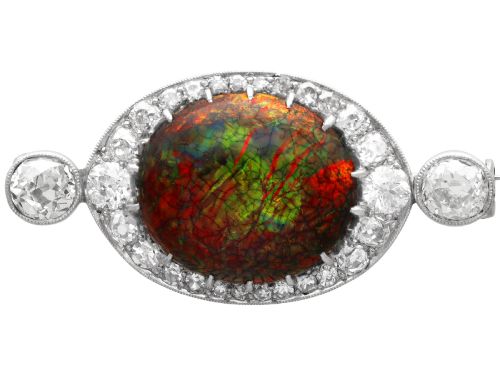
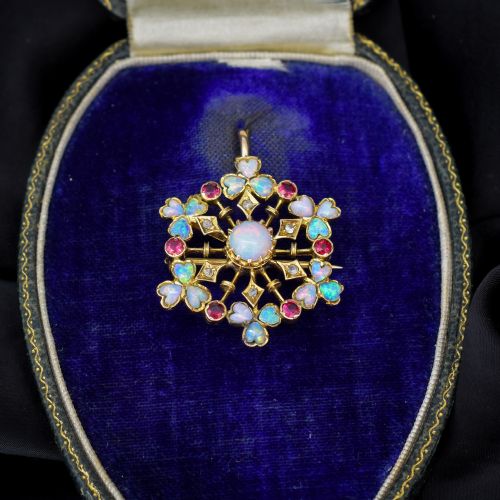
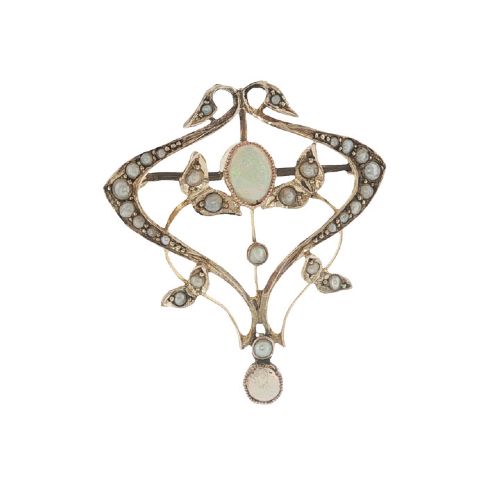
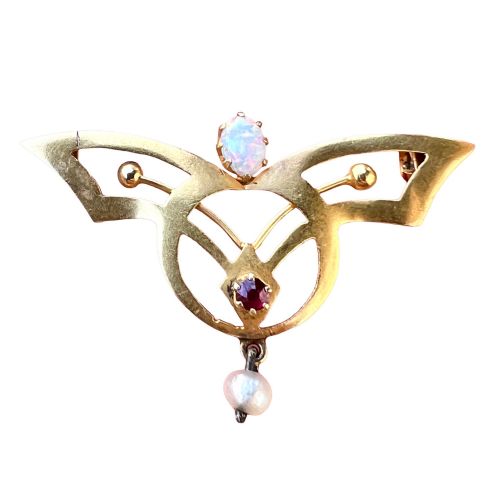
A vintage opal brooch brings together colourful opals paired with diamonds, rubies, and pearls, often designed to function as both a pendant and a brooch.
Buyers browsing this selection meet pieces from the Victorian, Edwardian, and Art Nouveau periods, alongside later twentieth-century examples.
Common forms include bar brooches, cluster designs, and floral motifs set in yellow gold, white gold, or silver.
Materials and construction
Craftsmen built these pieces using 9ct gold, 18ct gold, and silver, frequently combining opals with accent stones like rubies, diamonds, and seed pearls.
Many items utilise secure settings such as bezels and claws to hold central opals and smaller surrounding gemstones in place.
Assessing quality
Quality rests heavily on the vibrancy of the opal's play-of-colour and the harmony of the surrounding gem arrangement, such as matched rubies or diamonds.
The finesse of the metalwork, whether delicate Edwardian openwork or robust Victorian bar construction, distinguishes finer examples.
the Gaskins
The Vintage Opal Brooch Glossary
- Bar brooch
- A narrow horizontal pin set with gems along its length. These designs were particularly popular during the Victorian and Edwardian eras.
- Play-of-colour
- The optical phenomenon where internal flashes of spectral colours shift as the stone moves in the light. This is the defining optical characteristic of quality opals.
- Seed pearl
- A tiny, naturally small pearl often used in Victorian and Edwardian jewellery clusters. They add a delicate border texture around central stones.
- Assay
- An official stamp or mark indicating the purity of the precious metal. Pieces often bear marks showing where and when they were tested.
Vintage Opal Brooch: Frequently Asked Questions
Can I wear a vintage opal brooch every day?
Opals are softer than diamonds, so daily wear requires care to avoid hard knocks against the stone.
Pinning the brooch to sturdy fabrics helps secure its weight throughout the day.
How do I tell an Edwardian brooch from a Victorian one?
Victorian pieces often feature heavier gold work and clustered gemstones, reflecting mid to late nineteenth-century tastes.
Edwardian designs tend to favour lighter white gold or platinum settings with airy, delicate motifs.
Are all these brooches made of solid gold?
The materials vary across the selection, including 9ct gold, 15ct gold, 18ct gold, and silver.
Assay marks and hallmarks stamped into the metal help confirm the specific standard used.