

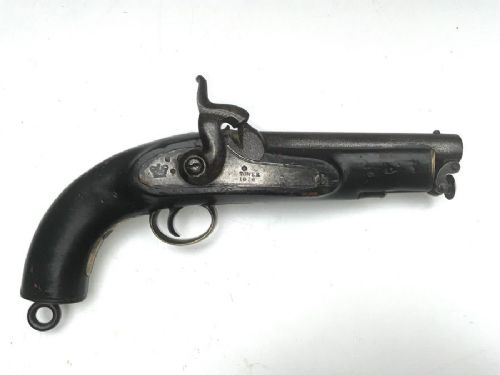
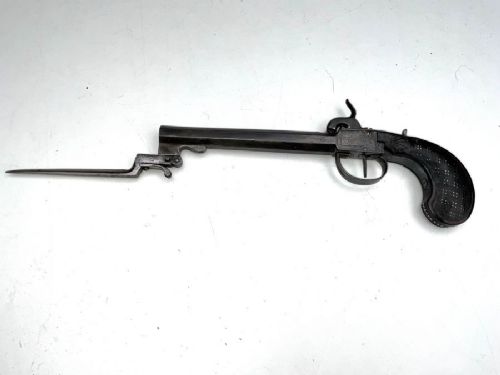
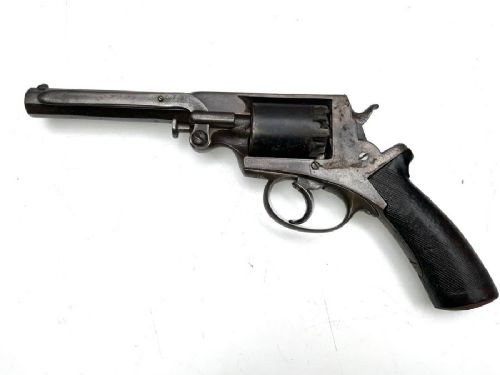


Vintage Military Pistol
These vintage military pistol examples span the 18th to the 20th century, offering collectors authentic firearms and militaria with tangible service history.
Vintage Military Pistol
When you search for a vintage military pistol, you encounter historic firearms and related items spanning the 18th century through the 19th century and into the 1920s. These pieces range from flintlock and percussion service arms to boxed revolvers and associated oil paintings.
The version you are most likely to meet on this page is the 19th century percussion pistol or revolver. These include Tower stamped belt pistols, Beaumont-Adams revolvers, and U.S. martial issue Colt models.
Origin points and styles vary widely across the selection, taking in Georgian, Regency, and Victorian military aesthetics alongside 18th century French pieces. Alongside the firearms themselves, the category occasionally accommodates period artwork such as depictions of air aces.
How they were made
Makers utilised robust metals like steel, iron, and brass for barrels, lock plates, and mounts. These metallic elements were paired with stocks fashioned from walnut, hardwood, or general wood.
Construction techniques involved precision smithing for smoothbore and percussion mechanisms, often incorporating folding bayonets or custom stamping. Accessories such as canvas and oil also appear in the material record for housing and maintenance.
Vintage Military Pistol Retail Price Guide 2026
Typical asking prices for vintage military pistol among the pieces listed under this phrase on Sellingantiques today, from the lower quarter to the upper quarter. They describe what is for sale here now, not the wider market.
One listed scene captures an air ace firing his pistol right from the cockpit.
What varies in quality
Quality diverges according to the original commissioning body and the renown of the maker. Signatures, London or French origins, and official martial issue markings elevate specific examples above standard service arms.
The integrity of matching components and original housing sets, such as boxed revolver kits, distinguishes high-end pieces. Finer grade items demonstrate superior execution in brass barrels and lock plates.
Colt Model 1860·Beaumont-Adams·Wilson·A.W Spires
The Vintage Military Pistol Glossary
- Percussion
- A firearm ignition system using a percussion cap struck by a hammer to ignite the powder charge. This technology superseded flintlock mechanisms in the 19th century.
- Flintlock
- An ignition mechanism utilising a flint striking against a steel frizzen to create sparks. This system dominated military sidearms through the 18th century.
- Smoothbore
- A barrel lacking internal rifling, designed to fire lead shot or balls. Many early service pistols utilised this bore type before rifled barrels became standard.
- Pinfire
- An early cartridge design where a percussion pin protrudes radially from the base of the cartridge. These appear in mid-19th century double-barrel designs.
- Martial issue
- Equipment specifically contracted and manufactured for military service rather than private civilian purchase. These arms often bear government inspection marks or unit stamps.
Vintage Military Pistol: Frequently Asked Questions
How do I date a percussion pistol?
Dating relies on proof marks, maker signatures, and stylistic shifts between flintlock and percussion systems. Many pieces carry explicit date stamps or reflect the reigning military pattern of their decade.
Changes in barrel length, lock plate geometry, and the transition from smoothbore to rifled barrels help narrow the period of manufacture.
What is the difference between flintlock and percussion?
Flintlock pistols use a piece of flint striking steel to generate sparks for ignition, which was standard prior to the 19th century. Percussion pistols employ a small cap struck directly by a hammer, offering greater reliability in wet weather.
Percussion arms largely replaced flintlocks across military forces during the mid-1800s.
Were these pistols used in combat?
Many examples carry U.S. martial issue stamps or British service markings indicating deployment during major conflicts like the American Civil War. Officer and dragoon pistols were issued directly for active military service.
Provenance, serial numbers, and unit stamps often provide a paper trail linking a specific arm to historical campaigns.
How should I display a vintage pistol?
Displaying these firearms safely involves secure wall mounting or placement in locked glass cabinets away from direct sunlight and moisture. Boxed revolvers are best housed flat in their original fitted cases.
Maintaining stable room temperature preserves the integrity of the wood stocks and metal finishes.