
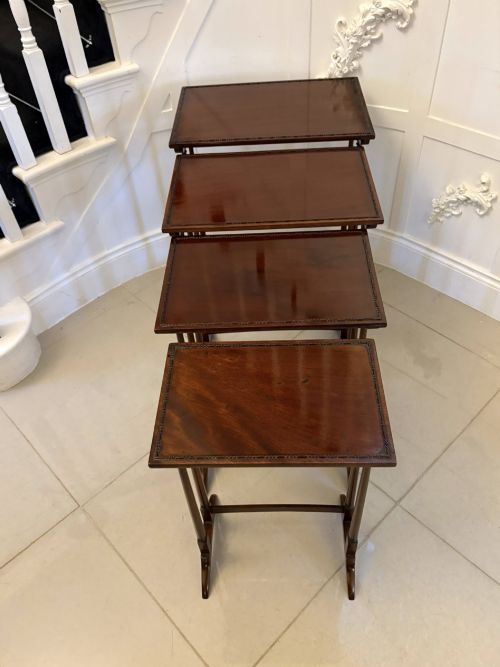
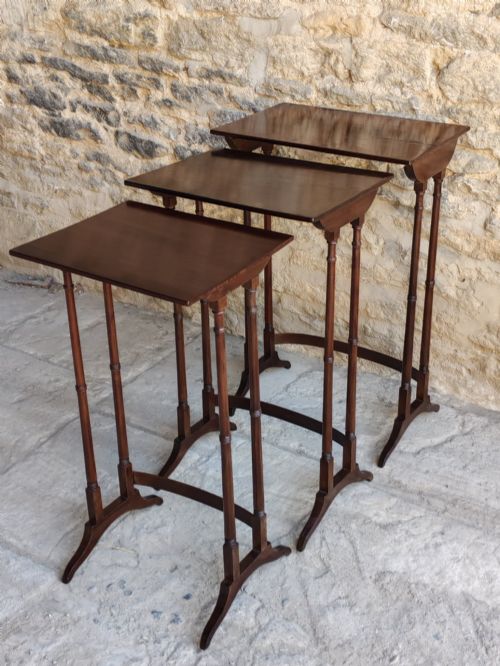
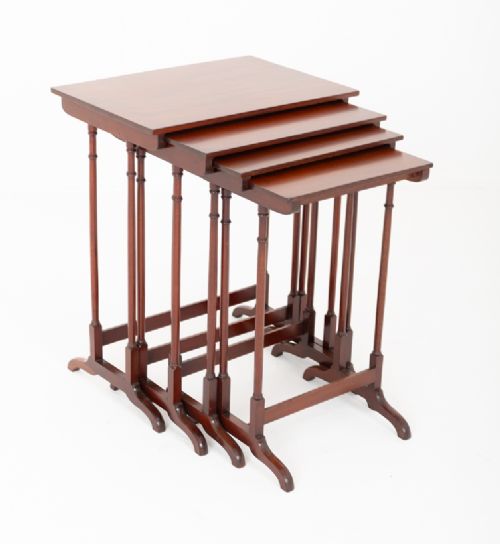


Vintage Mahogany Nesting Set
A vintage mahogany nesting set offers practical tiered surfaces, and these tables combine rich timber grain with clever graduated storage.
Vintage Mahogany Nesting Set
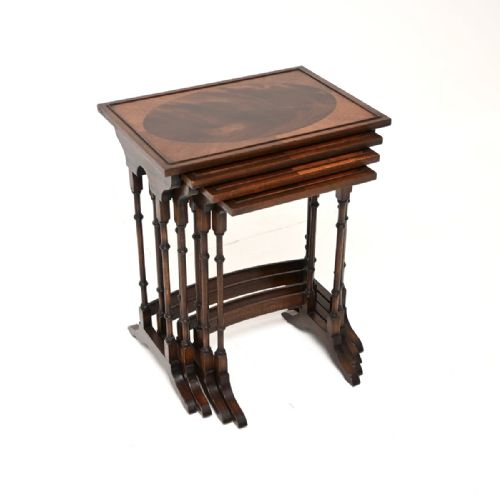
A vintage mahogany nesting set comprises multiple small tables designed to slide neatly beneath one another when not in use. These pieces appear in configurations ranging from sets of three up to sets of five, with four-table quartetto arrangements being particularly common.
The selections span various periods from the nineteenth century through the Edwardian era and into the 1920s and 1930s. Buyers frequently encounter Edwardian examples alongside Georgian style revivals and Regency pieces.
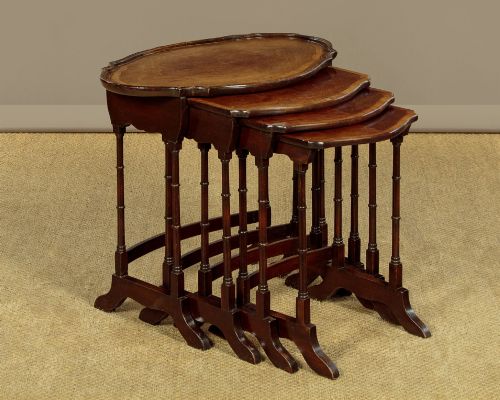
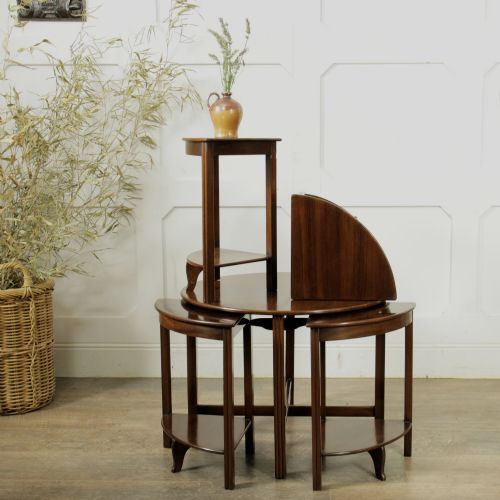
Forms include traditional rectangular shapes as well as circular and oval variations used as occasional or coffee tables. They serve primarily as flexible living space accessories that deploy quickly when extra surfaces are required.
How they were made
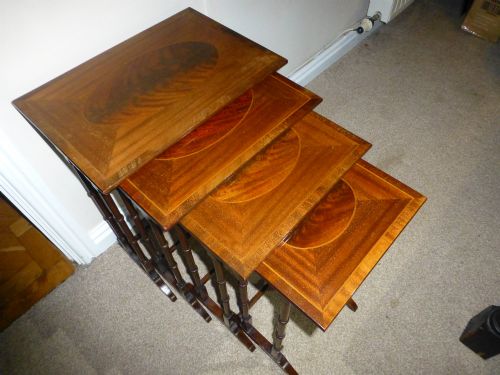
Cabinet makers utilised solid mahogany and mahogany veneer over secondary timbers to construct the frames and table tops. Figured mahogany often provides the primary visual interest across the upper surfaces.
Decorative embellishments involve contrasting timbers and metals applied to the primary structure. Craftsmen incorporated satinwood cross banding, boxwood and ebony stringing, satinwood inlay, and brass details.
Structural supports vary from square tapered legs to turned columns depending on the stylistic period. Tables designed in the quartetto tradition rely on precise dimensional grading to ensure each smaller member fits smoothly beneath the next.
The listings on this page span the Georgian, Regency, and Victorian periods through to Edwardian interpretations and 1930s revivals.
What varies in quality
The selection of timber grain largely determines the visual hierarchy among these table sets. Highly figured mahogany and crisp, precise inlay work distinguish finer examples from plain utilitarian productions.
Construction fidelity shows in the tightness of the joints and the proportional clearance between the sliding tiers. Tables that glide smoothly into their nesting position without binding demonstrate superior initial craftsmanship.
The Vintage Mahogany Nesting Set Glossary
- Quartetto
- A matched set of four small tables designed to nest together. This traditional term frequently appears in Edwardian and nineteenth-century descriptions.
- Cross banding
- A border veneer applied around the edge of a table top with the grain running perpendicular to the central panel. This technique frames the primary mahogany timber.
- Satinwood inlay
- Contrasting light yellowish wood inserted into recesses on the dark mahogany surface to create decorative patterns. It provides sharp visual borders on Edwardian pieces.
- Stringing
- Thin inlaid lines of contrasting wood such as boxwood or ebony used to outline table tops and legs. It creates subtle linear definition.
- Regency revival
- A stylistic movement reproducing the classical furniture designs of the early nineteenth century. Pieces from this grouping often feature during the 1920s.
Vintage Mahogany Nesting Set: Frequently Asked Questions
How many tables are in a set?
Sets typically contain three, four, or five tables graded by size so they slide beneath one another.
Quartetto sets specifically comprise four tables designed to nest in a single stack.
What is a quartetto nest?
A quartetto nest is a matched group of four tables built to stack together.
This format gained widespread popularity during the Edwardian period.
Where were these tables used?
These pieces function as occasional side or coffee tables in living spaces.
They provide extra surface area for tea or books and stow away compactly when space is needed.
How do I identify an Edwardian set?
Edwardian sets often feature delicate inlaid borders of satinwood, boxwood, or ebony.
They date from the early twentieth century and frequently employ square tapered legs.