
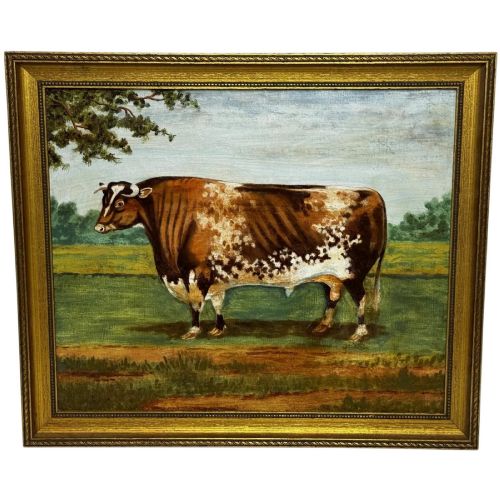
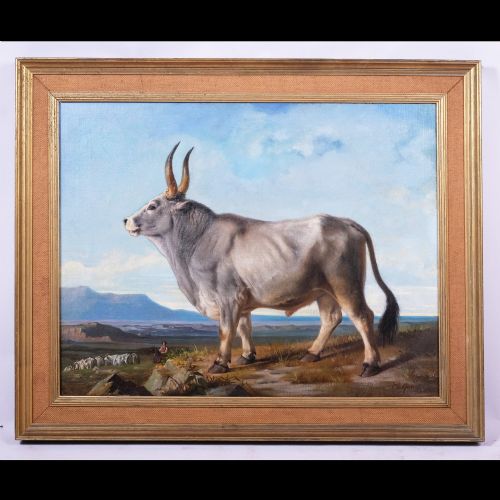


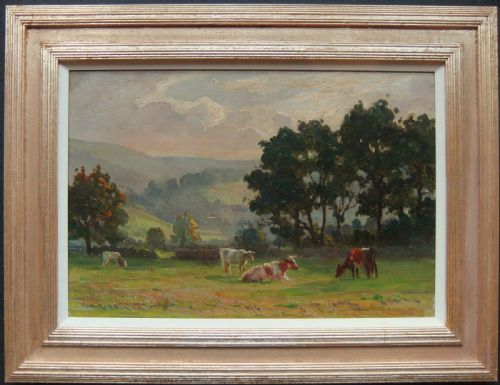

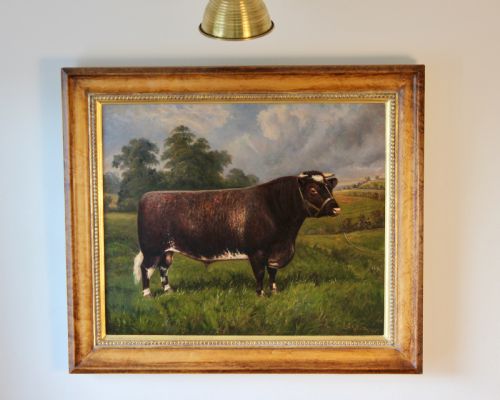

Vintage Livestock Oil Painting
These vintage livestock oil paintings capture rural animal life across the nineteenth and early twentieth centuries.
Vintage Livestock Oil Painting
A vintage livestock oil painting focuses on cattle, sheep, horses and calves situated within pastoral and coastal landscapes. These works emerge from Victorian, Edwardian, Georgian and later twentieth century periods, reflecting agrarian interests of past eras.
The compositions range from detailed portraits of prized shorthorn bulls to broader pastoral scenes featuring herds near rivers and streams. British school painters and continental artists dominate the selection, bringing rural farm life directly onto the canvas.
Buyers seeking a vintage livestock oil painting often encounter works by named artists such as Eugene Verboeckhoven, Claude Cardon, William Sidney Cooper and W.A. Clark. These pieces bridge fine art traditions with agricultural heritage, portraying prized animals in authentic countryside settings.
Materials and technique
Painters utilised oil paint applied to stretched canvas surfaces, supported by wooden stretcher frames. This combination allowed for rich colour blending and layered textures to depict animal coats and natural light.
Many works retain their original gilt or gesso wood frames, which complement the traditional oil medium. The technique relies on brushwork ranging from tight realism in animal portraits to looser Impressionist touches in background landscapes.
Featured locations include Kent, Swaledale, Tuscany and Canterbury, capturing distinct regional landscapes across Britain and Europe.
Distinctions in craftsmanship
Superior examples demonstrate precise anatomical rendering of livestock alongside well-balanced landscape perspectives. The handling of light on animal hides and surrounding pastures separates accomplished works from simpler school pieces.
The presence of clear signatures, identifiable locations such as Kent or Swaledale, and documented artist attributions elevate the standing of a painting. Original framing and good preservation of the canvas surface also contribute to overall distinction.
Eugene Joseph Verboeckhoven·Claude Cardon·William Sidney Cooper·W.A. Clark·Ernest Higgins Rigg·Owen Bowen·Thomas E Francis
The Vintage Livestock Oil Painting Glossary
- Canvas
- A heavy woven fabric stretched across a wooden frame to serve as the foundation for oil paintings. It provides a durable surface that holds layered paint effectively.
- Gesso
- A plaster mixture applied to wooden frames or panels to prepare the surface for gilding and ornamentation. It creates a smooth base for decorative gold leaf finishes.
- Pastoral
- A style of art that idealises rural life, shepherds and agricultural scenes. These works emphasise tranquil countryside settings and domesticated animals.
- School
- A group of artists working in a similar style or geographic region during a specific period. It often denotes followers or pupils influenced by a master painter.
Vintage Livestock Oil Painting: Frequently Asked Questions
How do I date an old painting?
Dating relies on stylistic clues, canvas types, framing methods and artist signatures recorded in the work. Period framing and written inscriptions on the reverse often provide reliable chronological markers.
Comparison with documented works by the same school or artist helps narrow the decade of creation.
Where should I hang these artworks?
These pieces suit traditional living spaces, studies and dining rooms where rural and equestrian themes complement interior decor. Position them away from direct sunlight and damp conditions to protect the oil pigments.
Pairing the canvas with traditional wood furniture enhances the historic character of the room.
What subjects are most common?
Cattle, sheep, horses and calves feature prominently, often shown grazing near rivers, coastal paths or rural farmyards. Shorthorn bulls were particularly popular subjects for Victorian agrarian portraiture.
Human figures occasionally appear tending to the animals or managing farm routines.
How do I identify a signed canvas?
Signatures typically appear in the lower corners of the canvas, rendered in matching oil pigment. Some works include dates or location names written alongside the artist's name.
Unsigned pieces are frequently attributed to specific schools based on brushwork style and period characteristics.