


Vintage Howard Style Couch
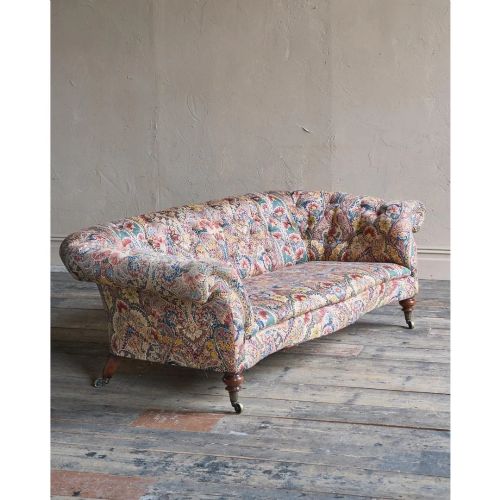
A vintage howard style couch offers deep, sprung comfort with generous proportions, making it the ultimate anchor for any classic country house interior.
Vintage Howard Style Couch
A vintage howard style couch represents the pinnacle of nineteenth and early twentieth century English seating comfort, built with deep seats and low profiles. When searching for a vintage howard style couch, buyers encounter generous three-seater sofas, drop arm designs, daybeds, and double wingback forms originating from the Victorian and Edwardian eras.
The pieces appearing on this page span several decades, reaching from the nineteenth century through the 1930s. Makers such as Howard and Sons set the standard for these deep-seated country house sofas, often upholstered in ticking fabric, calico, or chintz.
Buyers will find variations including Aesthetic Movement models with claw and ball feet, as well as simpler hardwood-framed daybeds. Each version retains the characteristic low-slung silhouette and coil-sprung architecture designed for relaxed lounging.
Materials and construction
The foundational structure relies on robust hardwoods such as beech and walnut, providing a sturdy cage for complex internal spring systems. Joinery is traditionally heavy and concealed beneath layers of traditional upholstery materials.
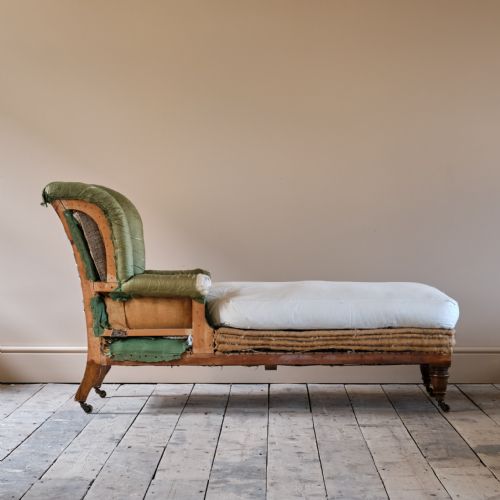
Makers built the deep cushioning using hessian, cotton, and horsehair stuffing, often finished in plain calico or ticking fabric. Brass casters frequently fitted to the legs allow these heavy pieces to move smoothly across floors.
Listings span the 19th Century, Edwardian, and 1930s periods, incorporating materials like beech, walnut, hessian, and brass.
Distinctions in quality
Quality rests heavily on the integrity of the original frame and the retention of traditional stuffing methods. Pieces retaining their early calico or ticking upholstery demonstrate authenticity that replaces superficial modern recovering.
Refinement appears in the turning of the hardwood legs, the presence of specific maker stamps, and subtle details like carved claw and ball feet. The firmness and resilience of the internal spring suspension dictate the enduring comfort of the seating.
Howard and Sons
The Vintage Howard Style Couch Glossary
- Ticking
- A tightly woven cotton or linen fabric traditionally used as a hard-wearing inner cover for mattresses and upholstered furniture. It appears frequently in original Victorian examples.
- Calico
- A plain-woven unbleached cotton textile used beneath decorative outer fabrics to maintain the shape of deep upholstery. It forms the traditional foundation layer on high-end frames.
- Drop arm
- A moveable sofa arm mechanism that lowers on one or both sides to create a daybed or lounging surface. This feature adds versatility to nineteenth-century designs.
- Claw and ball
- A furniture foot carved to resemble a bird's talon clutching a spherical ball. This motif surfaces on select Aesthetic Movement pieces from the late nineteenth century.
- Daybed
- An elongated seating form designed for reclining, combining the characteristics of a chair and a bed. These appear across Victorian and Edwardian listings.
Vintage Howard Style Couch: Frequently Asked Questions
What defines a Howard style sofa?
A Howard style sofa is characterised by its deep, sprung seat, low-slung profile, and rolled arms designed for exceptional comfort. These pieces originated in the nineteenth century and became staples of English country house interiors.
They combine robust hardwood frames with traditional upholstery techniques, often resting on low turned legs with brass casters. The aesthetic prioritises relaxed lounging over rigid formal posture.
Are these sofas comfortable for daily use?
These sofas are engineered specifically for deep seating and sustained relaxation, utilising complex internal coil springs. Their generous proportions make them exceptionally suited for everyday living rooms and libraries.
Because they rely on traditional stuffing materials like horsehair and cotton, the seats maintain a supportive yet yielding quality. Modern users find their deep dimensions ideal for lounging.
How do I identify a Victorian example?
Victorian examples display characteristically heavy hardwood framing, often accompanied by turned walnut or beech legs fitted with brass castors. Stylistic markers from this period include traditional ticking or calico foundations and deep hand-tied springing.
One may also encounter distinct regional variations or maker stamps confirming nineteenth-century production. The materials and joinery methods provide clear chronological indicators.