

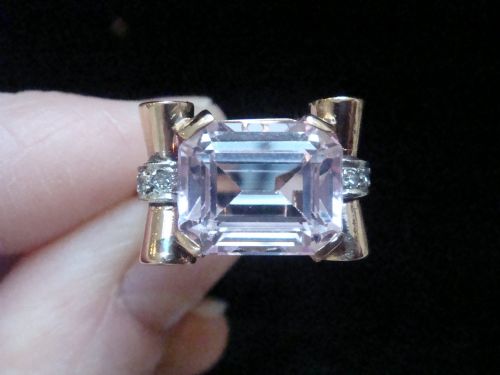


Vintage Gold Tank Ring
These substantial vintage gold tank ring examples deliver the bold, architectural presence of mid-century design.
Vintage Gold Tank Ring
A vintage gold tank ring embodies the heavy, volumetric styling that emerged during the mid-twentieth century, often drawing inspiration from military vehicle treads. These sculptural pieces command attention through dimensional metalwork and broad shoulders that taper smoothly into the band.
The most common examples encountered on this page date from the 1930s through to the 1950s, capturing the Retro Modern and Art Deco sensibilities. They frequently combine warm yellow gold with contrasting platinum settings to highlight the central stones.
Materials and construction methods
Construction relies heavily on 18ct gold and platinum, utilising substantial metal weights to achieve the characteristic chunky profile of a vintage gold tank ring. Pave setting techniques allow diamonds to be closely clustered across the curved surfaces with minimal visible metal.
Gemstones such as natural rubies, emeralds, kunzite, and sapphires serve as focal points, often flanked by smaller accent diamonds. The integration of synthetic rubies also appears in pieces from the mid-century period, reflecting contemporary gemological practices.
Vintage Gold Tank Ring Retail Price Guide 2026
Typical asking prices for vintage gold tank ring among the pieces listed under this phrase on Sellingantiques today, from the lower quarter to the upper quarter. They describe what is for sale here now, not the wider market.
Periods represented in the selection range from Edwardian examples to items created through the 1930s, 1940s, and 1950s.
Distinctions in quality and execution
Quality in a vintage gold tank ring is determined by the crispness of the architectural stepped mounts and the fluidity of the curves. Superior examples display seamless integration between the heavy gold body and the precise geometric stone settings.
The choice and saturation of central gemstones, alongside the weight and clarity of accompanying diamonds, elevate the piece. Heavier gram weights and robust structural integrity separate standard production from finer cocktail variations.
The Vintage Gold Tank Ring Glossary
- Tank ring
- A bulky, architectural ring style originating in France during the Second World War, characterised by heavy metal curves resembling military treads. This form defines the primary aesthetic of the pieces found here.
- Retro Modern
- A design period spanning the 1930s to 1950s known for sculptural jewellery, oversized forms, and warm-toned gold. It moves away from the flat geometry of earlier Art Deco towards three-dimensional curves.
- Pave setting
- A technique where small gemstones are closely set together with tiny beads of metal, creating a continuous surface of sparkle. This method is frequently used on the shoulders of these rings.
- Kunzite
- A pale pink to lilac gemstone variety of spodumene that occasionally forms the dramatic central stone in mid-century cocktail jewellery. Its soft colour contrasts sharply with heavy yellow gold settings.
- Cocktail ring
- A large, showy ring designed to draw attention during evening wear, typically featuring a prominent central gemstone surrounded by diamonds. Many pieces in this category fall under this functional description.
Vintage Gold Tank Ring: Frequently Asked Questions
What defines a tank ring?
A tank ring is characterised by heavy, volumetric gold or platinum work featuring stepped, ribbon-like motifs that recall wartime machinery. The style prioritises bold three-dimensional presence over delicate filigree.
These pieces typically date from the 1930s to the 1950s, capturing the shift toward industrial-inspired fashion in French and European jewellery workshops.
How do I wear a cocktail ring daily?
Because these rings feature prominent settings and substantial metal weights, they require care to avoid knocks against hard surfaces. Rotating them to the palm side during heavy manual tasks protects the central stones.
Pairing them with simpler outfits allows the architectural lines and coloured gems to function as the focal point of your attire.
Are the gemstones natural?
The listings include a mix of natural gemstones such as rubies, emeralds, kunzite, and diamonds, alongside occasional synthetic stones like mid-century synthetic rubies. Each piece reflects the specific materials available and utilised during its respective decade.
Checking individual item descriptions confirms whether a coloured stone is certified natural or synthetic.
How do I tell periods apart?
Earlier pieces from the 1930s often lean into strict Art Deco geometry, while items from the 1940s and 1950s embrace softer, highly stylised Retro curves. The integration of platinum with yellow gold spans both eras.
Maker marks, French control stamps, and overall design motifs assist in placing a piece within the 1930 to 1950 timeframe.