
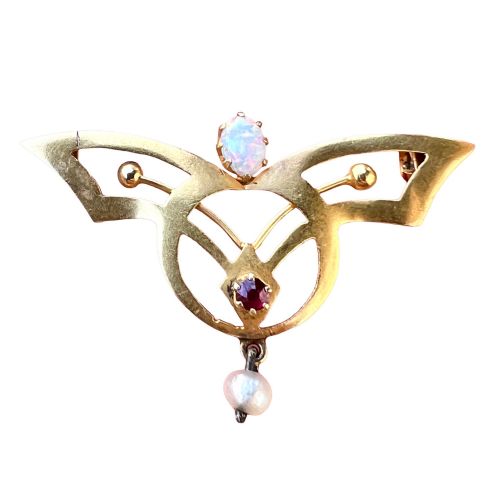
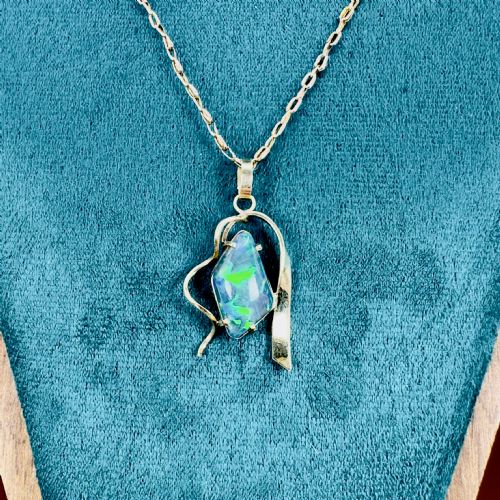


Vintage Gold Opal Pendant
A vintage gold opal pendant catches the light with shifting play of colour, suspended from a delicate chain to rest near the collarbone.
Vintage Gold Opal Pendant
A vintage gold opal pendant brings together warm precious metals and iridescent gemstones in forms ranging from simple solitaires to intricate drop designs. When you search for a vintage gold opal pendant, you encounter pieces that span the nineteenth century through the mid-twentieth century, capturing aesthetic shifts from Victorian naturalism to mid-century minimalism.
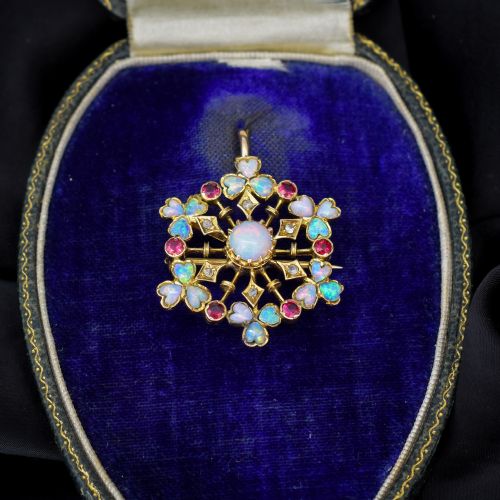
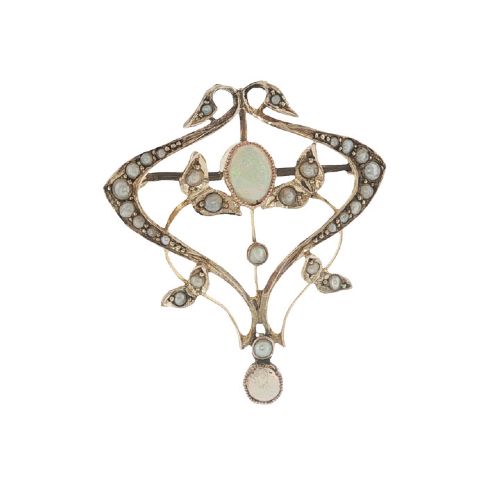
Many designs integrate additional gemstones, pairing opals with diamonds, rubies, pearls, or garnets to enhance the central play of colour. Some items also double as brooches, featuring hinged pin mechanisms alongside suspension loops for versatile wear.
Materials and construction
Craftsmen built these pieces using yellow or white gold in various purities, notably nine-carat, fifteen-carat, and eighteen-carat standards, alongside occasional platinum settings. Stones were secured via traditional claw settings, bezels, or flush mountings designed to protect the softer gemstone.
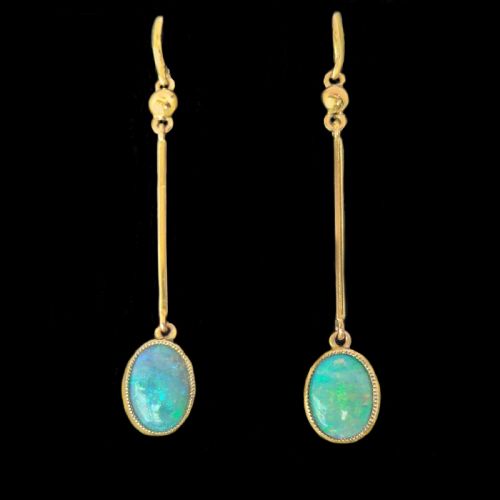
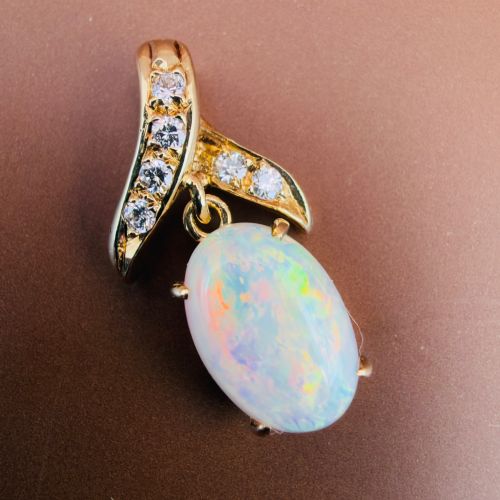
Opals used in these pieces include natural white stones, black opals, and fire opals, shaped into cabochons to display their characteristic play of colour. Jewelers frequently enhanced these central opals with melee diamonds, seed pearls, or small rubies set into intricate filigree or geometric frames.
The listings span periods from the nineteenth century through the 1960s, with a strong representation of mid-century nine-carat gold designs.
Factors of quality
Quality in these pieces rests primarily on the optical characteristics of the opal itself, including the intensity of its spectral flash, pattern distribution, and overall body tone. A stone displaying vibrant flashes of red, green, and blue across its entire surface commands greater attention than one with muted or directional colour play.
The precision and substance of the metalwork also define the upper tier of pieces, where heavy gold construction and detailed hand-finishing or filigree distinguish master workmanship from standard production. Well-integrated gem combinations, such as balanced diamond and ruby clusters around the central stone, further elevate a piece.
The Vintage Gold Opal Pendant Glossary
- Cabochon
- A gemstone shaped and polished with a smooth, convex domed surface rather than faceted. This cut is essential for opals as it best displays their internal play of colour.
- Play of colour
- The optical phenomenon where spectral colours shift and flash across the stone as the angle of light or viewing changes. It results from the interference and diffraction of light through microscopic silica spheres within the opal.
- Doublet
- A composite gemstone consisting of a thin slice of natural opal glued to a darker backing material, such as ironstone or onyx, to deepen the apparent body tone and play of colour. This technique was often utilised in vintage jewellery to give the visual impact of a solid black opal.
- Filigree
- Ornamental work consisting of fine, twisted wire soldered together in openwork patterns. It appears frequently in Edwardian and Art Deco metalwork surrounding central stones.
- Solitaire
- A piece of jewellery featuring a single gemstone as the primary focal point without surrounding accent stones. These items rely entirely on the quality and cut of the central opal.
Vintage Gold Opal Pendant: Frequently Asked Questions
How do I care for my opal pendant?
Opals contain water within their structure and have a moderate hardness, meaning they require gentle treatment to avoid scratching or drying out. Remove the pendant before swimming, bathing, or engaging in strenuous physical work.
Clean the piece using only a soft damp cloth, avoiding harsh chemical cleaners, ultrasonic baths, or prolonged immersion in water that might damage the setting or the stone.
Were these always worn as pendants?
Many early pieces were constructed with dual-purpose fittings, featuring both a fold-down loop and a secure pin mechanism on the reverse. This allowed the wearer to utilise the item either as a pendant suspended from a chain or as a brooch pinned to a garment.
By the mid-twentieth century, dedicated suspension loops became standard as necklace wear grew more popular than brooch fastening.
What is the difference between solid opals and doublets?
A solid opal consists of a single piece of natural opal material cut and polished from the rough stone. These represent the entirety of the gemstone without artificial backing.
A doublet uses a thin upper layer of genuine opal adhered to a darker support layer, which strengthens the stone and enhances the visibility of the internal colours.
How do I date an opal pendant?
Dating relies on stylistic clues, metal hallmarks, and the specific cut or setting of the gems. Edwardian pieces often feature delicate white gold or platinum filigree, while Art Deco items lean towards geometric arrangements.
Mid-century pieces frequently utilise heavier nine-carat yellow gold settings with clean, minimalist lines or simple claw mounts.