



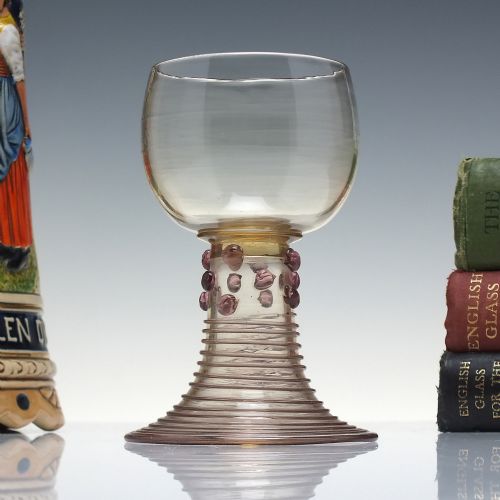


Vintage German Wine Glasses
These vintage german wine glasses bring colourful enamels, heavy roemers and Jugendstil curves directly to the table.
Vintage German Wine Glasses
The pieces on this page are most commonly roemers, hock glasses, and chalices, alongside decanters and wine dispensers. These drinking vessels often display rich colours such as green, amethyst, and amber, frequently paired with intricate surface work.
How they were made
Makers utilised hand-blown glass and crystal as the foundation for these vessels, shaping them into traditional forms such as the rounded roemer bowl. Artisans then applied coloured glass elements, including amber bowls fused to contrasting stems.
Decoration relied heavily on surface techniques like engraving, gold leaf detailing, and polychrome enamel work featuring heraldic motifs and florals. Some serving pieces incorporated wrought iron and brass mountings alongside the primary glass body.
Vintage German Wine Glasses Retail Price Guide 2026
Typical asking prices for vintage german wine glasses among the pieces listed under this phrase on Sellingantiques today, from the lower quarter to the upper quarter. They describe what is for sale here now, not the wider market.
Materials appearing across the inventory include hand-blown glass, crystal, gold leaf, enamel, wrought iron, and brass.
What varies in quality
Quality separates simple production ware from pieces executed by notable workshops through the precision of the glass cutting and the refinement of the enamel work. Hand-blown forms display individual character in their weight and wall thickness.
The complexity of the ornamentation, such as detailed heraldic enamelling or delicate gold leaf applications, dictates the distinction between standard vessels and exceptional examples by houses like Theresienthal or Frits Hechert.
Theresienthal·Frits Hechert·Adelbert Niemeyer
The Vintage German Wine Glasses Glossary
- Roemer
- A traditional Germanic wine glass featuring a large bowl resting on a ribbed or studded cylindrical stem. This form developed in the Rhineland and remains a staple of continental glassware.
- Jugendstil
- The continental manifestation of Art Nouveau, characterised by fluid, organic lines and natural motifs. It heavily influenced German decorative arts around the turn of the twentieth century.
- Hock glass
- A tall wine glass traditionally used for white wine, often featuring a coloured bowl and an elongated stem. The term derives from hock, an old British name for German Rhine wine.
- Historismus
- An architectural and decorative style reviving historical periods, particularly the Renaissance and Gothic eras. German craftsmen applied these historic motifs to glassware around nineteen hundred.
- Biedermeier
- An influential style in Central Europe focusing on utilitarian comfort and clean lines without excessive ornamentation. Pieces from this period exhibit understated elegance.
Vintage German Wine Glasses: Frequently Asked Questions
What are hock glasses used for?
These tall glasses were specifically designed for serving white wine, particularly the aromatic varieties produced along the Rhine and Moselle rivers.
The coloured bowls historically served to mask impurities in early glass while protecting the wine from direct light.
How do I identify a roemer?
A roemer is easily recognised by its distinctive spherical bowl sitting atop a cylindrical stem covered in applied glass prunts or studs.
This sturdy base design was originally intended to prevent slipping from greasy fingers during medieval feasts.
How can I tell Jugendstil from Victorian styles?
Jugendstil designs rely on asymmetrical, flowing plant motifs and sinuous curves inspired by natural forms. Victorian and Historicism pieces often draw upon rigid heraldic themes and formal nineteenth-century revival patterns.