


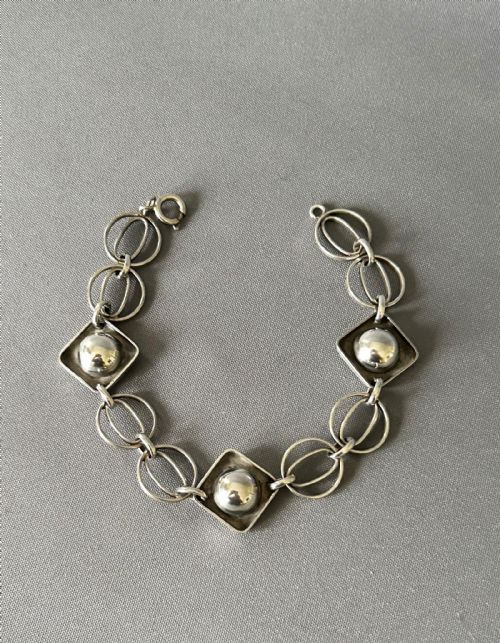


Vintage Geometric Panel Bracelet
A vintage geometric panel bracelet brings striking linear design to the wrist, offering the architectural symmetry that collectors prize in mid-century and earlier twentieth-century jewellery.
Vintage Geometric Panel Bracelet
A vintage geometric panel bracelet comprises a sequence of interconnected segments forming a structured band around the wrist. The form relies on repeated rectangular, square, or abstract shapes arranged in a continuous line.
Most examples encountered on this page belong to the Art Deco era or the mid-century period. These pieces demonstrate the period preference for clean angles, structured links, and balanced architectural compositions.
Origins span Britain, France, Austria, and Germany, alongside specialised German metalwork from makers such as Jakob Bengel. The designs range from stark industrial chrome constructions to precious platinum mountings set with diamonds and emeralds.
How they were made
Makers utilised precious metals including platinum, white gold, yellow gold, and silver as the foundational structure for fine gemstone-set pieces. Alternative materials such as chrome, chromium, and nickel appear in industrial designs, often paired with applied enamel.
Gemstone setting involved securing diamonds, sapphires, rubies, emeralds, chalcedony, and glass panels into precise bezels or channel mounts within the metal framework. Enamel work was fused to metal surfaces to introduce blocks of solid colour alongside polished stones and marcasite accents.
Some 1930s German industrial bracelets use chrome and enamel to turn machine-age geometry into high fashion.
What varies in quality
The choice of materials dictates the primary tier of quality, separating base metal and enamel items from pieces mounted in platinum or gold and set with fine diamonds. The precision of the articulation between individual panels also determines the standard of manufacture, ensuring the bracelet drapes smoothly around the wrist.
Design complexity and the reputation of the workshop separate standard production from exceptional examples. Pieces bearing documented attributions to notable makers demonstrate superior metalworking techniques and more inventive geometric configurations.
Jakob Bengel
The Vintage Geometric Panel Bracelet Glossary
- Panel bracelet
- A bracelet constructed from a series of rigid or semi-rigid sections linked together. These segments often display engraved, enamelled, or gemstone-set surfaces.
- Art Deco
- A design style dominant in the 1920s and 1930s characterised by sleek lines, geometric shapes, and modern industrial influences. This aesthetic defines the majority of links seen in these pieces.
- Chromium
- A hard, corrosion-resistant metal used during the industrial metalwork of the 1930s. It provided a bright, durable finish for base-metal accessories.
- Marcasite
- Small, faceted pyrite stones cut and polished to resemble steel or dark gems. They are typically set in silver to add sparkle alongside enamel or stones.
Vintage Geometric Panel Bracelet: Frequently Asked Questions
What is a geometric panel bracelet?
A geometric panel bracelet is a piece of wrist jewellery made from linked segments that feature symmetrical shapes, straight lines, or repeated patterns.
These designs draw heavily on early twentieth-century modernist art movements and architectural forms.
How do I date a vintage bracelet?
Dating relies on the combination of materials, construction techniques, and stylistic markers visible in the design. Metal choices like platinum or chromium often point directly to specific decades.
Maker marks and hallmarks stamped onto the metal clasp or reverse also provide precise origin clues.
How do I care for my bracelet?
Care depends entirely on the materials used in the construction of the specific piece. Platinum and diamond items require gentle cleaning with warm soapy water and a soft brush.
Enamelled or chrome base-metal pieces need protection from moisture and harsh chemicals to preserve the surface finish.
How do I style a panel bracelet?
A panel bracelet functions as a strong standalone statement piece on the wrist. It pairs effectively with evening wear or tailored daytime attire that complements its architectural lines.
Layering should be approached carefully to avoid scratching softer metals or delicate enamel work.