




Silver Geometric Bracelet
A silver geometric bracelet brings clean lines and sharp angles to the wrist, offering a distinct design that collectors prize.
Silver Geometric Bracelet
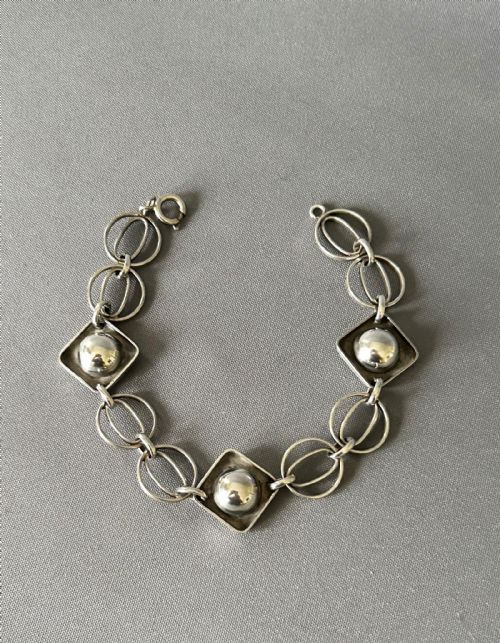
A silver geometric bracelet captures the structural designs typical of the Art Deco period and mid-century Scandinavian styles. Pieces span the 1920s, 1930s, and 1960s, showing how makers translated architectural forms into wearable ornaments.
Originating from makers in Germany, Austria, and Scandinavia, these items demonstrate a clear preference for symmetry and linear arrangement in silver and alternative metals.
How they were made
Makers shaped silver, sterling silver, and chromium or chrome into structured links, often integrating enamel and glass elements for colour and contrast. Some designs incorporate chalcedony and marcasite to highlight specific geometric facets.
Techniques relied on precise metal fabrication, seen in the interlocking brickwork patterns and panel assemblies. Chromium plating and enamel application provided durable surfaces alongside traditional silversmithing.
Current listings span the 1920s, 1930s, and 1960s, incorporating silver, sterling silver, chrome, chromium, nickel, enamel, glass, chalcedony, and marcasite.
What varies in quality
Quality rests on the precision of the geometric assembly and the integrity of applied materials like enamel and glass. Pieces by documented makers show superior execution in their mechanical linkages and surface finishes.
The choice of supplementary stones, such as chalcedony and marcasite, alters the visual weight and complexity of a piece. Better examples maintain crisp edges on every panel and secure settings for all inset elements.
Jakob Bengel·Alton·Bulova
The Silver Geometric Bracelet Glossary
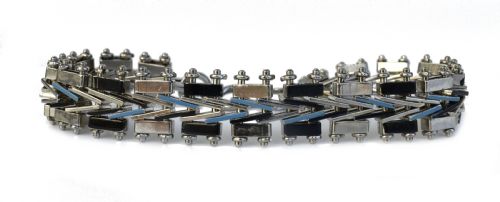
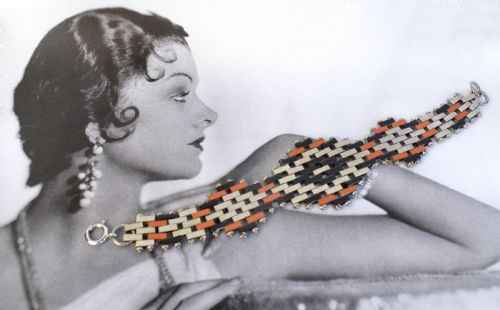
- Brickwork bracelet
- A flexible link bracelet constructed to resemble miniature masonry courses. This form is closely associated with German industrial workshops of the 1930s.
- Panel link
- A bracelet formed of rigid geometric sections joined by hidden hinges. This construction allows the ornament to curve smoothly around the wrist while preserving flat planes for decoration.
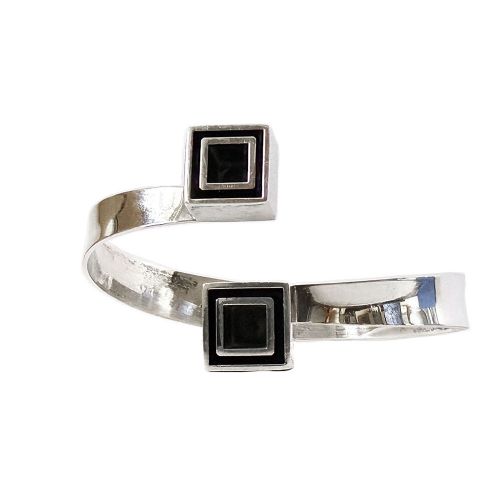
- Square terminals
- The finished ends of a rigid bangle that terminate in distinct four-sided blocks. These often feature linear or step-cut detailing.
- Marcasite
- Small faceted polished pyrite stones set into silver to provide sparkle. They are frequently used to outline geometric motifs in Art Deco jewellery.
Silver Geometric Bracelet: Frequently Asked Questions
How do I date a silver geometric bracelet?
Dating relies on stylistic markers such as the stark linear motifs of the 1930s Art Deco movement or the cleaner modernist lines associated with the 1960s.
Materials also offer clues, as chromium and specific enamel combinations point directly to interwar manufacturing techniques.
What materials are common in these bracelets?
Silver and sterling silver form the primary base for many examples, often paired with chrome, chromium, or nickel. Enamel, glass, chalcedony, and marcasite add colour and texture to the metal framework.
Some pieces utilise base metals alongside chrome to achieve an industrial aesthetic.
How were geometric bracelets worn historically?
These bracelets served as prominent wrist adornments during the interwar period, often complementing the tailored silhouettes of contemporary fashion. Matched sets allowed wearers to coordinate bracelets with necklaces.
Certain designs integrated functional timepieces, combining utility with decorative metalwork.
Are these bracelets flexible?
Flexibility depends entirely on the construction method used by the maker. Panel links and brickwork designs use articulated hinges to move easily around the wrist.
In contrast, bangles with square terminals maintain a rigid circular or oval shape.