
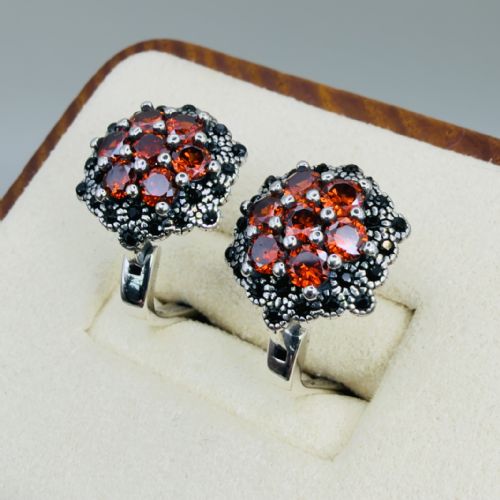


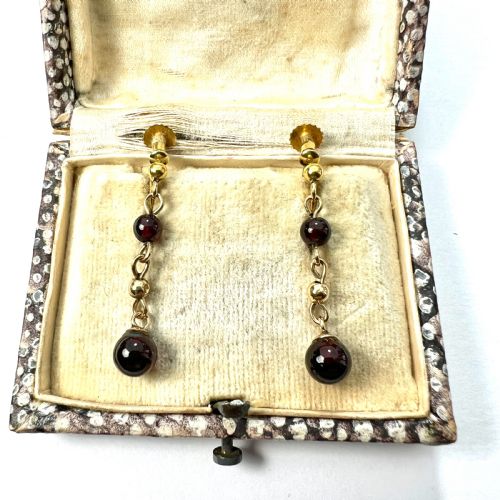


Vintage Garnet Earrings
These vintage garnet earrings bring deep crimson warmth to the ear, spanning Victorian and mid-century designs that collectors prize.
Vintage Garnet Earrings
Vintage garnet earrings encompass cluster, drop, and stud forms featuring deep red stones set across multiple eras. The pieces on this page range from Victorian cluster designs and Edwardian screwbacks to 1950s studs and 1960s drop variations.
Buyers encounter diverse configurations, including floral cluster flower studs, double drop styles, and halo arrangements. These ornaments often incorporate pearls or diamonds alongside the primary red stones.
Origins stretch from Austro-Hungarian workshops to British and vintage makers working in silver, yellow gold, rose gold, and gilt settings. Drop earrings and jewellery suites offer matching sets for formal or everyday wear.
What varies in quality
The depth of stone colour and the uniformity of the garnet cuts dictate visual appeal, with larger cabochons and matched clusters commanding attention. Metal purity, ranging from lower gold carats to 15ct and 18ct gold or sterling silver, shifts the weight and richness of the piece.
Finishing details, such as intricate filigree work and secure setting integrity, separate standard production items from finer artisan creations. The inclusion of complementary gems like diamonds or pearls further elevates the composition.
Recorded periods span from the Victorian and Edwardian eras through the 1950s and 1960s.
The Vintage Garnet Earrings Glossary
- Cluster
- A stone arrangement where a central gem is surrounded by smaller stones to form a floral or geometric shape. This traditional technique maximises the visual impact of the garnets.
- Cabochon
- A gemstone shaped and polished with a smooth, rounded surface rather than faceted edges. This style highlights the natural depth of the garnet material.
- Screwback
- A mechanical earring fastening utilising a threaded post and a nut that twists down to secure the piece on unpierced lobes. It was common in Edwardian and vintage jewellery.
- Paste
- Hand-cut glass used historically as a gemstone substitute in antique jewellery. It mimics the appearance of garnets or diamonds in period settings.
- Gilt
- A thin layer of gold applied to a base metal like silver or brass. This finish provides the rich appearance of solid gold without the associated weight.
Vintage Garnet Earrings: Frequently Asked Questions
How do I date vintage garnet earrings?
Dating relies on metal hallmarks, fastener types, and the stone-setting style. Victorian pieces often feature closed-back settings or Etruscan revival motifs, while Edwardian designs favour delicate filigree and screwbacks.
Mid-century pieces from the 1950s and 1960s typically introduce streamlined stud mountings and distinct hinge backs. Comparing the cut of the garnets and accompanying materials helps confirm the era of manufacture.
Are these earrings suitable for daily wear?
Many vintage garnet earrings function well for regular use, provided the settings and backings are secure. Robust stud and drop designs in 9ct gold handle routine wear comfortably.
More delicate antique silver or gilt pieces with intricate filigree or pearl accents require gentle treatment. Storing them carefully prevents stone abrasion and metal fatigue.
What is the difference between Victorian and 1950s styles?
Victorian garnet earrings frequently display ornate cluster designs, heavy gold work, and deep rose-cut or cabochon stones. They often carry romantic or symbolic motifs like floral clusters.
Fifties styles lean towards cleaner lines, featuring round-cut or pear-cut garnet studs and double drop configurations. These mid-century items focus on bright, uniform gemstone displays.
How should I clean vintage garnet jewellery?
Cleaning requires a soft cloth and warm water to wipe away surface dust without harming the metal or stones. Harsh chemical dips risk damaging softer pearls or loosening paste and foil-backed gems.
Professional inspection is advisable for antique pieces with delicate prongs or screwback mechanisms. Keeping them dry and separate from harder gems prevents scratching.