

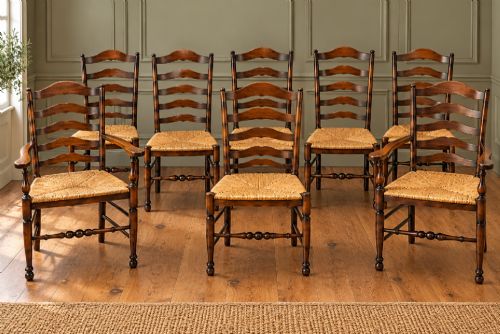
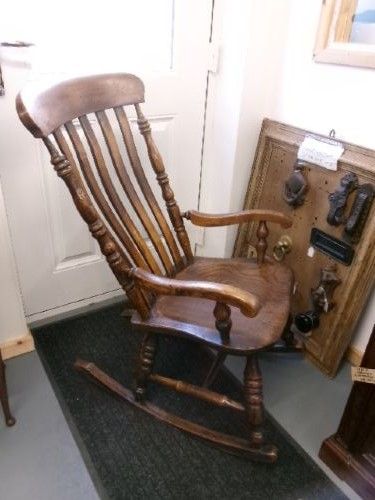
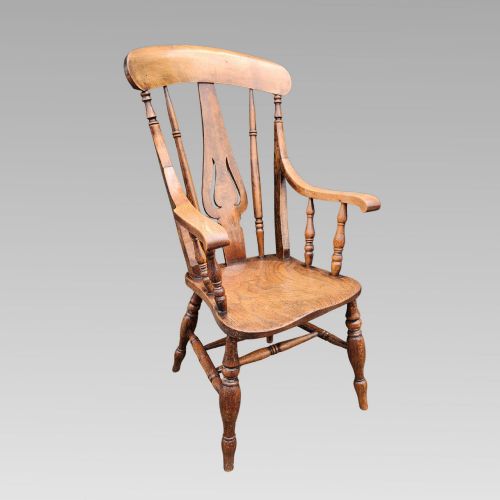


Vintage Farmhouse Armchairs
These vintage farmhouse armchairs bring sturdy rural comfort and honest timber character straight into a modern interior.
Vintage Farmhouse Armchairs
Vintage farmhouse armchairs encompass sturdy wooden seating built for daily domestic utility across British and continental rural homes. They draw on traditional regional construction methods, often taking the form of Windsor or spindle-back designs suited to heavy kitchen and dining use.
The versions most commonly met on this page span the Victorian era, the late nineteenth century, and early twentieth-century revivals. They frequently pair steam-bent elements with carved wooden seats, offering a robust profile that balances utilitarian function with regional craftsmanship.
How they were made
Cabinetmakers and rural joiners utilised native hardwoods such as elm, beech, ash, oak, and fruitwood, selecting timbers for strength and flexibility. Elm was frequently chosen for seats because its interlocking grain resisted splitting when shaped into a saddle form.
Spindles, legs, and stretchers were shaped on pole lathes and assembled using traditional pegged mortise and tenon joints. Steam-bending allowed makers to create continuous hoop backs and curved arm bow supports without weakening the timber.
Vintage Farmhouse Armchairs Retail Price Guide 2026
Typical asking prices for vintage farmhouse armchairs among the pieces listed under this phrase on Sellingantiques today, from the lower quarter to the upper quarter. They describe what is for sale here now, not the wider market.
Listings feature timbers including elm, beech, oak, ash, fruitwood, and walnut across periods from the eighteenth century to the 1930s.
What varies in quality
Quality depends upon the choice and figuring of the timber, particularly the grain depth in the elm seat and the integrity of the turned spindles. Better examples display balanced proportions, with extra height or wider hoop backs achieved without sacrificing structural harmony.
Construction details differentiate standard workshop production from finer regional pieces. Well-executed wedge joints, cleanly turned stretchers, and thoughtful wood combinations show the maker's hand clearly through years of everyday use.
The Vintage Farmhouse Armchairs Glossary
- Windsor
- A chair built with a thick wooden seat into which the legs, back spindles, and arms are fitted directly. This technique creates a remarkably sturdy and unified frame.
- Spindle back
- A chair back filled with numerous slender turned wooden rods. These vertical members support the sitter while keeping the overall piece light and airy.
- Saddle seat
- A wooden chair seat hollowed out into a shallow curve for comfort. Elm was often utilised for this purpose due to its natural resistance to splitting.
- Stretcher
- A horizontal wooden brace connecting the legs of a chair to provide extra stability. Turned stretchers add subtle decorative detail near the floor.
Vintage Farmhouse Armchairs: Frequently Asked Questions
Where were these chairs used?
These chairs served primarily in farmhouses, large country kitchens, and rural dining spaces. Their robust construction allowed them to withstand heavy daily use by families and workers alike.
Over time, they moved from working rooms into everyday living areas, valued for their honest proportions and comfortable wooden seats.
How do I clean the wood?
Dust the timber regularly with a soft, dry cloth to remove grit that might scratch the surface. Avoid harsh chemical cleaners that strip the historic finish.
Applying a traditional beeswax polish occasionally helps nourish dry hardwood and maintains a gentle, authentic sheen.
Are these chairs comfortable?
The comfort comes from traditionally shaped saddle seats that distribute weight evenly across the solid wood. Many examples also feature high spindle backs and curved arms that support an upright posture.
Adding a simple loose linen or wool cushion provides extra softness for extended sitting during meals or reading.
Can I mix these with modern furniture?
The honest materials and straightforward forms allow these chairs to sit comfortably alongside contemporary or mid-century pieces. Their natural timber tones bring warmth and textural contrast to minimalist spaces.
A single armchair works well in a hallway or bedroom, while a pair creates an inviting focal point around a modern dining table.