



Vintage Equestrian Watercolour
These vintage equestrian watercolour works capture horses, hounds, and riders across the nineteenth and twentieth centuries.
Vintage Equestrian Watercolour
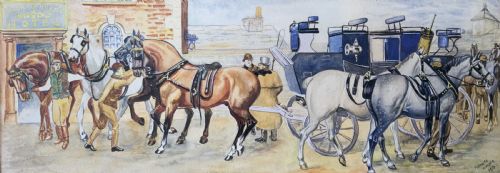
A vintage equestrian watercolour brings together horses, hounds, riders, and rural labour rendered in fluid pigments on paper. Buyers searching this phrase encounter subjects ranging from fox hunting and horse racing to cart horses and coaching scenes.
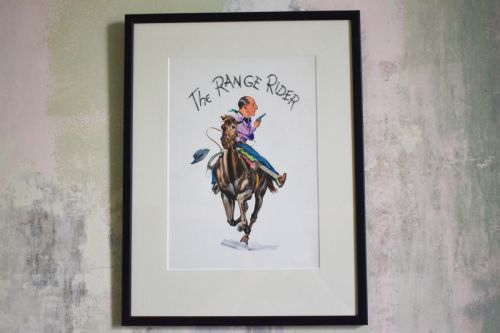
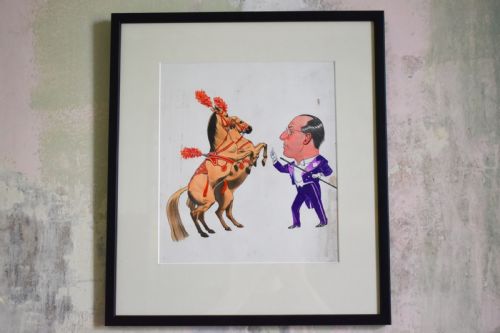
The selections available here span from the nineteenth century into the mid-twentieth century, encompassing British sporting art, Edwardian illustration, and Victorian works. Framed pieces under glass dominate the selection, preserving delicate pigment and ink on paper.
Materials and Technique
Watercolour pigment, gouache, and ink are applied directly to paper support sheets, often combined with bodycolour for opaque highlights. Artists utilise these water-based mediums to achieve rapid washes for skies and landscapes alongside fine pen work for horse anatomy and rider detail.
Framing relies upon traditional timber surrounds, notably oak frames, which house glass to protect the paper works from atmospheric moisture and handling damage.
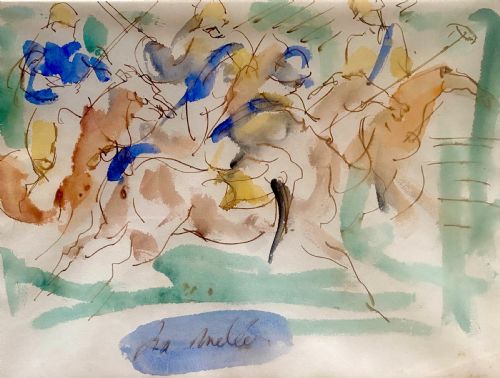
Represented styles encompass British sporting art, Victorian illustration, Edwardian works, and mid-century modern expressionism.
Assessing Quality
Quality rests upon the artist's command of equine anatomy, movement, and composition, distinguishing rapid sketches from finished exhibition pieces. Master hands convey the tension of a race or the weight of a plough team with economy and precision.
Condition of the paper and vibrancy of the pigments dictate overall merit, as watercolours are susceptible to fading when exposed to sustained light. The harmony between the original artwork and period framing also influences the integrity of the piece.
Herman S Melville·John Rattenbury Skeaping·Basil Nightingale·John Augustus Atkinson·Charles Clifford Turner·John Sanderson Wells·Charles Johnson Payne Snaffles·Tom Carr·William J Hodgson·Henry Charles Fox·Johan Noah Bemmel·Frank Dadd·Charles James Adams
The Vintage Equestrian Watercolour Glossary
- Gouache
- An opaque water-based paint that includes white pigment to create solid, light-reflecting passages within a watercolour. It allows artists to build dense highlights on horses and riders.
- Bodycolour
- A term historically used interchangeably with gouache to describe the addition of opaque white pigment to watercolours. This technique strengthens contrast in nineteenth-century sporting scenes.
- British Sporting Art
- A genre dedicated to depictions of horses, hounds, shooting, and hunting, rooted in eighteenth and nineteenth-century traditions. These works document rural pastimes and prized animal portraits.
- Wash
- A fluid layer of diluted watercolour pigment applied across paper to create smooth backgrounds, skies, or atmospheric terrain. Controlled washes set the tonal depth for equestrian compositions.
Vintage Equestrian Watercolour: Frequently Asked Questions
What periods do these watercolours cover?
The works span from the eighteenth century through the Victorian era and into the mid-twentieth century. Edwardian and 1920s examples appear frequently.
Sporting art traditions evolved across these periods, shifting from detailed narrative hunting scenes to looser expressionist interpretations of horses and riders.
How should I frame and display them?
Watercolours require protection behind glass to prevent atmospheric damage and fading from direct sunlight. Conservation mounting keeps the paper stable away from the glazing.
Positioning them in rooms with controlled indirect light preserves the integrity of the original pigments and paper support.
How are horses typically depicted?
Depictions range from precise anatomical portraits of individual hunters and racehorses to dynamic action scenes involving full hunts and racing fields. Working horses pulling carts or ploughs also feature.
Artists capture movement through varied brushwork, showing animals at rest in stables or stretched in gallop across open country.
Are these works signed by the artists?
Many examples bear signatures or monograms from listed painters and illustrators of sporting subjects. Signatures frequently appear in ink or pencil within the lower corners of the sheet.
Unsigned works rely on stylistic attribution, contemporary inscriptions, and framing history to identify the hand and period.