





Vintage Enamel Coffee Spoons
These vintage enamel coffee spoons bring bright colour and sharp geometry to the table, spanning the early twentieth century through to the mid-century.
Vintage Enamel Coffee Spoons
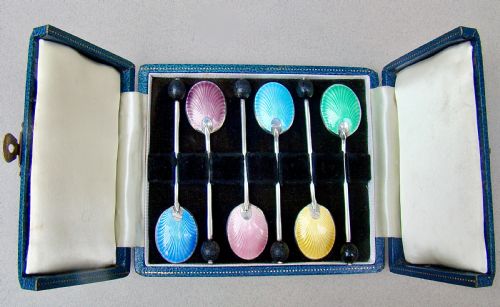
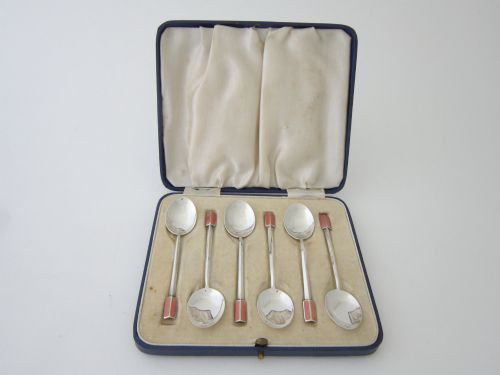
Most examples originate from the twentieth century, with periods ranging from the early 1900s through the 1930s and into the 1960s. These pieces often feature specialised motifs, including bean knops, card suits, or yacht club insignia, reflecting the decorative tastes of their respective decades. Cased sets frequently retain their original satin and velvet linings inside leatherette presentation boxes.
How they were made
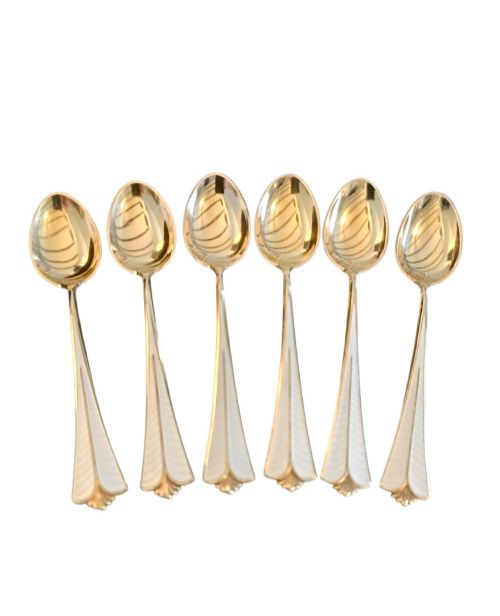
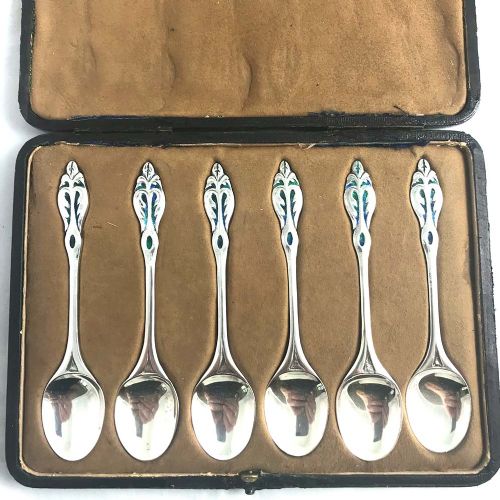
Makers formed these spoons primarily from sterling silver or silver gilt, often applying a layer of translucent guiloche enamel over an engine-turned metal ground. Vitreous enamel, made from powdered glass fused to metal under high heat, provides the hard, glossy colour characteristic of these items.
Workshop production involved stamping or casting the silver blanks before skilled artisans applied the coloured glass pastes by hand. Firing the pieces in a kiln melted the enamel into a smooth, durable surface locked securely within silver borders.
Vintage Enamel Coffee Spoons Retail Price Guide 2026
Typical asking prices for vintage enamel coffee spoons among the pieces listed under this phrase on Sellingantiques today, from the lower quarter to the upper quarter. They describe what is for sale here now, not the wider market.
Listings feature items spanning from 1900 to 1960, incorporating sterling silver, vitreous enamel, and satin-lined presentation boxes.
What varies in quality
Quality in these spoons rests primarily on the crispness of the metalwork and the complexity of the enamel technique, such as detailed guiloche patterns beneath translucent glass. Heavier gauges of silver and intricate handles, like bean knops or specific club commissions, elevate a set above standard production.
The condition and completeness of the original fitted presentation case also influence the overall character of the set. Boxes lined with clean satin and velvet that securely house every spoon indicate careful preservation over the decades.
Turner & Simpson·David Andersen·Liberty & Co
The Vintage Enamel Coffee Spoons Glossary
- Guilloche enamel
- A decorative technique where a geometric pattern is mechanically engraved into the silver base before a translucent coloured enamel is applied over the top. This allows the underlying pattern to show through the glossy coloured glass.
- Bean knop
- A finial shaped like a small bean, commonly found at the terminal end of spoon handles from the mid-twentieth century. This specific form provides a tactile grip for such small items of cutlery.
- Silver gilt
- Silver that has been coated with a thin layer of gold on its surface, giving the metal a warm golden appearance. This finish was frequently utilised on the bowls of coffee spoons.
- Vitreous enamel
- A material made by fusing powdered glass to a substrate by firing, usually at high temperatures. The resulting compound forms a durable and smooth ceramic coating.
- Leatherette
- A synthetic material designed to imitate leather, commonly used for the exterior of the presentation boxes housing these spoon sets. It protects the interior velvet and satin linings.
Vintage Enamel Coffee Spoons: Frequently Asked Questions
What are vintage enamel coffee spoons used for?
These small spoons are designed specifically for stirring sugar or milk into demitasse coffee after a meal. Their compact size suits small cups and saucers.
Today, collectors use them for afternoon tea service or display them within their original presentation boxes.
How do I date these spoons?
Dating relies heavily on hallmarks stamped onto the silver stems, which indicate the assay office, year of production, and maker. Stylistic cues, such as geometric Art Deco lines or mid-century Scandinavian forms, also narrow down the era.
Packaging materials and interior box styles provide additional clues regarding the decade of manufacture.
How should I store a cased set?
Keep the spoons inside their original fitted presentation box to protect the delicate enamel from scratching against other pieces of cutlery. Store the box in a dry environment away from direct sunlight to preserve the velvet and satin linings.
Avoid wrapping individual spoons in ordinary rubber bands or reactive materials that can tarnish the silver.