



Vintage Drum Table
A vintage drum table brings circular symmetry and practical drawers to a room, offering the classic library form suited for modern living.
Vintage Drum Table
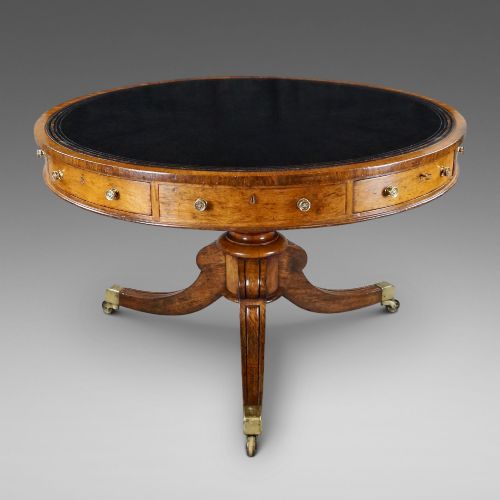
A vintage drum table is a circular occasional table, typically fitted with multiple frieze drawers around the perimeter and supported on a central pillar with spreading feet. The form originates from libraries and studies where scholars required a revolving or stationary surface with partitioned storage for books and papers. The examples seen here span periods from the Georgian era through Victorian and Edwardian times up to 1930s Art Deco interpretations.
The version most commonly met on this page is constructed from mahogany, oak, or walnut, frequently featuring a circular leather inset top. Alongside standard pedestal tables, the selection includes Georgian Revival pieces, campaign variants, and specialised items such as burr root maple or zebra hide finishes. These tables function equally well as centre tables, side tables, or coffee tables in contemporary interiors.
How they were made
Cabinet makers constructed the circular tops of solid timbers like mahogany, oak, and walnut, often applying decorative veneers such as birds eye maple or burr root maple to the outer rim. The integration of curved drawer fronts demanded high levels of joinery skill to ensure smooth operation within the circular frame. Surfaces frequently incorporated tooled leather insets framed by subtle brass or wood banding.
Support structures typically relied on a central column rising from a platform base with brass paw feet or casters, though earlier and revival pieces often utilised tripod legs. Materials such as brass hardware, glass tops, and marble elements appear across different periods to accent the primary woods. Construction methods reflect the functional demands of heavy library use combined with domestic elegance.
Vintage Drum Table Retail Price Guide 2026
Typical asking prices for vintage drum table among the pieces listed under this phrase on Sellingantiques today, from the lower quarter to the upper quarter. They describe what is for sale here now, not the wider market.
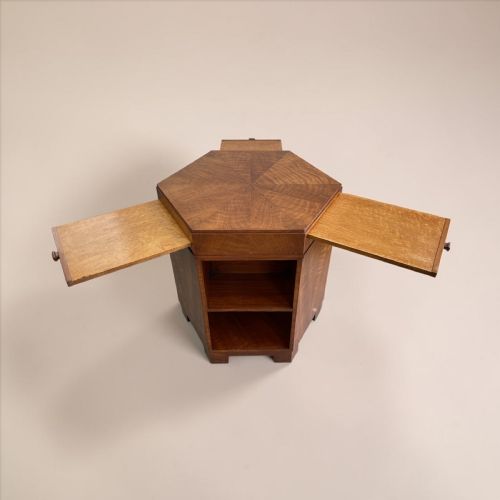
Form variations range from standard library tables and campaign pieces to bedside cabinets and low coffee tables.
What varies in quality
Quality in a vintage drum table rests primarily on the choice of timber and the precision of the curved drawer construction. Superior examples utilise dense, finely figured mahogany, walnut, or burr maple veneers that wrap seamlessly around the circular carcass without buckling. The secondary woods inside the drawers and the crispness of any hand-tooled leather work further separate standard pieces from exceptional ones.
Proportion and stability dictate the visual success of the piece, particularly the relationship between the diameter of the drum top and the weight of the central pedestal. Finer items display harmonious scaling, original brass hardware, and well-executed turnings or carvings on the base. The integration of specialised materials like zebra hide or gilt ormolu details also marks the distinction between everyday utility and ambitious design.
The Vintage Drum Table Glossary
- Drum table
- A circular library table with a deep top containing multiple drawers, traditionally mounted on a single pillar and tripod or pedestal base.
- Frieze drawer
- A drawer located just beneath the top surface of a table, often one of several arranged in a ring around a drum table.
- Burr maple
- Wood harvested from the growth excrescences of a maple tree, displaying highly intricate swirling grain patterns used for decorative veneer.
- Campaign table
- Furniture designed for military transport, typically featuring recessed brass handles and collapsible or easily disassembled components.
- Ormolu
- Gilded bronze ornamentation applied to furniture and clocks, popular in French and English decorative arts during the nineteenth century.
Vintage Drum Table: Frequently Asked Questions
What is a drum table?
A drum table is a circular table with a deep top that houses multiple drawers around its circumference. It traditionally sits on a central pedestal base.
Originally designed for libraries and studies, the shape allowed books and writing materials to be stored close at hand within the compartments.
How were drum tables used?
They served as central library tables where readers could sit and access reference materials stored in the surrounding drawers. The circular format made them accessible from all sides.
In modern spaces, they function effectively as standalone centre tables, side tables, or compact coffee tables.
What woods are common?
Mahogany, oak, and walnut appear most frequently in the construction of these tables. Cabinet makers also utilised decorative veneers like burr root maple and birds eye maple.
Leather tops with gilt tooling are a standard feature, alongside brass fittings and occasional exotic finishes like zebra hide.
How do I date a drum table?
Dating relies on identifying the prevailing style, timber choices, and construction techniques associated with periods like Georgian, Victorian, or Edwardian. Georgian and Regency pieces tend to show classic mahogany construction with tripod bases.
Later Edwardian and 1930s Art Deco examples often introduce exotic veneers, streamlined pedestals, or avant-garde materials such as glass and marble.