
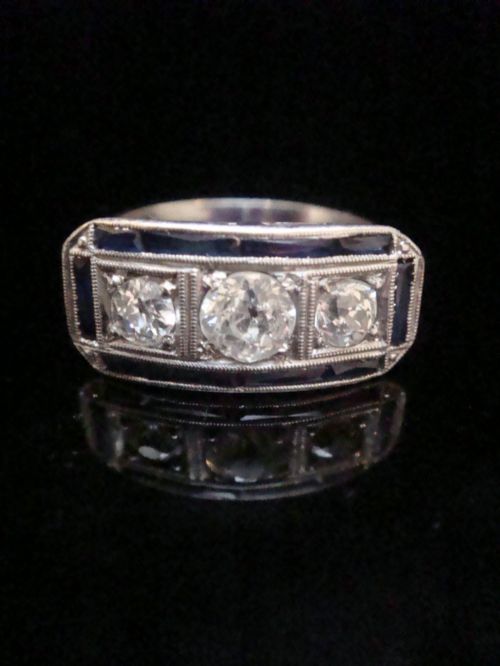


Vintage Diamond Panel Ring
A vintage diamond panel ring offers geometric elegance on the hand, combining period gemstones with structured metalwork from the early twentieth century.
Vintage Diamond Panel Ring
A vintage diamond panel ring presents a flat or gently domed face set across the finger, drawing the eye with geometric arrangements of stones. When you search for a vintage diamond panel ring, you encounter pieces designed to maximise visual spread and light return without relying on a single towering centre stone.
The majority of these pieces originate from the Art Deco period, alongside Edwardian and Mid-Century iterations. Platinum and white gold settings dominate the listings, frequently paired with calibré-cut sapphires, rubies, or emeralds framing the central diamonds.
Makers shaped these panels into rectangles, plaques, and elongated geometric forms that sit low to the hand. This design philosophy prioritized architectural lines and detailed metalwork, creating distinct silhouettes that survived from the 1910s through to the 1950s.
Materials and construction
Craftsmen built these rings primarily in platinum and various carats of gold, including 18ct yellow gold, 18ct white gold, and 14ct gold. Platinum provided the tensile strength required to form delicate millegrain edges and secure multiple small stones in tight geometric formations without excessive metal bulk.
Goldsmiths utilised old cut, transitional cut, and baguette diamonds alongside calibrated colour stones like sapphires, rubies, and emeralds. Setting techniques combined claw work with channel and bezel methods to lock stones flush into the metal panels.
The inventory records pieces originating from the Edwardian era through the 1920s Art Deco period up to 1950s American Retro styles.
Quality variations in panel rings
Quality rests primarily in the precision of the geometric layout and the matching of the accent stones. Superior pieces display crisp symmetry in the piercing of the metal and uniform colour saturation in calibre-cut sapphires or emeralds.
The choice of metalwork execution also separates standard production from finer work. Hand-carved millegrain borders, even stone spacing, and substantial metal weight in the shank indicate higher workshop standards.
The Vintage Diamond Panel Ring Glossary
- Panel ring
- A ring featuring a flat or slightly curved face designed to cover more of the finger. These configurations showcase geometric stone arrangements.
- Plaque ring
- A specific type of panel ring characterised by a flat, often pierced metal plate covered in small gemstones. This style reached peak popularity during the Art Deco era.
- Millegrain
- A decorative technique involving tiny raised metal beads along the edge of a setting. It softens the transition between metal and skin.
- Old cut diamond
- A precursor to the modern brilliant cut, featuring a smaller table, higher crown, and open culet. These stones catch candlelight effectively.
- Calibré cut
- Small gemstones cut specifically to fit a precise geometric channel or pattern within the design. They provide unbroken lines of colour.
Vintage Diamond Panel Ring: Frequently Asked Questions
How do I wear a panel ring daily?
These rings sit low to the finger, which helps protect the central setting during normal hand movements.
However, the delicate millegrain and small accent stones benefit from removal during heavy manual tasks to preserve the metalwork.
Are these rings from the Art Deco period?
Many examples on this page date from the Art Deco era of the 1920s and 1930s, characterised by geometric motifs and platinum settings.
Other pieces stem from the Edwardian period or later 1950s Retro era, bringing different metal combinations and scroll designs.
What metals are common in these rings?
Platinum is the most frequent choice, valued for its strength in holding intricate pierced designs and secure stone settings.
Gold also appears regularly, spanning 18ct yellow gold, 18ct white gold, and 14ct gold variations.
How are coloured stones used alongside diamonds?
Coloured stones such as sapphires, rubies, and emeralds act as borders or geometric accents framing the central diamonds.
These additions introduce contrast and highlight the architectural shapes typical of panel designs.