



Vintage Decorative Candle Stands
These vintage decorative candle stands bring warmth and architectural presence to a room, ranging from slender brass stems to grand carved wood torcheres.
Vintage Decorative Candle Stands
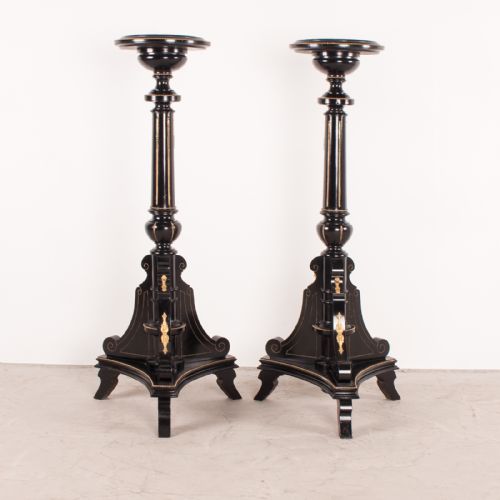
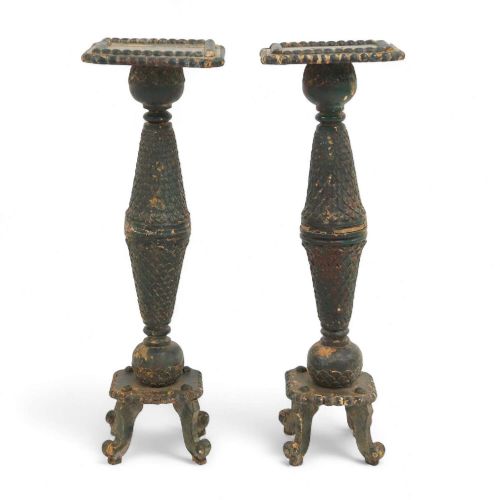
When you search for vintage decorative candle stands, you encounter a diverse gathering of lighting pieces designed to elevate a single taper or branch several candles. The items gathered under this heading span multiple centuries and functions, incorporating tall floor-standing torcheres, multi-armed candelabra, and table-top candlesticks.
The selection on this page leans heavily toward paired examples from the nineteenth century, alongside later Art Deco and Edwardian designs. Forms range from utilitarian chambersticks and advertising night lights to elaborate cast bronze figures and neoclassical giltwood stands.
How they were made
Makers utilised a wide array of metals and timbers, casting brass, bronze, and gilt bronze, or plating copper with silver. Other examples employ carved and ebonised wood, horn, tin, and applied green or black paint.
Techniques varied by period and material, from hand-engraving Persian brass and casting French ormolu to turning mahogany and carving intricate torcheres. Individual details were achieved through skilled metalwork, patination, and surface finishing.
One extraordinary Victorian piece doubles as an advertising night light featuring a tin lighthouse.
What varies in quality
Quality rests in the crispness of the casting and the depth of the chased or engraved detail. Pieces originating from known workshops or specific design movements display superior proportions and finer finishing.
The integrity of the original surface, whether patinated metal, original paint, or untouched gilding, dictates the desirability of a piece. Heavier gauge metals and substantial timber construction separate standard production from superior examples.
Rene Lalique·Abel Landry·Decoro England
The Vintage Decorative Candle Stands Glossary
- Torchiere
- A tall ornamental stand or floor candelabrum designed to hold a light source high above the floor. They often feature tripod bases or slender turned shafts.
- Ormolu
- Finely ground high-carat gold applied to a bronze base using a mercury amalgamation process. This technique gives nineteenth-century French pieces their distinctive warm, metallic lustre.
- Chamberstick
- A low portable candlestick fitted with a saucer base and a loop handle. They were carried through dark houses before the invention of electric lighting.
- Pricket candlestick
- A candlestick featuring a sharp metal spike at the top rather than a socket, designed to impale the base of a large candle. They are frequently found on ecclesiastical and Arts and Crafts pieces.
- Sheffield plate
- An early form of composite metal made by fusing a thin sheet of silver onto a thicker copper base. It was widely utilised before modern electroplating techniques were developed.
Vintage Decorative Candle Stands: Frequently Asked Questions
What is the difference between a candlestick and a candelabrum?
A candlestick is designed to hold a single candle upright in a single socket or on a pricket.
A candelabrum branches out into multiple arms to support several candles simultaneously, offering a more prominent lighting arrangement.
How do I date a brass candlestick?
Dating brass depends on manufacturing marks, base construction, and the style of turning or casting. Earlier pieces often display pontil marks or heavier hand-finished components.
Later nineteenth and twentieth-century examples frequently utilise more uniform machine production methods and distinct stylistic revival motifs.
Where should I place a torchere stand?
Torcheres suit empty corners, landings, or flanking larger pieces of furniture where vertical height adds balance to a room. Their slender profiles allow them to occupy minimal floor space while drawing the eye upward.
Historically used to hold lights or decorative objects, they function well today as display pedestals for sculpture or plants.
Are silver plated candle holders difficult to maintain?
Silver plate requires gentle occasional cleaning with a non-abrasive polish to maintain its finish and prevent heavy tarnish accumulation. Regular soft dusting helps preserve the underlying metal and any decorative engraving.
Avoiding harsh chemical dips ensures the thin silver layer remains intact over decades of use.