

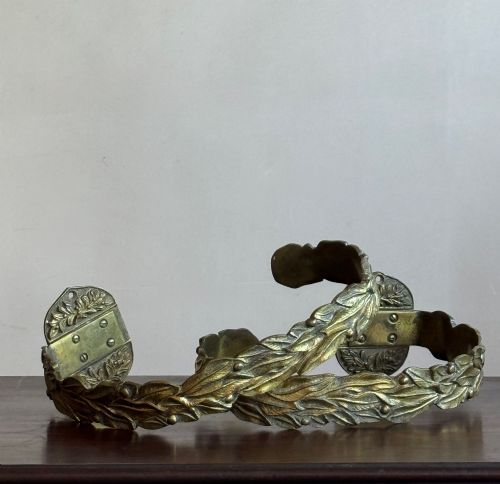


Vintage Curtain Hardware
Vintage curtain hardware brings genuine period character to window treatments through heavy metals and ornate forms.
Vintage Curtain Hardware
Vintage curtain hardware encompasses metal fixtures designed to hold and display window dressings, dominated here by curtain tie-backs and poles. These pieces mostly originate from the 18th century, the 19th century, and the Victorian era, offering substantial weight and decorative presence.
Pairs of curtain tie-backs form the vast majority of what you will encounter on this page, frequently cast in France and Britain. Alongside these fixings, occasional wooden curtain poles and specialised tapestry banner hangers appear to complete interior schemes.
The aesthetic leans heavily towards revivalist movements, with French Rococo and Louis XVI styles prevailing among the cast metal examples. Buyers select these items to replace modern plastic or thin metal fittings with authentic period metalwork.
Materials and construction methods
Makers utilised cast bronze, brass, and copper to create these decorative fixtures, often applying gilding to achieve a rich surface finish. Ormolu and gilt brass pieces demonstrate the high standard of metal casting common in 19th-century French workshops.
Enamel sections are sometimes integrated into the metal armature, adding colour and intricate detail to 18th-century tie-backs. Wooden elements, such as mahogany curtain poles, provide a contrasting texture for heavier window hangings.
Vintage Curtain Hardware Retail Price Guide 2026
Typical asking prices for vintage curtain hardware among the pieces listed under this phrase on Sellingantiques today, from the lower quarter to the upper quarter. They describe what is for sale here now, not the wider market.
Some tie-backs survive in sets of four, proof that past households took their window symmetry very seriously indeed.
Assessing quality in period hardware
The crispness of the casting marks the difference between standard production and superior craftsmanship, particularly in the deep relief work of French Rococo designs. Sharp details in the foliage and scrollwork indicate skilled hand-chasing after the metal came out of the mould.
The durability and depth of the original gilding or ormolu surface dictate the visual appeal of each piece over time. Weight also plays a role, as heavier brass and bronze castings provide a more substantial feel in the hand and on the wall.
The Vintage Curtain Hardware Glossary
- Ormolu
- Finely chopped gold or gold amalgam applied to a bronze base, creating a brilliant golden surface finish. This technique was widely mastered by French metalworkers.
- Tie-back
- A decorative fixture mounted beside a window to hold a curtain curtain open. They take the form of metal arms or rosettes.
- Gilt brass
- Brass that has been given a thin coating of gold to imitate solid gold or richer bronze work. It offers durability combined with a bright metallic sheen.
- Rococo Revival
- A 19th-century design style that revived the asymmetrical scrolls, C-curves, and naturalistic motifs of the 18th-century French court. It remains the dominant aesthetic for these decorative tie-backs.
Vintage Curtain Hardware: Frequently Asked Questions
How do I mount vintage tie-backs?
Most tie-backs feature a backplate with screw holes designed to secure directly into the window frame or surrounding plasterwork. Ensure you use appropriate wall anchors given the heavy metal composition of brass and bronze pieces.
Position them at roughly two-thirds the height of the window for a balanced look, checking that the projection safely clears your chosen curtains.
Can I use these with modern curtains?
These hardware pieces integrate smoothly with contemporary drapes, provided the fabric weight matches the strength of the fixings. Solid metal tie-backs easily manage heavy velvet or linen panels.
For wooden poles, confirm the internal diameter or length suits your window span before hanging modern eyelet or ringed headings.
How do I clean gilt metal hardware?
Dust gently with a soft, dry cloth to remove surface particles without disturbing delicate gilding or ormolu surfaces. Avoid commercial metal polishes, which can strip away thin gold layers.
If grime accumulates, a very mild soap solution on a damp cloth followed by immediate drying is the safest method for preservation.
What defines the French Rococo style?
French Rococo design relies on asymmetrical curves, shell motifs, and elaborate floral scrolls rather than rigid symmetry. This aesthetic brings a sense of fluid movement to metal castings.
Objects from this tradition feel ornate and theatrical, distinguishing them from simpler, linear Victorian utility hardware.