




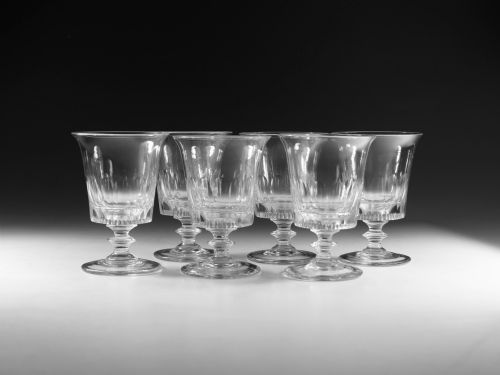


Vintage Crystal Rummers
These vintage crystal rummers are heavy, generous drinking vessels designed for spirits and ales, offering a tangible connection to nineteenth-century hospitality.
Vintage Crystal Rummers
Vintage crystal rummers encompass substantial drinking glasses spanning the Georgian, Victorian, and Edwardian periods, utilised primarily for ale, wine, and spirits. Buyers searching this phrase encounter forms ranging from simple eighteenth-century etched gin vessels to heavily cut Anglo-Irish dram glasses and wide-bowled drinking glasses.
The English and Bohemian pieces on this page display distinct regional characteristics, such as the engraved hops and barley motifs or commemorative Sunderland Bridge scenes. Sets frequently appear alongside pairs and individual serving rummers, demonstrating the diverse scales produced across these eras.
Dating ranges from the late eighteenth century through to nineteen hundred, encompassing periods identified as Georgian, Victorian, and Edwardian. The forms shift from early hand-blown lead glass bodies towards more elaborate cut lead crystal designs.
Materials and construction methods
These items rely upon lead glass, lead crystal, and flint glass, materials prized for their refractive qualities and considerable weight. Artisans shaped these heavy vessels using hand-blown glass techniques before subjecting them to detailed surface decoration.
Surface ornamentation on these pieces combines wheel-engraving and deep cutting to depict botanical motifs, architectural subjects like the Sunderland Bridge, or geometric patterns. Stems often feature baluster profiles, supporting wide bowls formed from clear or coloured glass including turquoise green and amber.
Vintage Crystal Rummers Retail Price Guide 2026
Typical asking prices for vintage crystal rummers among the pieces listed under this phrase on Sellingantiques today, from the lower quarter to the upper quarter. They describe what is for sale here now, not the wider market.
Some rummers are so substantial they double as impromptu doorstops, though generations of toasts suggest a more spirited career.
Assessing quality in antique drinkware
Quality in these drinking glasses rests upon the clarity of the metal and the precision of the hand-cut facets. Superior examples display crisp engraving and balanced proportions, particularly where heavy baluster stems meet expansive bowls.
The distinction between standard utility vessels and finer pieces lies in the depth of the wheel-cut decoration and the uniformity of the lead crystal. Coloured pieces gain distinction through rich saturation, such as deep turquoise or amber hues.
The Vintage Crystal Rummers Glossary
- Rummer
- A large, heavy-bowled drinking glass traditionally used for ale, wine, or spirits during the eighteenth and nineteenth centuries. These vessels typically feature short stems and substantial footed bases.
- Flint glass
- An early term for high-clarity potassium-lead glass developed to increase brilliance and weight. It provides the heavy substance characteristic of Georgian and Victorian tablewares.
- Baluster stem
- A turned or knopped support shaft resembling a architectural baluster, common on eighteenth and nineteenth-century drinking vessels. This form adds stability and tactile grip to heavy crystal bodies.
- Anglo-Irish cut glass
- Glassware produced in Ireland and England during the period of free trade, noted for deep, sharp geometric cutting and heavy lead content. Pieces from this tradition exhibit intense brilliance and deep faceting.
- Roemer
- A continental European drinking vessel, particularly associated with German and Bohemian production, featuring a globular bowl and a studded stem. They often appear in coloured glass such as amber or green.
Vintage Crystal Rummers: Frequently Asked Questions
What were rummers originally used for?
These large vessels were designed for heavy ales, wines, and spirit-based punches in taverns and domestic settings. Their generous capacity made them central to communal toasts.
Over time, smaller versions emerged for drams and specialised spirits, while larger serving variants held central table roles during formal dining.
How do I date an antique rummer?
Dating relies upon evaluating the weight of the metal, the pontil mark on the base, and the style of the cutting. Georgian examples often show deep Anglo-Irish faceting and hand-blown irregularities.
Later Victorian and Edwardian pieces tend toward standardised mould-blown forms with machine-smoothed bases and lighter lead crystal structures.
Are these glasses safe to use today?
These historical drinking vessels remain physically robust enough for regular use, provided they receive careful manual washing. Their lead crystal composition requires gentle handling to avoid thermal shock.
Many collectors utilise them for special occasions, enjoying the tactile experience of drinking from eighteenth and nineteenth-century lead glass.
Why do some rummers feature engraved motifs?
Engraving served both decorative and commemorative purposes, frequently depicting agricultural themes like hops and barley for ale glasses. Other pieces recorded significant local structures such as bridges.
These wheel-engraved details help historians and buyers attribute pieces to specific English, Irish, or Bohemian workshops of the period.