

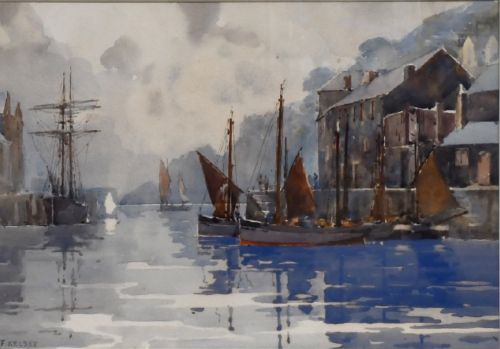


Vintage Cornish Coastal Scene
A vintage cornish coastal scene captures the weathered harbours, fishing luggers, and dramatic Atlantic light of the West Country through the eyes of artists drawn to its shores.
Vintage Cornish Coastal Scene
A vintage cornish coastal scene brings together watercolours and oil paintings depicting familiar maritime subjects such as St Ives, Polperro, and Mousehole. These works range from late nineteenth-century traditional views to mid-twentieth-century Impressionist interpretations.
The selections on this page centre heavily on framed artwork produced across several decades, capturing harbours, fishing vessels, and coastal villages. Buyers encounter both intimate watercolours on paper and larger canvases executed in oil paint.
Many of these paintings record specific locations like Mevagissey and Looe, reflecting the enduring appeal of the region's fishing communities. The pieces span periods from Victorian Fine Art and Edwardian Marine Art through to the twentieth-century British School.
How they were made
Artists working on these coastal subjects typically utilised oil paint on canvas or wood panels, alongside watercolours applied to paper and pastel drawings. These traditional media allowed painters to capture the shifting weather, sea spray, and light characteristic of the Atlantic coast.
The finished works are frequently housed in wooden frames, sometimes accented with gesso mouldings that complement the period of the painting. Canvas supports provide texture for heavier oil applications, while paper suits the fluid washes seen in maritime watercolours.
The selection includes contributions from members of established artistic circles, notably the St Ives and Newlyn schools.
What varies in quality
The distinction between standard works and exceptional examples often lies in the artist's ability to render the atmospheric light and spatial depth of the harbour or seascape. Stronger pieces display confident brushwork and a sure handling of tone that brings movement to the water and sky.
Provenance and association with recognised artistic groups, such as the Newlyn School or the St Ives School, elevate the standing of a painting. The strength of the composition and the specific location depicted also influence how compelling a particular coastal scene appears.
William Banks Fortescue·Frank Kelsey·George F Pennington·Richard Harry Carter·Gyrth Russell·George Turland Goosey·William Pitt·Ernest F Hill·Frederick Stuart Richardson·William Lambert Bell·Jack R Mould·William Lee Hankey·Walter Sweet·Cuthbert Crossley
The Vintage Cornish Coastal Scene Glossary
- Newlyn School
- An art colony based in the Cornish fishing village of Newlyn during the late nineteenth and early twentieth centuries. Artists here favoured painting en plein air, focusing on local fisherfolk and coastal life.
- Watercolour painting
- A medium where pigments are suspended in a water-based solution, typically applied to paper. It allows for translucent washes of colour well suited to capturing marine atmospheres.
- Oil paint
- A slow-drying paint made with pigmented particles suspended in a drying oil, usually linseed. It provides rich colour depth and substantial texture on canvas or wood supports.
- Woodblock print
- A technique for printing text, images or patterns used widely across historical printmaking. Impressions are taken from carved wooden blocks.
- Gesso
- A paint mixture consisting of a neutral binder mixed with chalk, gypsum, or pigment. It is commonly applied to wooden frames or panels to prepare a smooth surface for painting or gilding.
Vintage Cornish Coastal Scene: Frequently Asked Questions
What subjects do these Cornish scenes usually show?
These works primarily depict working harbours, fishing trawlers, coastal cottages, and open seascapes around West Country locations like St Ives, Polperro, and Mousehole.
The compositions often capture local maritime life, including luggers moored in tidal ports and village rooftops tumbling down towards the water.
How do I identify a Newlyn School painting?
Paintings associated with this group generally focus on realist depictions of local fisherfolk and coastal activities rendered with naturalistic light.
Many works originating from this movement reflect the distinct artistic community that gathered in the Cornish fishing port from the late nineteenth century onwards.
Are these paintings usually framed?
Most of the artworks listed on this page arrive framed, frequently in wood or gesso frames that match the period of the piece.
These surrounds range from simple wooden mouldings to more decorative historical frames chosen to complement the painting.
What is the difference between oil and watercolour here?
Oil paintings on canvas offer heavier texture and rich colour depth, allowing artists to build up thick layers of pigment for dramatic seascapes.
Watercolours on paper rely on transparent washes to create lighter, more luminous impressions of coastal air and changing weather.