





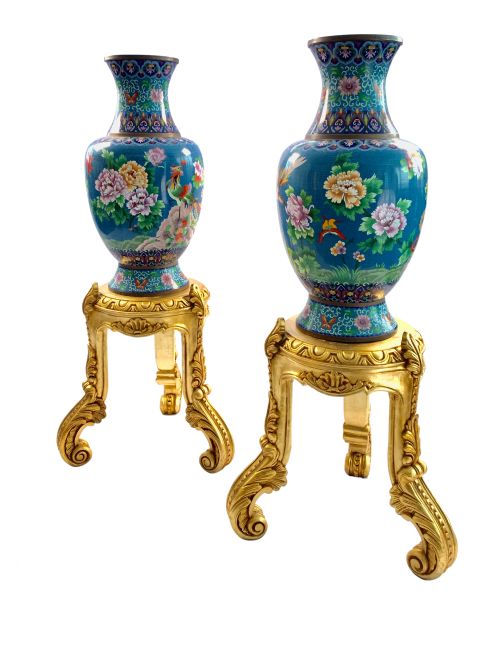


Vintage Cloisonne Pair
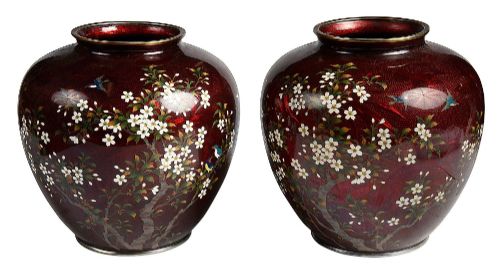
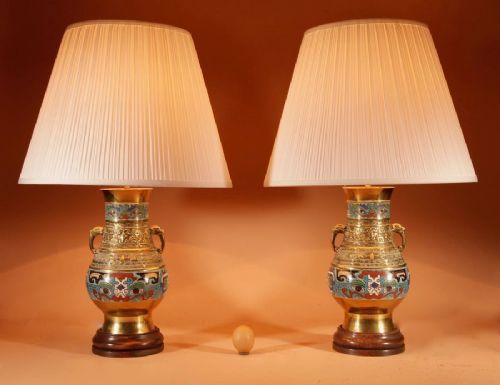
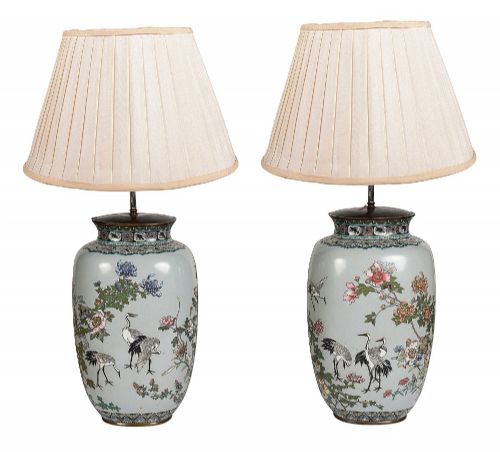
These vintage cloisonne pair selections bring together matched metalwork vessels and lamps spanning the nineteenth century through to the mid-twentieth century.
Vintage Cloisonne Pair
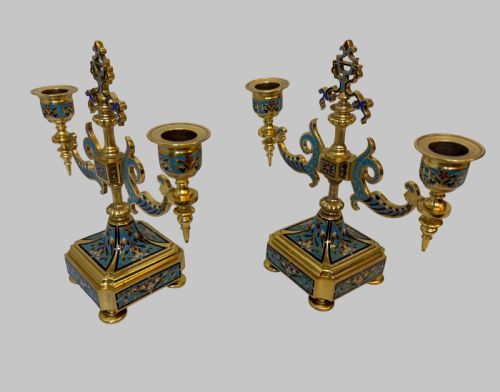
A vintage cloisonne pair consists of matched decorative objects created using soldered wire partitions filled with coloured vitreous enamel pastes. When seeking a vintage cloisonne pair, buyers generally encounter twin vases, ginger jars, and lidded vessels, alongside matched pairs adapted into table lamps and candlesticks.
The pieces originating from Chinese workshops span Imperial and export styles alongside Qing dynasty influences, often taking the form of large decorative urns, cranes, or side tables. Japanese examples frequently date from the Meiji period, presenting intricate miniature vases, plates, and sculptural forms.
European adaptations also appear, notably nineteenth-century French productions combining enamelwork with gilt bronze or ormolu mounts. Dating across the selection ranges from the late nineteenth century through the Edwardian era into the 1930s and 1940s.
Materials and construction methods
Artisans formed the foundation of each piece using metals such as brass, copper, bronze, and gilt bronze. Thin metal wires were soldered onto the metallic base to outline intricate patterns and compartmentalise the design.
Craftsmen filled the resulting cells with coloured enamel pastes before firing the objects at high temperatures to fuse the glass-like surface. Secondary materials such as wood, fabric, and ormolu mounts frequently support or complete lamps, tables, and mounted vessels.
Vintage Cloisonne Pair Retail Price Guide 2026
Typical asking prices for vintage cloisonne pair among the pieces listed under this phrase on Sellingantiques today, from the lower quarter to the upper quarter. They describe what is for sale here now, not the wider market.
The listings span the late nineteenth century through the 1940s, utilising brass, copper, gilt bronze, and enamel across forms like vases, lamps, and side tables.
Distinctions in craftsmanship and design
The refinement of the wirework soldering dictates much of the visual precision, separating tightly executed cell patterns from simpler, coarser outlines. Superior examples display smooth, evenly polished enamel surfaces with minimal pitting or irregularity across the coloured fields.
The weight and finish of the underlying base metal, whether gilt bronze, heavy brass, or copper, contribute significantly to the substantial feel of the finished objects. Furthermore, the integration of matched components within a pair, such as symmetrical bird figures or evenly proportioned vase dimensions, determines the overall harmony of the set.
The Vintage Cloisonne Pair Glossary
- Cloisonne Enamel
- An ancient decorative technique where metal wires form cells on a metallic base to hold vitreous enamel pastes. The surface is then fired and polished to a smooth finish.
- Champleve
- A method where troughs or depressions are gouged out of a heavy metal base and filled with enamel before firing. It differs from wire-formed work by utilising excavated channels.
- Meiji Period
- A notable era in Japanese history spanning from 1868 to 1912. Production during this time is celebrated for exceptional detail and technical mastery.
- Ormolu
- Gilded bronze mounts applied to decorative objects and furniture. This French technique adds structural enhancement and ornate decoration.
- Ginger Jar
- A globular storage vessel with a wide mouth and a fitted lid. Originally designed for spices, these jars became staple decorative forms in East Asian art.
Vintage Cloisonne Pair: Frequently Asked Questions
How were cloisonne pairs used originally?
Many pairs served as ornamental display items within formal rooms, placed upon mantelpieces, side tables, or altars. Larger vessels and ginger jars functioned as decorative statements in both Eastern and Western interiors.
Over time, numerous twin vases were adapted into functional table lamps or fitted with candelabra hardware while retaining their decorative character.
How do I care for my cloisonne pieces?
Dust the surfaces gently with a soft, dry cloth to prevent accumulation within the wire crevices. Avoid harsh chemical cleaners or abrasive pads that can scratch the delicate vitreous enamel and polished metal.
Keep the items away from direct sunlight and damp environments to preserve the integrity of the metal base and the vibrant enamel colours.
How do I distinguish Japanese from Chinese pieces?
Japanese items from the Meiji period often exhibit exceptionally fine, dense wirework depicting naturalistic motifs such as birds and flora. Chinese works frequently draw upon Imperial or traditional Qing dynasty aesthetics, displaying bolder colour palettes and heavier metallic foundations.
Examining the underlying metal and the style of the base rim often provides additional clues regarding the workshop origin.
Can I convert lamp pairs back to vases?
Most conversions involve wiring threaded through the central axis or mounted externally without permanently altering the core structure. A professional restorer can usually remove electrical fittings and restore the vessels to their original appearance.
It is advisable to check the interior condition of the neck and base to ensure the original metal was not drilled or damaged during the lamp conversion.