
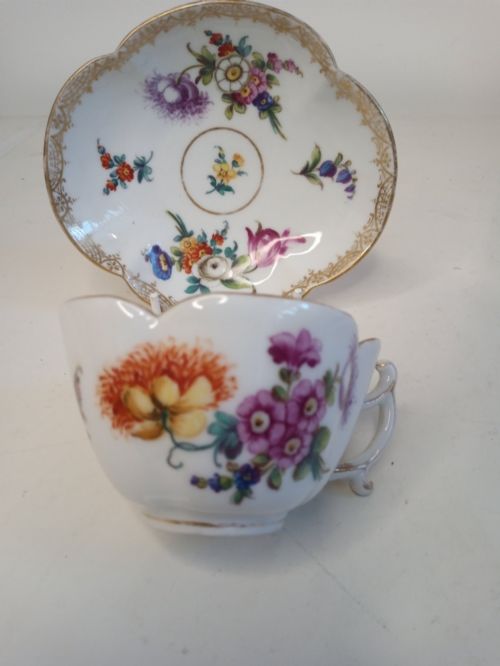


Vintage China Teacup
A vintage china teacup brings tactile domestic history to the morning table, offering delicate porcelain forms and hand-painted glaze patterns from earlier centuries.
Vintage China Teacup
A vintage china teacup sits at the centre of traditional drinking customs, taking the form of handled vessels paired with matching saucers or small tea bowls. When searching for a vintage china teacup, buyers encounter examples ranging from eighteenth-century tea bowls to twentieth-century morning sets.
The selections span distinct historical periods including Georgian, Victorian, Edwardian, and the 1920s to 1930s. Teacups appear both individually and as part of larger afternoon tea services, breakfast sets, and coffee sets.
English manufactories dominate the material evidence, alongside Chinese export porcelain pieces from the late nineteenth century. Forms vary from simple utilitarian shapes to cabinet pieces designed purely for display.
How they were made
Potters shaped these vessels using porcelain, bone china, and soft-paste porcelain, applying liquid glaze to seal the ceramic body before kiln firing. Many pieces feature hand-painted decoration executed directly onto the ceramic surface or beneath the glaze.
Gilding techniques introduced gold leaf and gold gilt highlights to rims, handles, and borders. Enamel colours were layered onto the porcelain to create complex floral, bird, and geometric patterns characteristic of specific periods.
Some nineteenth-century decorators painted entire flocks of fancy birds onto tiny cups just to watch them circle the tea.
What varies in quality
The standard of painting distinguishes standard production from superior artistic output, particularly where hand-painted details replace transfer-printed designs. Finer cups display crisp brushwork in floral motifs, bird studies, and intricate gilt borders.
Material refinement also sets pieces apart, with high-grade bone china and early soft-paste porcelain offering thinner walls and greater translucency. The precision of the potting, uniformity of glaze application, and retention of original gold leaf contribute to a piece's overall standing.
Royal Crown Derby·Coalport·Shelley·Royal Worcester·Royal Albert·Doric China Longton Stafford·Sutherland Ware·Worcester·Masons Patent Ironstone China·Spode·Wileman Foley Shelley·Lowestoft Porcelain·Gladstone potteries
The Vintage China Teacup Glossary
- Bone china
- A type of soft-paste porcelain containing bone ash, developed to provide high strength and a bright white ceramic body. It allows for thinner vessel walls while maintaining durability.
- Soft-paste porcelain
- An artificial porcelain composition fired at lower temperatures than hard-paste, common in eighteenth-century English manufactories. It produces a warm tone and deep glaze integration.
- Gilding
- The application of gold leaf or powdered gold to ceramic surfaces for decorative trim. This technique accentuates rims, handles, and painted scenes.
- Tea bowl
- A handleless drinking vessel used in early tea service traditions before standard handle attachments became common. They often accompany matching saucers in eighteenth-century sets.
- Imari
- A decorative style inspired by Japanese export wares, featuring iron red, cobalt blue, and gold gilt. British potteries adapted these palettes extensively during the Victorian and Edwardian eras.
Vintage China Teacup: Frequently Asked Questions
How do I date an old teacup?
Dating relies on identifying ceramic marks stamped or painted on the underside, alongside stylistic clues such as handle shape and glaze type. Comparing the decorative motifs and porcelain body to known production eras helps narrow the timeline.
Evidence from eighteenth-century tea bowls differs markedly from Edwardian or 1930s bone china sets. Examining the weight, translucency, and painting style provides further confirmation of age.
Can I use these cups for daily tea?
Many sturdy bone china and porcelain cups remain fully functional for drinking hot beverages. However, pieces featuring heavy gold leaf gilding or delicate hand-painted enamel require careful hand washing.
Early soft-paste porcelain and fragile eighteenth-century tea bowls are better suited for light use or display. Avoiding dishwashers preserves the original glaze and decorative pigments.
What is a tea trio?
A tea trio consists of three matching components: a teacup, a saucer, and a corresponding small plate for cake or bread. This configuration became popular for formal afternoon tea service.
Trios often share a unified pattern or colour scheme, such as floral enamels or gilded borders. They appear frequently in Edwardian and twentieth-century dining sets.
Why are some cups handleless?
Early tea drinking traditions in Britain followed Chinese customs where small handleless bowls were held directly in the hands. These eighteenth-century tea bowls required drinkers to sip carefully as the ceramic absorbed heat.
Handles became standard as European tea culture evolved and manufacturing techniques changed. Finding a handleless bowl usually points to an eighteenth-century or early Georgian origin.