
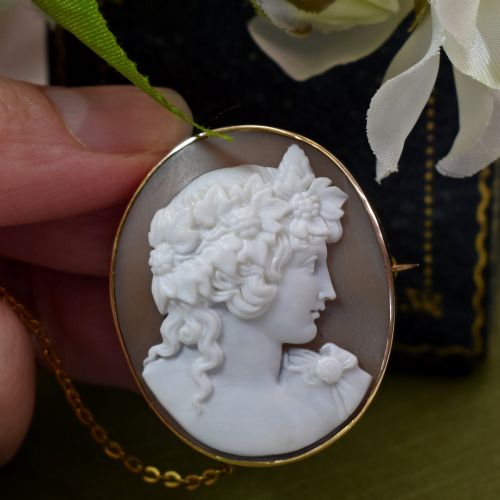
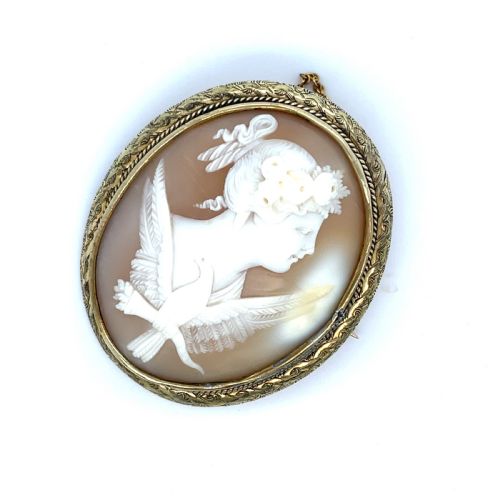


Vintage Carved Cameo Jewellery
Vintage carved cameo jewellery brings together hand-carved shell and hardstone profiles set in gold and silver mounts for daily wear.
Vintage Carved Cameo Jewellery
The primary forms found here are brooches and rings, frequently depicting classical figures, portraits, or mythological subjects. Mounts range from simple silver settings to detailed gold frames, including pinchbeck and high-carat gold.
Pieces span decades from the eighteen-sixties through to nineteen-sixty, showing revivals of neoclassical and Gothic styles alongside Italian craftsmanship. Shell and hardstone remain the dominant mediums for the carved elements across these eras.
How they were made
Carvers cut directly into natural materials such as layered shell, agate, onyx, coral, and black opal to exploit the contrasting colour zones. This relief technique requires steady hands to shape portraits and motifs against a darker or lighter background.
Goldsmiths and silversmiths housed these carvings in secure metal mounts, utilising nine-carat gold, fifteen-carat gold, eighteen-carat yellow and rose gold, silver, and pinchbeck. Frames often featured detailed wirework, rope twists, or diamond halos to complement the central carving.
Listings span Victorian, Edwardian, and mid-century eras, featuring shell, agate, onyx, coral, and black opal set in gold and silver.
What varies in quality
The weight and purity of the metal mount, alongside the integration between the carving and its setting, separate standard production from high-end jewellers. Robust gold frames with secure bezel settings and secondary decorative elements demonstrate higher workshop standards.
Chaumet·R.Pernice
The Vintage Carved Cameo Jewellery Glossary
- Cameo
- A method of carving an object such as an engraved gem, item of jewellery, or vessel. The design is raised in relief against a contrasting background.
- Hardstone
- A gemstone of high density used for carving cameos, including agate, onyx, and black opal. These stones offer durable layers for precise miniature portraits.
- Pinchbeck
- An alloy of copper and zinc invented in the eighteenth century to imitate gold. It provides a warm golden tone for affordable jewellery mounts.
- Bezel setting
- A method of securing a gemstone or carving by wrapping a thin metal strip around its perimeter. This technique holds the cameo firmly in place within its frame.
- Conch shell
- A large marine mollusc shell utilised for carving pink and white cameos. Its natural colour gradient creates soft tonal contrasts in portrait pieces.
Vintage Carved Cameo Jewellery: Frequently Asked Questions
How do I date a cameo?
Dating relies on the style of the metal mount, the clasp mechanism, and the subject matter of the carving. Victorian pieces often feature heavy gold frames with tube hinges, while later pieces adopt simpler fastenings.
Material choices also guide dating, as shell cameos span the nineteenth and twentieth centuries alongside hardstone and coral variations from specific revivals.
What materials are cameos carved from?
Carvers use natural shells, including queen conch, alongside hardstones such as agate, onyx, and black opal. Coral and jet also appear in specific coloured suites.
Each material dictates the carving technique, with softer shells allowing deeper relief and hardstones offering extreme durability for fine detail.
How do I wear a cameo brooch?
A cameo brooch fastens securely to heavy fabrics like wool coats, structured lapels, or knitted shawls using its pin and catch. Ensure the fabric weight supports the metal frame without pulling.
Positioning the brooch near the shoulder or collarbone keeps the carved profile upright and visible during movement.
Are all cameos unique?
Hand-carved cameos are individual works of art because artisans carve each shell or stone freehand. Variations in facial expression and material grain mean no two carvings match exactly.
Even pieces produced in workshops bear subtle differences due to the natural properties of the shell or gemstone used.