


Vintage Cameo Jewellery
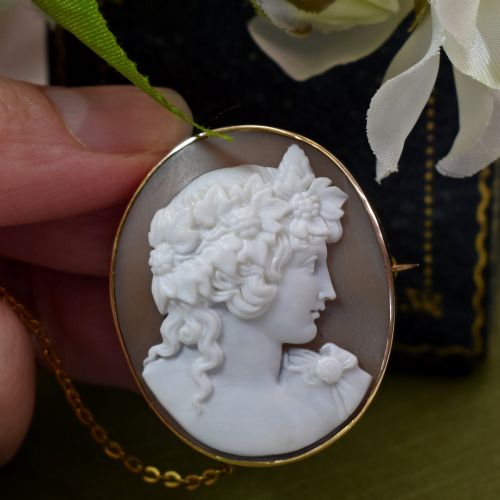
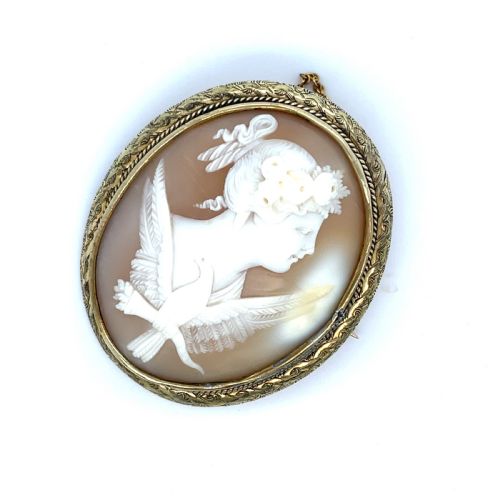
Vintage cameo jewellery comprises carved shell, stone and coral pieces set in gold and silver, prized for classical portraiture and fine miniature relief work.
Vintage Cameo Jewellery
Vintage cameo jewellery encompasses brooches, rings, earrings and bracelets featuring raised profile carvings, with Victorian and Edwardian shell brooches appearing most frequently on this page alongside mid twentieth century Italian examples.
The objects take various forms, from single carved shell plaques mounted in gold frames to intricate agate rings, coral bracelets and Wedgwood jasperware portrait medallions.
Origins span nineteenth century Britain and Italy, reflecting both classic revival tastes and regional carving traditions that persisted well into the twentieth century.
Materials and methods
Carvers shaped natural materials such as conch shell, hardstone agate, coral and ceramic stoneware, exploiting natural colour strata to create contrast between figure and background.
Mounts utilise precious metals including nine carat and eighteen carat yellow and rose gold, silver, pinchbeck and brass, often detailed with wirework, bezels or diamond halos.
Materials represented include conch shell, black opal, coral, agate, onyx and Wedgwood stoneware.
Assessing quality and execution
Quality rests primarily on the crispness and depth of the carving, where master carvers achieved subtle facial expressions, correct anatomical proportions and clean undercut edges.
The weight and substance of the metal mount also distinguish finer examples, as does the integration between the carved subject and its precious metal or stonework setting.
R.Pernice·Chaumet
The Vintage Cameo Jewellery Glossary
- Cameo
- A method of carving an object such as a gemstone, shell or piece of stoneware where a relief image is raised above a contrasting background. This technique highlights layered colours in the raw material.
- Pinchbeck
- An alloy of copper and zinc invented in the eighteenth century to imitate gold. It provides a warm metallic appearance often found on nineteenth century frames.
- Jasperware
- A type of fine stoneware developed by Josiah Wedgwood, characterised by a matte finish and contrasting white moulded reliefs applied to a coloured body.
- Hardstone
- A semi-precious stone such as agate or onyx used for glyptic carving. These materials offer greater durability and sharper detail than shell.
Vintage Cameo Jewellery: Frequently Asked Questions
How do I date a shell cameo?
Dating relies on the style of the carving, the shape of the metal mount and the fastening mechanisms employed. Victorian pieces often feature high relief classical profiles in heavy yellow gold frames with extended pin stems.
Later twentieth century examples tend to have simpler bezel settings and modern safety catches while retaining traditional Italian motifs.
What is the difference between shell and stone cameos?
Shell cameos utilise conch or helmet shells which display natural colour layers, typically white against a pink or orange-brown ground. They offer a softer texture suited to intricate drapery and hair.
Stone and hardstone cameos use banded agates or onyx, providing greater durability and starker monochrome contrast for precise neoclassical portraits.
How should I care for antique cameo jewellery?
Shell and coral are organic materials that require gentle handling and protection from harsh chemicals, perfumes and ultrasonic cleaners. Soft cloths and mild soapy water suffice for cleaning.
Store pieces individually in padded boxes to prevent scratching against other items in a collection.
What subjects appear on these pieces?
Classical mythology and antique portraiture dominate, frequently depicting figures such as Aphrodite, Antinous Vertumnus or profile busts of noble women. Floral motifs and animal subjects also appear in coral and hardstone variants.
These designs reflect successive revivals of neoclassical and Renaissance tastes throughout the nineteenth and twentieth centuries.