



Vintage Brass Pan Scales
Vintage brass pan scales bring functional nineteenth and twentieth century weighing equipment into modern interiors.
Vintage Brass Pan Scales
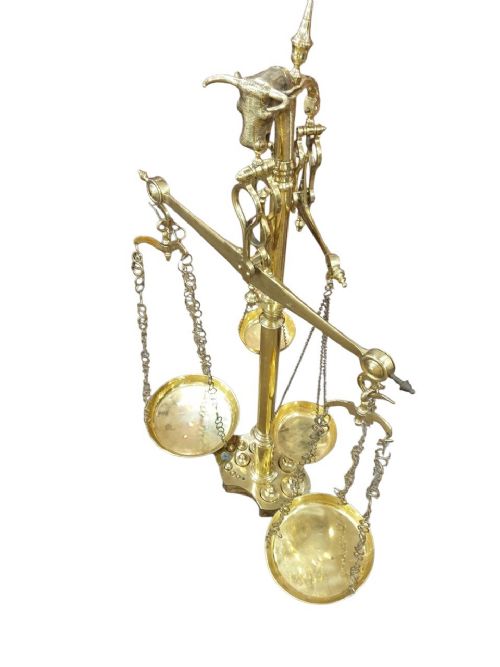
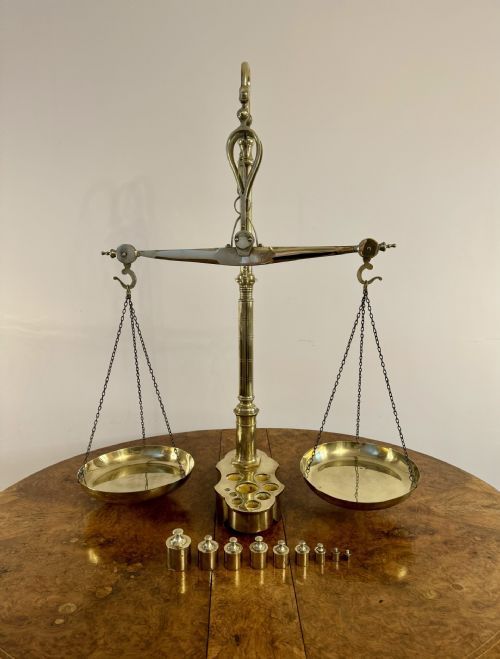
Vintage brass pan scales represent traditional weighing apparatus spanning the Victorian, Edwardian and mid twentieth century periods. A buyer seeking vintage brass pan scales will encounter balance scales, beam scales and shopkeeper's models originating from British, French and Dutch workshops.
The pieces listed on this page include large butcher's scales, grocer's balances and free hanging beam scales. Domestic vegetable garden scales in copper and brass also appear alongside commercial shop apparatus.
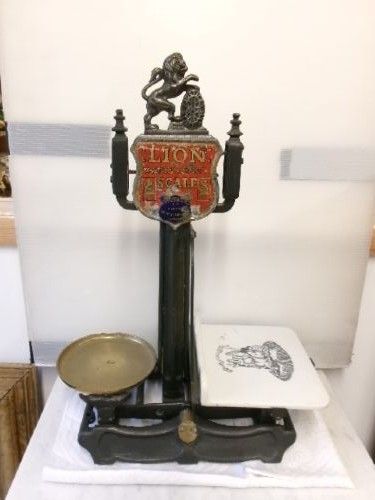
Victorian examples predominate among these listings, often featuring heavy cast iron or mahogany bases paired with polished brass pans and beams. Form follows function closely, resulting in robust utilitarian objects designed for daily trade.
How they were made
Makers constructed these balance scales using cast iron, brass, copper and steel, frequently mounted upon substantial mahogany bases. Metal components were cast, hammered and turned before being polished to a bright finish.
Beams and pans required precise balancing to ensure accurate measurement in commercial environments such as butcher shops and grocers. Structural integrity was achieved through heavy iron framing and reinforced pivot points.
Vintage Brass Pan Scales Retail Price Guide 2026
Typical asking prices for vintage brass pan scales among the pieces listed under this phrase on Sellingantiques today, from the lower quarter to the upper quarter. They describe what is for sale here now, not the wider market.
Vegetable garden scales bring unexpected copper polish to root crops.
What varies in quality
Quality in vintage brass pan scales rests upon the precision of the beam mechanism and the integrity of the original materials. Superior examples demonstrate substantial weight, cast maker details and harmonious proportions between the timber base and metal pans.
Decorative presence distinguishes utilitarian workshop tools from impressive commercial display pieces. The retention of original calibrated weights and clear maker inscriptions elevates the distinction of an individual set.
Bartlett and Sons·De Grave and Co London
The Vintage Brass Pan Scales Glossary
- Beam scales
- Weighing instruments utilising a central pivoting horizontal beam with pans suspended from each end. They rely on gravitational equilibrium to determine mass.
- Balance scales
- Devices designed to weigh objects by balancing them against known standard weights placed on the opposing pan. This category includes shopkeeper and grocer variants.
- Free hanging
- A suspension method where the scale hangs from a central hook or ceiling point rather than resting upon a counter or table. This configuration is typical of certain traditional Dutch designs.
- Cast iron
- A strong, heavy alloy used for the structural bases and frames of commercial weighing equipment. It provided the necessary stability for accurate measurement.
Vintage Brass Pan Scales: Frequently Asked Questions
How do vintage brass pan scales work?
These scales operate on the principle of mechanical equilibrium, using a central pivoting beam to compare an object's weight against standard metal masses placed on the opposite pan. When both sides achieve level balance, the measurement is read.
Commercial variants required careful calibration to ensure precise trade transactions in butcher shops and grocers. The interaction of the central fulcrum and side pivots dictates the sensitivity of the movement.
Where were these scales originally used?
Commercial sets served in nineteenth and twentieth century retail establishments, including butcher shops, grocery stores and open-air markets. Their robust construction suited the demands of daily mercantile trade.
Other variations, such as domestic copper and brass garden scales, fulfilled specific household or utilitarian roles. Free hanging Dutch and French models were adapted to particular spatial arrangements in European shops.
How do I date a set of scales?
Dating relies upon stylistic markers, materials and stamped maker signatures found on the beam or base. Victorian and Edwardian examples often display distinct decorative casting patterns on their iron supports.
Reference to the period of manufacture, such as nineteenth century French or c1920 production, helps establish the chronological context. Stamped company names like De Grave or Bartlett provide firm historical benchmarks.
How do I care for brass pans?
Maintenance involves gentle cleaning with appropriate metal care products to preserve the polished appearance of the brass and copper components. A soft cloth prevents scratching the softer metal surfaces during routine dusting.
Protecting the original mahogany or cast iron bases from excessive moisture ensures the structural stability of the timber and metal joints. Allowing a natural patina to develop over decades is often preferred by collectors.