




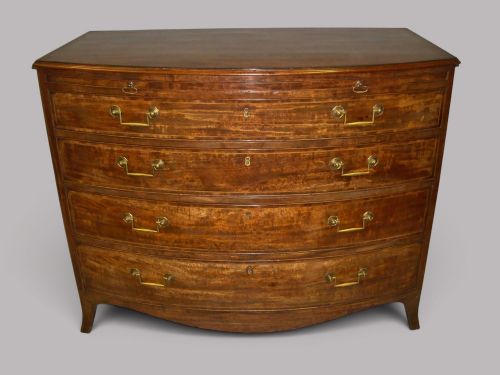


Vintage Bow Front Bureau
A vintage bow front bureau offers curved storage with a drop-down writing surface, combining compact elegance with practical domestic workspace.
Vintage Bow Front Bureau
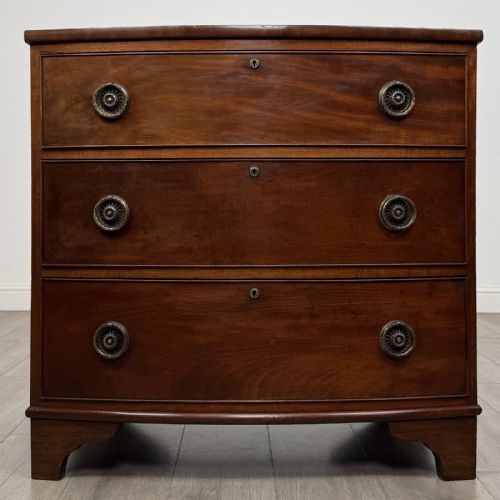
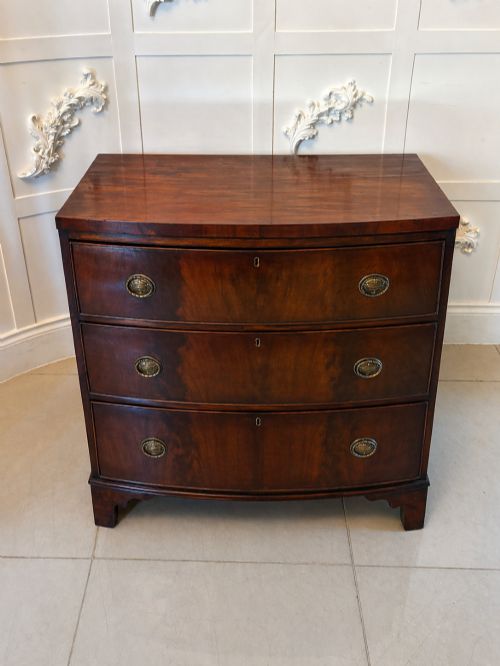
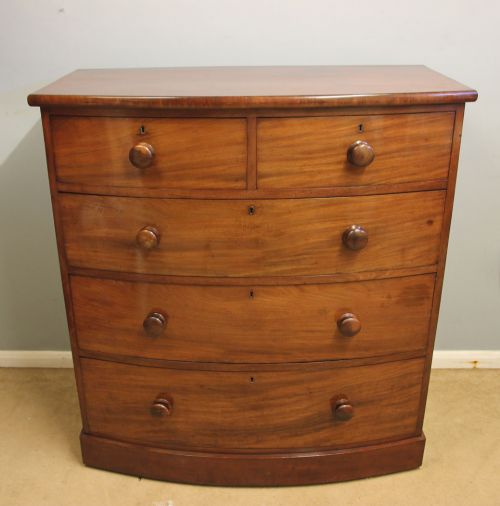
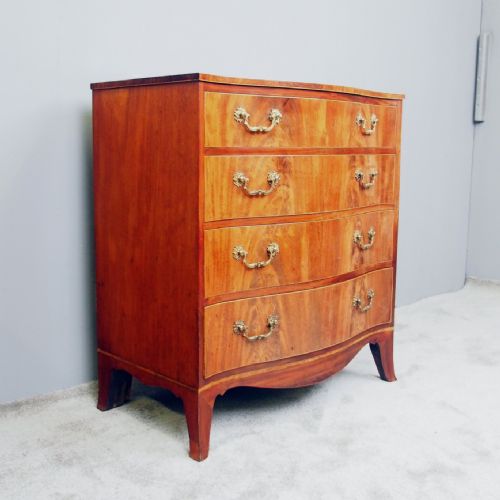
A vintage bow front bureau brings together the curved facade typical of nineteenth-century case furniture and the fitted interior of a writing desk. These pieces span periods from the Georgian era through to the early twentieth century, showing influences from Sheraton, Hepplewhite, and Regency design traditions.
The form usually combines three or more graduating drawers beneath a fall-front writing flap that conceals small pigeonholes and drawers. Most examples found here appear in solid mahogany, flame mahogany veneer, and occasionally walnut, reflecting the favoured cabinet timbers of their respective periods.
Makers adapted these desks for smaller domestic spaces where a full library table or standalone bureau was impractical. The curved front softens the rigid lines of traditional case furniture while retaining the deep storage capacity needed for household papers and linens.
Materials and construction methods
Cabinet makers constructed these pieces using dense hardwoods like mahogany and walnut, frequently applying figured flame mahogany veneers across the curved drawer fronts to create striking visual movement. Satinwood inlay often borders the drawer edges and top surfaces, adding delicate contrast to the darker primary timber.
Brass handles and escutcheons punctuate the drawer faces, ranging from simple stamped backplates on later pieces to ornate cast rings on earlier examples. Secondary timbers line the interior drawer boxes, whilst leather inserts frequently surface on the pull-out or drop-down writing slopes.
Vintage Bow Front Bureau Retail Price Guide 2026
Typical asking prices for vintage bow front bureau among the pieces listed under this phrase on Sellingantiques today, from the lower quarter to the upper quarter. They describe what is for sale here now, not the wider market.
Design influences across the inventory include Regency, Hepplewhite, Sheraton Revival, and Federal styles.
Assessing quality and craftsmanship
Quality rests heavily on the selection of timber and the precision of the curved drawer fronts. Superior pieces employ continuous grain matching across the entire bow front, whereas lesser examples use mismatched veneers that disrupt the visual sweep of the cabinet.
The integrity of the internal pigeonholes, secret compartments, and pigeonhole dividers indicates the care taken by the original maker. Dovetail joints cut finely by hand separate standard workshop production from finer cabinet work of the Regency and Georgian periods.
The Vintage Bow Front Bureau Glossary
- Bow front
- A convex curved front that projects outward from the centre, characteristic of many late eighteenth and nineteenth-century case pieces. This shape required advanced woodworking skill to bend timber or shape solid blocks accurately.
- Flame mahogany
- A veneer cut from the branch junction or fork of a mahogany tree, displaying a distinct flickering grain pattern. Cabinet makers reserved this highly figured timber for the most prominent exterior surfaces.
- Satinwood inlay
- A decorative technique using thin strips of pale satinwood inserted into contrasting dark wood to form geometric or floral borders. It provides a sharp, bright accent popular during the Sheraton revival and Georgian periods.
- Fall front
- A hinged writing flap that drops down to form a horizontal desk surface and conceals internal compartments. When closed, it maintains the flat profile of the cabinet facade.
- Secondary timber
- The interior wood used for drawer linings, backboards, and framing where the primary show wood is unnecessary. Common secondary woods include oak, pine, and mahogany depending on the region of manufacture.
Vintage Bow Front Bureau: Frequently Asked Questions
How do I date a bow front chest?
Examine the construction of the drawer boxes and the style of the brass hardware. Hand-cut dovetails and subtle timber shrinkage point toward earlier Georgian or Regency origins.
Later Victorian and twentieth-century reproductions often feature machine-cut joints and standardised internal framing that differs significantly from older workshop practices.
Where should I place a bureau in the home?
These pieces suit living rooms, studies, or hallways where their curved silhouette can be appreciated without blocking narrow pathways. The compact footprint allows them to function as display surfaces as well as working desks.
Keep them away from direct sunlight and strong heat sources to protect the mahogany veneer and leather writing surfaces from drying out.
How do I care for mahogany veneer?
Dust the surface regularly with a soft, dry cloth to prevent dirt accumulation in the grain and around the brass fittings. Avoid modern silicone sprays that can penetrate old finishes and soften the underlying polish.
Apply a traditional beeswax polish sparingly once or twice a year to nourish the timber and maintain a gentle, natural lustre.
What is the difference between a bureau and a chest of drawers?
A standard chest of drawers provides only storage space behind its stacked facade. A bureau incorporates a hinged writing flap that opens to reveal fitted pigeonholes and a sloped desk surface.
Both forms utilise the curved bow front profile to soften the visual impact of tall wooden furniture in a room.