
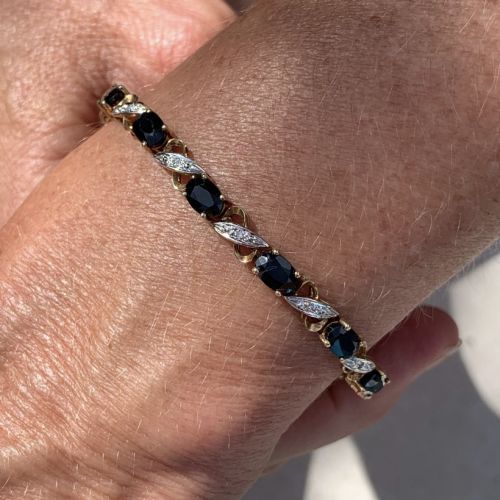


Vintage Blue Sapphire Bracelet
A vintage blue sapphire bracelet brings deep colour and enduring design to the wrist, moving easily from daily wear to evening.
Vintage Blue Sapphire Bracelet
When you search for a vintage blue sapphire bracelet, you encounter wrist jewellery spanning the Edwardian era through the mid-twentieth century. The pieces combine blue sapphires with diamonds, pearls and precious metals in varied configurations.
You are most likely to meet pieces from the 1920s and 1960s on this page, reflecting Art Deco geometry and mid-century fine jewellery. These items take the form of line bracelets and gem-set link bracelets.
The materials used across these periods range from platinum and 18ct white or yellow gold to 9ct gold in yellow and rose tones. Sapphires appear alongside diamond accents or as the primary stone.
How they were made
Makers set blue sapphires into platinum and gold mounts, often accompanied by brilliant-cut or single-cut diamonds. Platinum dominates the Art Deco pieces for its strength in holding intricate gemstone arrangements.
Gold options utilise 18ct yellow gold, 18ct white gold, and 9ct gold in yellow and rose hues. Seed pearls and pearls also appear alongside the stones in earlier Edwardian and 1900s examples.
Listings span the Edwardian period, 1900, 1910, 1920, 1930, 1950, and 1960, utilising platinum, 18ct yellow gold, 18ct white gold, and 9ct gold.
What varies in quality
The distinction between tiers rests on the carat weight and saturation of the blue sapphires, paired with the scale of the diamond work. Pieces featuring substantial diamond weight alongside certified stones sit at the higher end.
Metal choice also defines the grade, with platinum and 18ct gold settings housing more complex gemstone configurations than standard 9ct gold iterations.
The Vintage Blue Sapphire Bracelet Glossary
- Platinum
- A dense, durable white metal prized for secure gemstone settings. It allows for fine, delicate claw work without risking structural integrity.
- Art Deco
- A design style spanning the 1920s and 1930s characterised by geometric symmetry and clean lines. Pieces from this era frequently employ platinum and calibrate-cut stones.
- Edwardian
- A period spanning the early twentieth century known for light, lace-like platinum and gold work. Jewels from this time often incorporate pearls alongside sapphires and diamonds.
- Line bracelet
- A flexible bracelet featuring a continuous line of gemstones set closely together. This form is often referred to as a tennis bracelet.
- Basaltic sapphire
- A sapphire originating from alkali basalt terrains, known for deep, saturated blue tones. These stones appear in select antique settings.
Vintage Blue Sapphire Bracelet: Frequently Asked Questions
How do I wear a vintage blue sapphire bracelet?
These bracelets suit daily wear or formal events, depending on the scale and sparkle of the stones. Pair platinum line bracelets with evening attire or wear a lighter gold piece during the day.
Protect the setting by removing the bracelet during heavy physical tasks or sports to prevent claw damage.
What periods do these bracelets come from?
The pieces span from 1900 through the Edwardian era, the 1920s, 1930s, and into the mid-century 1950s and 1960s.
Each decade brings distinct metal choices and mounting styles, from Edwardian pearl accents to bold Art Deco platinum geometry.
Are diamonds always included with the sapphires?
Diamonds frequently accompany the sapphires, acting as borders, spacers, or central highlights within the design. The carat weight of these diamonds varies significantly across different pieces.
Some Edwardian and early examples incorporate seed pearls instead of or alongside diamonds.
How do I tell Edwardian from Art Deco pieces?
Edwardian bracelets often feature softer, garland-inspired motifs with millegrain edges and pearls. Art Deco pieces shift towards strict geometric lines and platinum settings.
Examining the underlying metal work and stone cuts clarifies the chronological origin.