
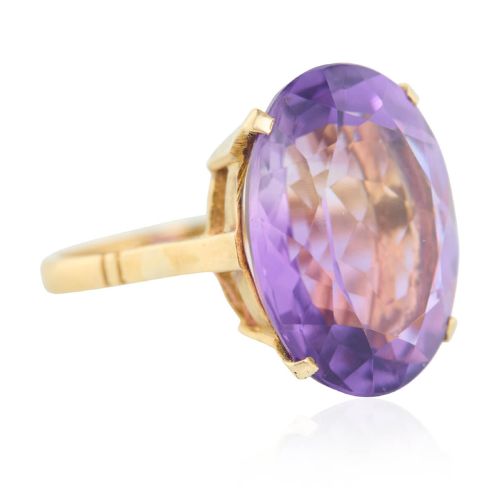


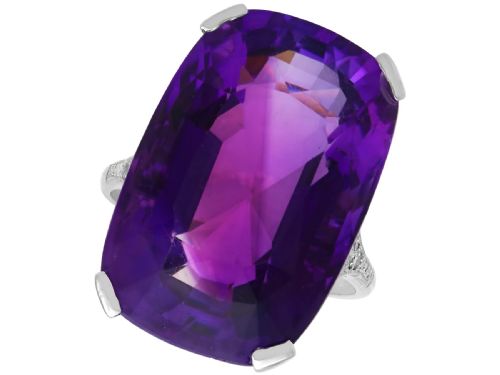


Vintage Amethyst Solitaire Ring
A vintage amethyst solitaire ring offers a rich violet focal stone set simply to catch the light, spanning eras from Victorian to Mid-Century.
Vintage Amethyst Solitaire Ring
When you search for a vintage amethyst solitaire ring, you encounter singular purple quartz stones held in gold or platinum settings across multiple decades. The selections range from compact mid-century pieces to substantial antique designs.
Most examples you meet on this page hail from the twentieth century, particularly the 1950s and 1960s, alongside earlier Edwardian and Art Deco expressions. These items demonstrate how jewellers across different decades favoured the deep purple quartz as a primary centre stone.
The styles span from restrained mid-century mountings to intricate Art Nouveau and geometric Art Deco frameworks. Each piece showcases the distinctive purple hue of the quartz, whether cut as an emerald shape, heart, cushion, or rectangle.
Materials and Construction
The metalwork relies primarily on 9ct and 18ct yellow gold, alongside rose gold, 14ct yellow gold, and durable platinum settings. These metals provide secure claws or bezels designed to hold substantial quartz gems securely.
Stones are faceted into specific geometries including emerald cuts, heart cuts, cushion cuts, and rectangular shapes. Certain iterations incorporate supporting diamonds alongside the main purple quartz to add contrast to the design.
Listings span periods from 1900 to 1960, utilising amethysts, diamonds, 9ct gold, 18ct gold, and platinum.
Evaluating Quality and Craftsmanship
Quality rests upon the depth and saturation of the purple quartz, alongside the precision of its faceting and the integrity of the surrounding metalwork. Superior examples display clean stone clarity and robust settings that securely anchor the stone without excessive bulk.
The distinction between standard commercial pieces and finer examples lies in the weight and purity of the gold or platinum, as well as the artistry of the setting. Heavier mountings and larger carat weights separate exceptional cocktail iterations from everyday wear.
The Vintage Amethyst Solitaire Ring Glossary
- Solitaire
- A jewellery setting featuring a single gem as the primary focal point, without secondary feature stones competing for attention. This layout directs the eye entirely towards the central quartz.
- Cushion cut
- A stone shape featuring rounded corners and larger facets that resemble a pillow, popular in antique and vintage rings. This cut maximises the internal light reflection within the purple quartz.
- Emerald cut
- A rectangular stone shape with cropped corners and step-cut facets that create a hall-of-mirrors effect. It highlights the clean transparency and deep colour of the amethyst.
- Art Deco
- A design period spanning the 1920s and 1930s characterised by geometric lines, symmetry, and stylised motifs. Rings from this era often embrace bold, architectural mountings.
- Art Nouveau
- A style prevalent around 1900 inspired by natural forms, flowing lines, and organic curves. Pieces from this movement frequently incorporate delicate floral or sinuous metalwork.
Vintage Amethyst Solitaire Ring: Frequently Asked Questions
How do I care for my ring?
Clean your amethyst ring using warm soapy water and a soft brush, avoiding harsh chemical dips that can damage softer metals and stones. Store it separately from harder gems to prevent surface scratching.
Amethyst is durable for regular wear on the hand, but removing it during heavy manual tasks protects the setting and claws from unnecessary impact.
Are these stones natural amethysts?
The listings encompass natural quartz varieties shaped by traditional lapidary techniques across the twentieth century and earlier eras. Each stone displays the characteristic purple coloration inherent to natural quartz.
Examining the stone under magnification reveals natural inclusions that confirm its status as genuine mined quartz rather than synthetic glass.
Can these rings be resized?
Most gold and platinum bands can be altered by a skilled jeweller to fit different finger sizes without compromising the structural integrity. The feasibility depends on the shoulder design and the presence of intricate side details.
Consult a professional goldsmith to assess the shank thickness before undertaking any alterations to antique or vintage metalwork.
How do I identify the period?
Dating relies on stylistic markers such as geometric Art Deco lines, organic Art Nouveau curves, or minimalist mid-century profiles. Hallmarks stamped inside the band often provide official assay office stamps and date letters.
Comparing the cut of the stone and the construction of the setting against known historical eras helps confirm the decade of manufacture.