


Vintage Amber Glass Vessel
A vintage amber glass vessel brings warmth and rich tone to a room, catching the light in a way clear glass never quite manages.
Vintage Amber Glass Vessel
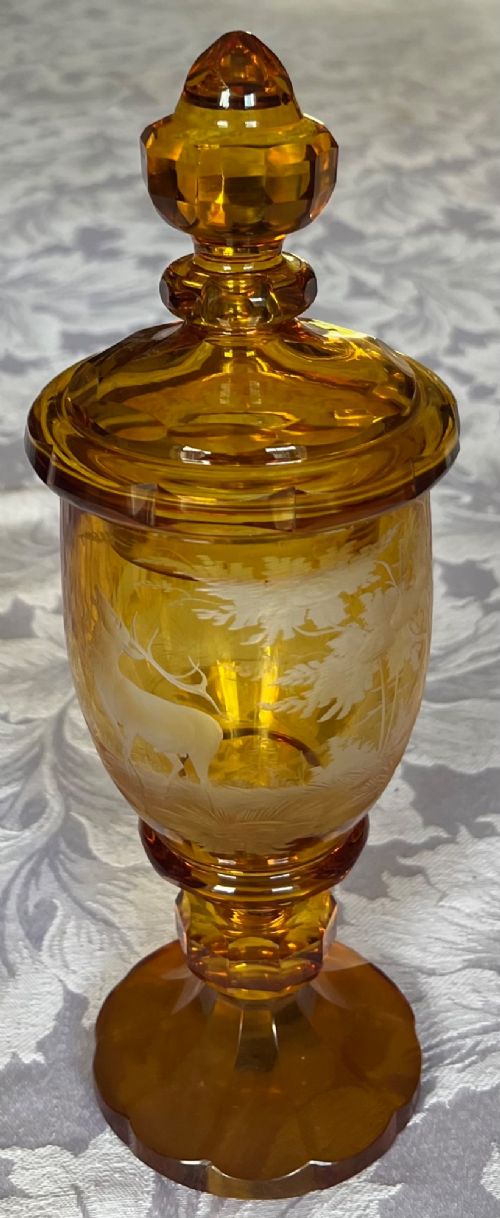
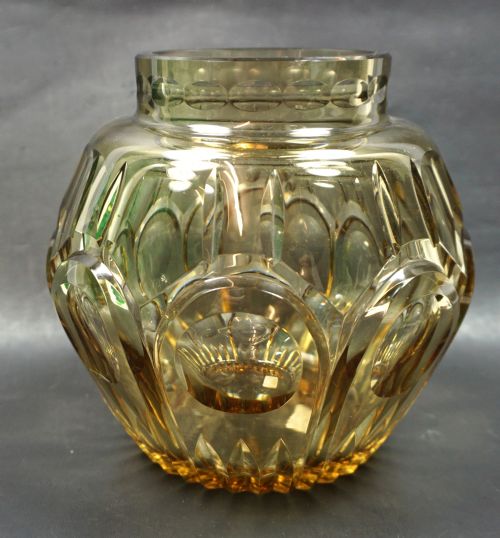
When you search for a vintage amber glass vessel, you enter a diverse field spanning the Georgian, Victorian, and twentieth-century decorative arts. The pieces on this page range from early nineteenth-century English finger bowls and decanters to twentieth-century Bohemian, Venetian, and French studio works.
The most common forms you will meet are vases, decanters, and finger bowls, created in styles that move from Victorian ornamentation through Art Nouveau fluidity to the geometric discipline of Art Deco.
Origins vary widely across Europe and Britain, taking in English glassworks, Belgian houses, Venetian glassmakers, and Czech studios. Each piece reflects the aesthetic priorities of its decade, whether that is heavy cut crystal or delicate cameo carving.
Materials and techniques in amber glass
Makers achieved the distinctive warm hue through the addition of mineral oxides to the molten batch, producing tones from pale straw to deep amber and topaz. This coloured glass was then worked by hand, often utilising techniques such as free-blowing, moulding, or casing.
Surface decoration frequently involved advanced processes like acid-etching, cameo carving through layered glass, and wheel-engraving. Some pieces incorporate contrasting elements, including latticinio glass bands, enamel work, or cut crystal facets that refract the light.
Distinguishing quality in glass vessels
Quality rests in the precision of the execution and the ambition of the design, separating standard production wares from masterworks by renowned houses. The crispness of wheel-cut facets, the depth of cameo layers, and the finesse of free-hand engraving dictate the standing of a piece.
The weight and balance of the vessel, alongside the clarity and purity of the amber metal itself, reveal the skill of the original glasshouse. Attributable works bearing signatures or documented factory characteristics command greater interest among collectors.
Val St. Lambert·Stevens & Williams·Pauly & Co.·Legras·LCT Tiffany·Venini
The Vintage Amber Glass Vessel Glossary
- Cameo glass
- A technique involving at least two distinct layers of coloured glass fused together, where the outer layer is carved or acid-etched away to reveal the contrasting design beneath. This method demands immense skill to maintain even depth across the surface.
- Latticinio glass
- An intricate Venetian technique featuring fine opaque white or coloured glass threads embedded within clear or tinted glass. These threads are typically twisted into delicate net or ribbon patterns.
- Favrile glass
- A term patented by Louis Comfort Tiffany for his iridescent art glass, characterised by a distinctive metallic sheen that reflects multiple colours in the light. The iridescence is achieved by exposing the glass to metallic vapours while hot.
- Finger bowl
- A small, bowl-shaped vessel historically filled with water and placed before diners between courses for rinsing the fingers. They often display deep cutting or unusual colour tints.
- Topaz glass
- A specific shade of transparent yellow-brown glass resembling the gemstone, frequently utilised during the Art Deco period. It provides a lighter, brighter alternative to traditional deep amber.
Vintage Amber Glass Vessel: Frequently Asked Questions
How do I date an amber glass vessel?
Dating relies heavily on stylistic markers, manufacturing techniques, and any visible signatures or acid-etched marks on the base. Art Deco and Art Nouveau pieces display characteristic geometric or organic motifs unique to their respective decades.
Earlier nineteenth-century examples often show distinct pontil marks on the bottom and heavier hand-finished qualities that differ sharply from later twentieth-century studio output.
Are these vessels safe to use daily?
While many of these items were originally created for functional purposes such as serving wine or holding flowers, antique and vintage pieces require careful handling. Hand washing in lukewarm water is essential to preserve surface treatments like enamel or delicate engraving.
Sudden temperature changes can crack old glass, so these vessels are best kept away from dishwashers and hot liquids unless confirmed as robust utility ware.
What is the difference between cameo and cut glass?
Cameo glass relies on chemical etching or carving through layered glass of different colours to create a raised, opaque design against a contrasting background. The effect is pictorial and sculptural.
Cut glass achieves its pattern by grinding geometric facets directly into a single thickness of glass using a wheel. This technique focuses on catching and refracting light through sharp angles.
How should I display my amber glass vessel?
Amber glass responds exceptionally well to natural light, making windowsills or well-lit shelves ideal locations for placement. The sun passing through the tinted material illuminates the warm tones and any internal details like latticinio threads.
Pairing pieces of varying heights and forms, such as placing a slender vase beside a wider bowl, creates a balanced display that highlights different manufacturing techniques.