


Vintage Abbey Landscape Artwork
These vintage abbey landscape artwork pieces capture historic religious ruins and coastal scenes, offering buyers a evocative window into British topography.
Vintage Abbey Landscape Artwork
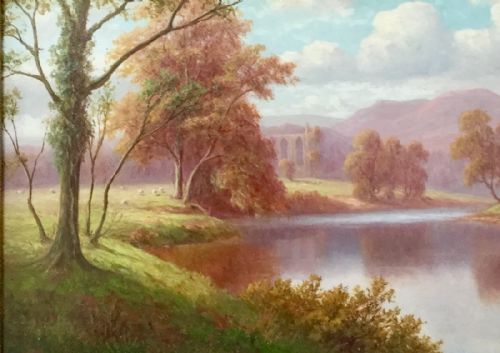
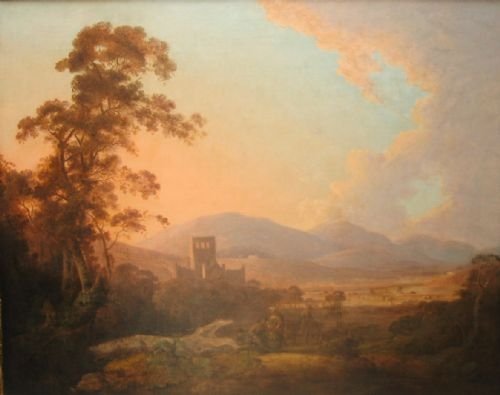
When you search for vintage abbey landscape artwork, you encounter paintings that focus on historic religious sites and coastal harbours, often featuring locations such as Whitby and Bolton Abbey. These works record ecclesiastical ruins alongside surrounding rivers, piers, and cliffs, preserving topographies that fascinated artists for generations.
The pieces on this page span several distinct periods, reaching from the eighteenth century through the Georgian and Edwardian eras into the nineteen-twenties and nineteen-thirties. You will find watercolours on paper and oils on canvas, reflecting the shifts in British landscape painting over two centuries.
Materials and methods
Artists working on these scenes utilised watercolour pigment on paper or oil paint applied to canvas, capturing light and atmosphere through established painterly traditions. Many of these watercolours and oils are preserved behind glass within gilt wood frames that complement the tones of the compositions.
The application of paint varies from the fluid washes characteristic of early twentieth-century watercolours to the heavier impasto found in twentieth-century realism and British impressionist oils.
Listings feature works spanning the eighteenth century, Georgian, and Edwardian periods, executed in oil on canvas and watercolour on paper.
Distinctions in quality
Quality in these landscape paintings rests upon the artist's command of light, composition, and atmospheric perspective rather than the subject matter alone. Works that successfully render the crumbling stonework of an abbey against coastal light or river waters display a superior grasp of tone and proportion.
The handling of secondary details, such as shipping off a pier or figures in a hayfield, distinguishes the more accomplished hand from routine topographical production.
Tom Clough·Fred Waugh·Herbert Royle·Albert Robert Quinton·William Samuel Horton·Harry Wanless·Walter Emsley·Rowland Henry Hill·Donald Wood·Everett Watson Mellor·Julius Caesar Ibbetson
The Vintage Abbey Landscape Artwork Glossary
- Watercolour
- A painting method where fine pigment is mixed with water-soluble binders and applied to paper. This medium allows for luminous washes that create soft skies and translucent water.
- Oil on canvas
- A technique using pigments bound in drying oils applied to stretched canvas cloth. It permits rich colour layering and varied surface textures.
- Gilt wood
- Wood coated with a thin layer of gold leaf or metallic gilt gesso used to finish picture frames. It adds a warm metallic border that enhances the tones within the painting.
- British Impressionism
- A late nineteenth and early twentieth-century painting movement focused on natural light and looser brushwork. Artists working in this style moved away from rigid academic finishes to capture immediate visual impressions.
Vintage Abbey Landscape Artwork: Frequently Asked Questions
What periods do these abbey artworks cover?
The pieces span from the eighteenth century through the Georgian and Edwardian eras into the nineteen-thirties. This range allows collectors to trace how British landscape representation evolved over two hundred years.
Earlier works lean towards romanticism, while later pieces incorporate impressionist and realist tendencies.
How do I care for watercolour paintings?
Watercolours require protection from direct sunlight to prevent the pigments and paper from fading over time. Displaying them away from moisture sources keeps the paper stable.
Glazing with glass helps shield the delicate pigment surface from atmospheric pollutants.
What subjects appear in these landscapes?
The artworks primarily depict historic ecclesiastical ruins such as Whitby Abbey, Bolton Abbey, Tintern Abbey, and Melrose Abbey. Many compositions also include surrounding elements like rivers, coastal piers, and harbour shipping.
These scenes combine architectural history with topographical recording.
Are these paintings framed?
Many examples are presented in period frames, often featuring gilt wood construction that matches the era of the canvas or paper. These frames provide both structural protection and historical context for the artwork.
Some pieces retain their original framing from the time of creation.