



Victorian Wellington Style Chest
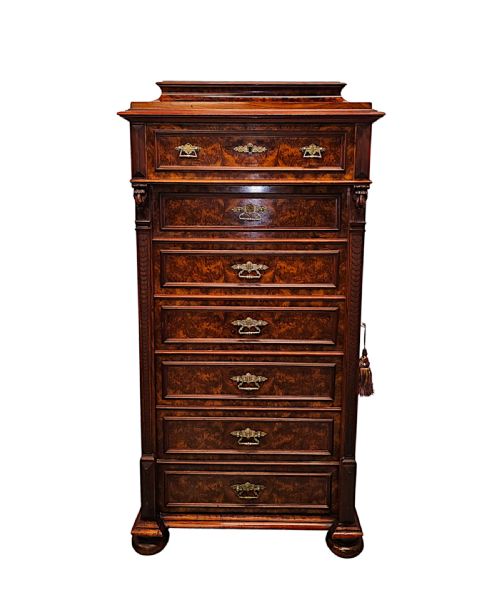
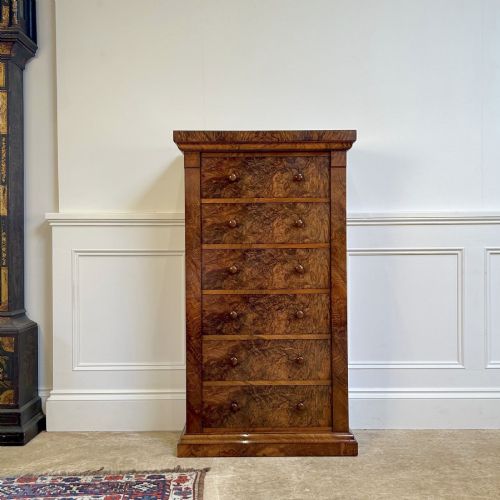
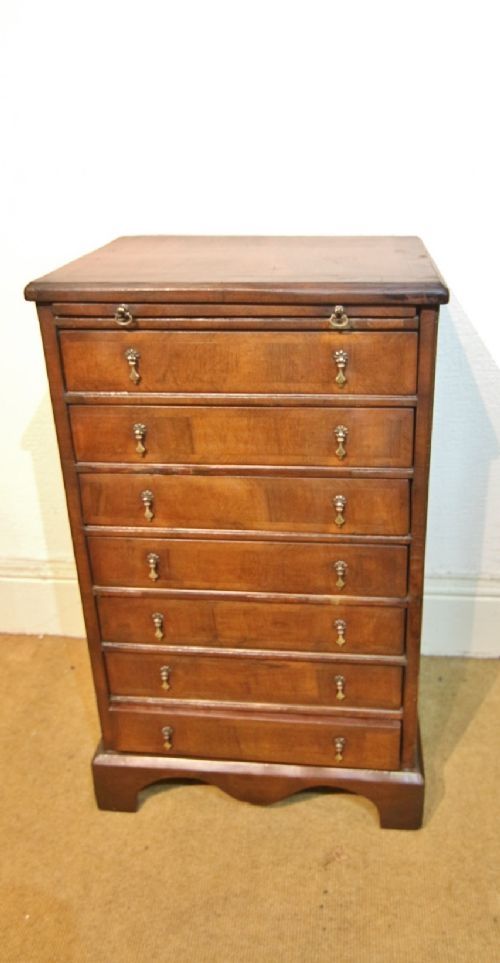
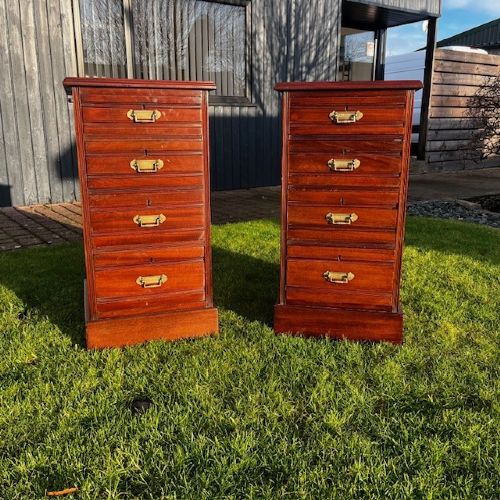
These Victorian wellington style chest pieces offer a tall, narrow profile with a characteristic locking side pilaster, giving you secure storage without taking up much floor space.
Victorian Wellington Style Chest
A victorian wellington style chest is a tall, narrow drawer unit defined by a hinged vertical locking stile on one side that secures all the drawers when locked. You will frequently encounter examples in mahogany and walnut, often dating from the nineteenth century across Victorian and Edwardian periods.
The form adapts easily to various rooms, appearing as standard tall chests or more compact bedside chests and tables. Makers also produced specialised variants like collectors chests and secretaire cabinets to suit specific storage needs.
How they were made
Cabinet makers utilised dense hardwoods such as mahogany and walnut, frequently applying burr walnut veneers or delicate marquetry and satinwood inlay to the exterior surfaces. Brass hardware appears on drawer pulls and the crucial side locking mechanisms.
Construction relies on solid joinery to support the tall, narrow proportions and numerous internal drawers. Glass occasionally integrates into specific cabinet configurations, while specialised pieces incorporate leather inserts.
Victorian Wellington Style Chest Retail Price Guide 2026
Typical asking prices for victorian wellington style chest among the pieces listed under this phrase on Sellingantiques today, from the lower quarter to the upper quarter. They describe what is for sale here now, not the wider market.
Listings for this phrase feature 19th Century and Victorian periods predominantly, alongside Edwardian examples in satinwood.
What varies in quality
Quality rests primarily on the choice of timber and the precision of the veneer work, with figured burr walnut and intricate marquetry marking the upper end of the range. The crispness of the carving on the locking pilaster and the integration of the internal drawer locking mechanism also distinguish finer pieces from simpler utility chests.
The pedigree of the maker elevates certain examples, as workshop attribution to firms like Gillows or Holland & Sons demonstrates superior cabinet-making standards. The balance of the tall proportions and the retention of original brass fittings complete the distinction between standard and exceptional pieces.
Gillows·Holland & Sons
The Victorian Wellington Style Chest Glossary
- Pilaster
- A vertical architectural element applied to the side of the chest that acts as the hinged locking bar. This bar swings away to release the internal drawers.
- Secretaire
- A desk drawer that folds down to reveal a writing surface and small pigeonholes. This feature conceals workspace within the traditional tall chest format.
- Marquetry
- Decorative patterns formed by fitting together contrasting veneers of wood. This technique creates elaborate floral or geometric designs across drawer fronts.
- Burr Walnut
- Wood taken from a walnut tree growth featuring swirling, knotty grain patterns. Cabinet makers prized this figured timber for high-status furniture facades.
Victorian Wellington Style Chest: Frequently Asked Questions
What is a wellington style chest?
A tall, narrow set of drawers featuring a hinged locking side pilaster that secures every drawer at once.
Originating in the nineteenth century, this design maximises storage capacity while occupying minimal floor space in a bedroom or study.
How does the locking mechanism work?
One of the vertical side pilasters is hinged and fitted with a keyhole, which operates a tongue or rebate system engaging the drawer edges.
When the pilaster is locked in place against the drawers, none of them can be pulled open, protecting the contents inside.
Where should I place a bedside chest?
These compact chests fit neatly beside a bed to provide enclosed vertical storage at a convenient height.
Their narrow footprint makes them particularly useful in smaller bedrooms where standard wide bedside tables would crowd the floor.
What woods were used for these chests?
Cabinet makers predominantly used dense hardwoods like mahogany and walnut for both structural integrity and fine appearance.
Many examples feature decorative veneers such as burr walnut or satinwood inlay to highlight the drawer fronts and top surfaces.