
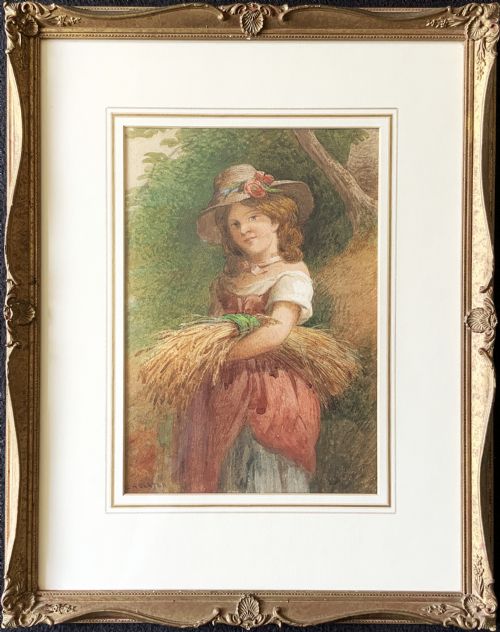


Victorian Watercolour Painting Girl
A victorian watercolour painting girl captures nineteenth-century pastoral innocence with delicate pigment washes and careful draftsmanship.
Victorian Watercolour Painting Girl
A victorian watercolour painting girl represents a distinct genre within nineteenth-century art, depicting subjects from portraiture to rural genre scenes. These works capture young subjects in settings such as pastoral landscapes, domestic interiors, and cottage gardens.
The examples on this page include miniature portrait paintings, framed works on paper, and larger genre compositions by listed artists. Most pieces date across the nineteenth century and the early twentieth century, spanning Victorian and Regency stylistic influences.
How they were made
Artists painted these works using water-soluble pigments applied to paper supports, sometimes finished as sketches or detailed genre paintings. The works rely on the translucent quality of watercolour to build form and light.
Framing materials recorded in the evidence include period ebonised wood, gilt wood, and glass to protect the paper surface. Brass elements appear occasionally in the mounting and hanging hardware of the frames.
Listings span the nineteenth century and 1910, utilising paper, watercolour, glass, gilt wood, ebonised wood, and brass.
What varies in quality
Quality rests upon the skill of the brushwork and the precision in capturing the expression and posture of the young subject. Finer works display accomplished handling of light, shade, and atmospheric perspective in the surrounding landscape.
The integrity of the paper support and the preservation of the original pigment vibrancy distinguish superior examples. Original period framing in ebonised or gilt wood further elevates the presentation of the painting.
Charles Henry Slater·Henry E Hobson·Joseph Kirkpatrick·Robert Kemp·Fred Morgan·James Hughes Clayton·Thomas Mackay·David Hardy
The Victorian Watercolour Painting Girl Glossary
- Watercolour
- A painting method in which the paints are made of pigments suspended in a water-based solution. The paper shows through the translucent washes.
- Genre Art
- A pictorial representation of scenes from everyday life. These paintings depict ordinary people engaged in common pursuits such as tending calves or peeling potatoes.
- Miniature
- A very small painting executed with fine detail. Early nineteenth-century examples often feature compact dimensions and intimate subject matter.
- Ebonised Wood
- Timber stained or treated to resemble ebony. This dark finish appears frequently on Victorian frames housing works on paper.
Victorian Watercolour Painting Girl: Frequently Asked Questions
How do I hang a watercolour painting?
Watercolours are sensitive to bright natural light and benefit from placement away from direct sun. Hanging them on interior walls helps preserve the paper and pigments.
Using stable picture hooks suited to the weight of the ebonised or gilt wood frame ensures secure wall mounting.
Are these paintings original?
The listings comprise original period works executed on paper during the nineteenth and early twentieth centuries. Each piece reflects the hand of an individual artist rather than a modern reproduction.
Signatures, dates, and framing materials correspond to the historical periods documented in the evidence.
What subjects do these paintings show?
The works depict young girls in various settings, ranging from formal studio portraits with hummingbirds to outdoor pastoral scenes. Common rural activities include feeding hens, tending calves, and walking over bridges.
Some compositions combine portraiture with detailed landscape backgrounds characteristic of Victorian genre art.
How are the frames described?
Frames typically consist of period ebonised wood or gilt wood, often glazed with glass to protect the delicate watercolour surface. Some listings specify original framing contemporaneous with the artwork.
Brass fittings and mounts appear in select examples to complete the period presentation.