



Victorian Walnut Caddy
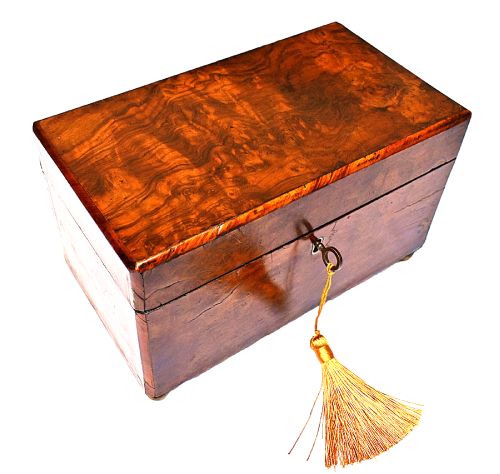
These Victorian walnut caddy pieces are finely grained desktop and tea storage boxes that bring rich nineteenth-century character to any room.
Victorian Walnut Caddy
A victorian walnut caddy is primarily a lidded box designed for storing tea leaves, though the selection also extends to related nineteenth-century forms such as stationery boxes, teapoys, and jewellery boxes. The pieces seen on this page span the Victorian era, utilising rich hardwoods and intricate surface decoration.
Buyers will most frequently encounter rectangular and dome top tea caddies alongside larger stationery cabinets and magazine racks. These objects date from the mid-nineteenth century, capturing a period of domestic refinement and meticulous cabinet making.
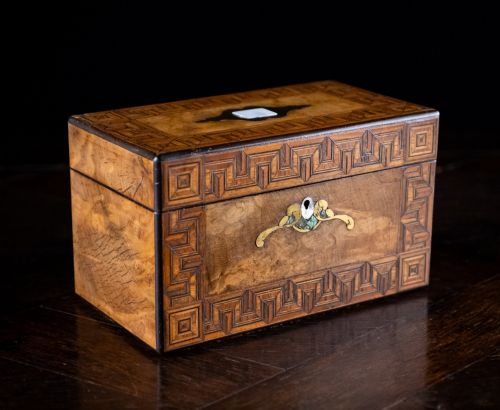
The variety ranges from simple timber boxes to elaborate sarcophagus double tea caddies and items featuring parquetry, marquetry inlay, or Tunbridge ware. Each form reflects the domestic habits of the era, from tea storage to correspondence.
Judgments of quality
Quality rests heavily on the selection of the burr walnut veneer, where tighter, more symmetrical grain patterns distinguish superior examples from plain timber. The crispness of the parquetry and marquetry inlay also marks the hand of a more accomplished workshop.
Construction details such as flush-fitting lids, original brass hardware, and the presence of working keys separate fine cabinet work from standard production pieces. Superior items maintain integrity in their mitred joints and retain their internal compartments.
Victorian Walnut Caddy Retail Price Guide 2026
Typical asking prices for victorian walnut caddy among the pieces listed under this phrase on Sellingantiques today, from the lower quarter to the upper quarter. They describe what is for sale here now, not the wider market.
Listings feature pieces spanning the entire Victorian era, utilising burr walnut, brass, mother of pearl, and marquetry inlay.
Henry Hollamby·Lenzkirch
The Victorian Walnut Caddy Glossary
- Burr walnut
- A timber taken from the growth excrescence of a walnut tree, yielding highly figured and swirling grain patterns. It was extensively used by Victorian cabinet makers for luxury boxes and decorative furniture.
- Teapoy
- A small table fitted with a lidded box on top for holding tea, often standing on a central pillar with tripod legs. These pieces served a central role in nineteenth-century hospitality.
- Tunbridge ware
- A specialised form of woodworking featuring intricate mosaic patterns made from tiny wood blocks of various natural colours. This technique created pictorial or geometric designs on small boxes.
- Sarcophagus
- A box shape featuring a convex sloping lid and an overall form resembling a stone coffin. This architectural style was popular for larger tea caddies during the nineteenth century.
- Parquetry
- A geometric mosaic of wood pieces used for surface decoration on boxes and furniture. It relies on precise cutting to form repeating patterns.
Victorian Walnut Caddy: Frequently Asked Questions
What was a victorian walnut caddy used for?
These boxes served to store and protect expensive loose tea leaves from moisture and loss in the nineteenth-century home.
Locked containers were necessary because tea was a high-value commodity managed strictly by the head of the household.
How do I identify a burr walnut finish?
Burr walnut is instantly recognizable by its dense, swirling grain and characteristic cluster patterns formed by knots in the timber.
Cabinet makers sliced this wood thinly for use as a decorative veneer on the exterior surfaces of high-end boxes.
Are original keys common with these boxes?
Original working keys occasionally accompany nineteenth-century boxes, though many survive today without them due to centuries of domestic use.
Locks were fitted to protect contents rather than for heavy security, often utilising brass escutcheons around the keyhole.
How should I care for nineteenth-century walnut?
Keep wooden boxes out of direct sunlight and away from sudden temperature shifts to prevent the delicate burr veneer from drying out.
Routine dusting with a dry cloth maintains the finish without risking moisture damage to the antique timber.