


Victorian Vanity Fair Lithographs
Victorian vanity fair lithographs capture the notable figures of the era with sharp caricature, offering a witty record of society, politics and sport that remains deeply collectable today.
Victorian Vanity Fair Lithographs
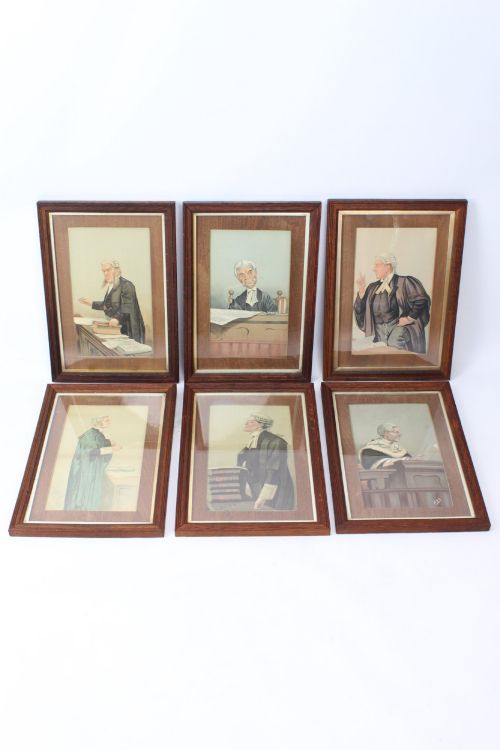
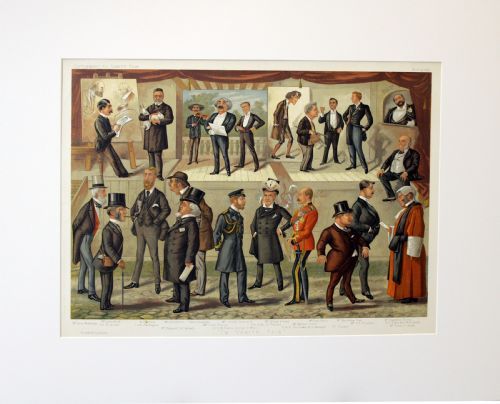
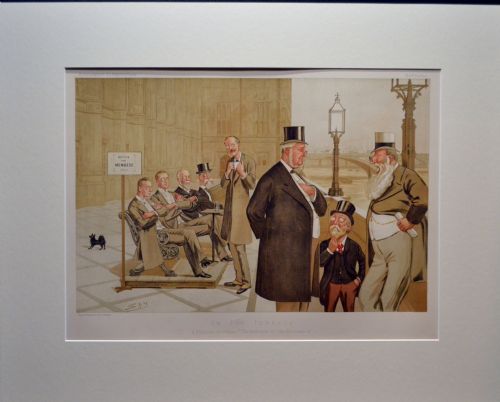
Victorian vanity fair lithographs encompass satirical portraits and group scenes published during the nineteenth and early twentieth centuries. These works include individual character studies alongside expansive double page spreads depicting prominent figures in politics, law, society and sport.
The selections available here range from single framed sheets to substantial sets featuring recurring themes such as politicians of empire, racing scenes and hunting. Buyers encounter both standard single plates and unfolded double page prints originating from the Victorian and Edwardian periods.
Subjects span titled personalities and recognizable public figures associated with specific thematic groupings like royalty, military and parks. The formats vary from loose sheets to framed pieces backed by mount board and card.
How they were made
Production relies on paper supports printed with ink using chromolithography and standard lithographic techniques to achieve varied colour depth and tonal range. Many sheets incorporate ink applications combined with paper media to render the distinctive caricatures.
Framed examples utilise wood, glass and metal alongside mount board to house and protect the fragile paper works. Preservation often involves card backing to maintain structural rigidity for wall display.
Listings span the Victorian, Edwardian and early twentieth century periods, utilising paper, ink, wood and glass.
What varies in quality
Quality depends upon the clarity of the printed ink and the preservation of the paper substrate across the decades. Finer examples retain crisp lines and vibrant tones without fading or significant foxing.
The presentation format also dictates distinction, separating loose unfolded double page sheets from professionally framed pieces housed beneath glass with appropriate mount board.
The Victorian Vanity Fair Lithographs Glossary
- Chromolithograph
- A multicoloured print produced through lithographic stones, allowing rich hues across the image surface. This technique delivers the vivid coloration seen in many double page plates.
- Double page
- A larger format print spanning the centre fold of the original publication, offering a wider composition. These unfolded sheets provide broader visual context than standard single pages.
- Spy
- The pseudonym for Leslie Ward, the most prolific and celebrated caricaturist for the publication. His portraits form the bulk of the character studies found in these collections.
- Mount board
- Heavy paperboard used to frame and separate the print from the glass. Quality framing employs acid free materials to protect the delicate paper underneath.
- Caricature
- A rendered portrait exaggerating physical traits for satirical effect. These illustrations capture the recognizable posture and attire of Victorian public figures.
Victorian Vanity Fair Lithographs: Frequently Asked Questions
What subjects appear in these prints?
The subjects include prominent politicians, royalty, military officers, legal figures and racing personalities of the nineteenth and twentieth centuries.
Many plates group individuals by themes such as empire, hunting and society gatherings, reflecting the preoccupations of the period.
How were these prints originally published?
They appeared originally as weekly inserts within a notable British satirical periodical of the Victorian and Edwardian eras.
Subscribers collected individual plates or bound volumes, leading to the survival of both single sheets and assembled sets today.
Are double page prints different from standard sheets?
Double page prints occupy twice the physical area and often feature group compositions or larger panoramic scenes rather than single portraits.
Unfolded examples preserve the central continuity of the illustration without the original binding crease.
How should I frame and display them?
Protect the paper from direct sunlight to prevent fading of the ink and discoloration of the support over time. Utilise professional framing with glass and mount board to keep the fragile sheet flat and secure.
How do I identify the artist?
Many caricatures bear pseudonyms or small signatures near the lower edge, such as the famous signature associated with Leslie Ward.
Attribution often relies on these distinctive signatures alongside contemporary records documenting the publication dates.