




Victorian Turquoise Set
These victorian turquoise set pieces bring together vibrant blue stones and period metals in rings, bracelets, and matched suites.
Victorian Turquoise Set
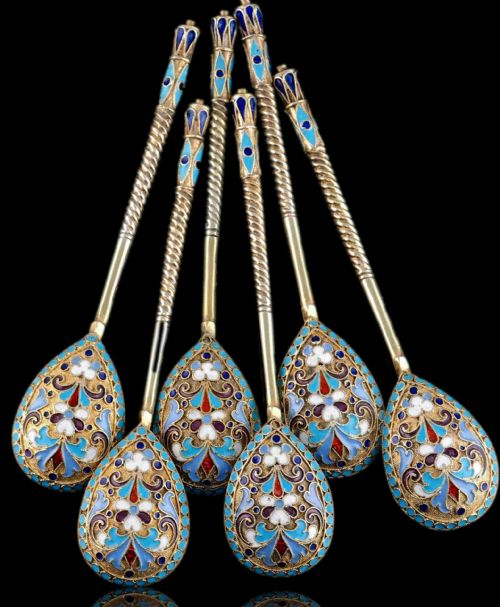
A victorian turquoise set spans matched jewellery suites, multi-piece tableware, and decorative clock groupings from the nineteenth century. These objects include parures combining earrings and pendants, silver spoon sets, and porcelain clock groupings.
The jewellery forms dominate the selection, appearing alongside enamel spoons and glass sets from the Victorian era and adjacent periods. Buyers encounter gold rings, pearl-accrued bracelets, and elaborate parures featuring cabochon blue stones.
The nineteenth-century origin defines the group, drawing on styles from Victorian workshops to Russian cloisonne makers. Each matching set demonstrates the period preference for coordinated decorative elements.
How They Were Made
Craftsmen utilised yellow and rose gold alongside silver, rolling or casting the metal to form intricate scroll settings and link bracelets. Stones were hand-set into mounting bezels alongside pearls and diamonds.
Enamelling techniques such as cloisonne and champeve added colour to silver spoons and clock cases, while porcelain surfaces received hand-painted details and gold leaf application.
Glassmakers blew lattico glass to shape ewers and goblets, pairing them with matching stands to complete table services.
Listings feature gold, silver, porcelain, and enamel across the nineteenth century.
What Varies in Quality
The distinction rests in the purity of the metal and the uniformity of the turquoise stones. Higher-tier examples employ solid 15ct or 18ct gold mounts rather than rolled gold, paired with closely matched natural cabochons.
Execution in subsidiary materials separates standard production from superior work. Finely detailed cloisonne enamel, crisp porcelain moulding, and complete matched sets elevate the standing of an item within the range.
Dmitrii Nikolaevich Nikolaev·Kerr and Binns·KPM Berlin
The Victorian Turquoise Set Glossary
- Parure
- A matched set of jewellery designed to be worn together, typically including earrings, a necklace or pendant, and a brooch or bracelet. Such suites represent coordinated nineteenth-century design.
- Cloisonne
- An enamelwork technique where thin metal wires are soldered to a metal base to form compartments filled with paste and fired. This method creates patterned surfaces on silver spoons and decorative objects.
- Cabochon
- A gemstone shaped and polished with a smooth convex surface rather than faceted. This cut highlights the opaque blue colour characteristic of period turquoise.
- Lattico
- A type of Venetian glass featuring opaque white threads encased in clear glass. It produces a distinctive striped pattern on nineteenth-century ewers and goblets.
- Champeve
- An enamel technique where troughs are carved into a metal surface and filled with enamel before firing. It provides robust decoration for clock sets.
Victorian Turquoise Set: Frequently Asked Questions
What is a parure set?
A parure is a coordinated suite of jewellery designed to be worn together, combining matching elements like earrings, pendants, and brooches.
In this selection, these matched groupings frequently pair turquoise with pearls and high-karat gold.
How do I identify Victorian gold?
Victorian gold items often display hallmarks or specific carat weights such as 15ct or 18ct, alongside rose or yellow metal tones.
Makers of the period utilised these high-purity golds to securely mount softer gemstones like turquoise.
What is cloisonne enamel?
Cloisonne is a decorative technique using thin metal wires soldered to a base to create cells that hold coloured enamel.
This method appears on nineteenth-century Russian silver spoons and tableware included in the range.
Are clock sets complete?
Clock sets from the period typically comprise a central mantel clock accompanied by matching side pieces such as garnitures or candelabra.
These ceramic and enamel groupings were designed to form a unified decorative display on a mantelpiece.