



Victorian Steel Fire Tools
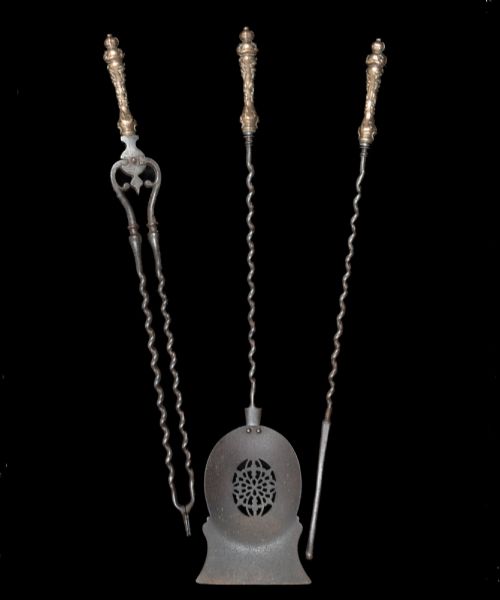
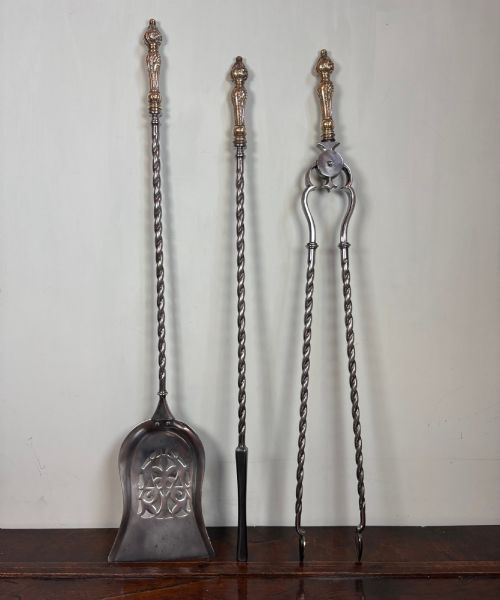
Victorian steel fire tools are robust hearth implements designed for daily service, combining heavy metalwork with practical utility.
Victorian Steel Fire Tools
Victorian steel fire tools comprise sets of hearth implements designed to manage coal and wood fires in nineteenth-century grates. Buyers searching for victorian steel fire tools encounter complete companion sets alongside matched pairs of fire irons and individual pokers, tongs, and shovels.
The pieces on this page originate predominantly from the nineteenth century, including Victorian and earlier Regency periods. Surviving examples range from simple polished steel implements to heavy three-piece companion sets incorporating brass accents and gunmetal.
How they were made
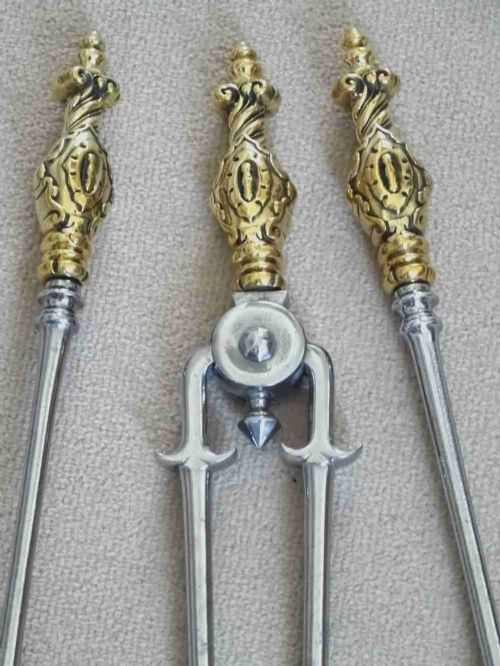
Makers shaped these implements primarily from steel, often pairing the grey metal with bright brass handles, mounts, and finials. Gunmetal and sterling silver also appear on specific handles and accessories, adding textural contrast to the hard iron stems.
Smiths employed forging and turning techniques to create slender shafts and decorative grips, finishing the metal with a high polish or leaving a darkened iron surface. Design styles span from plain utilitarian forms to ornate Arts and Crafts and Neoclassical patterns.
An unusual silver tinder tube survives among the heavy ironmongery, ready to catch a spark from a Victorian pocket.
What varies in quality
Quality rests in the substantial weight of the metal and the integrity of the joins between the handle and the shaft. Finer sets display crisp turning on the brass grips and balanced proportions across all three companion pieces.
Simpler irons show basic forged construction with minimal decoration, while better examples integrate cast brass details or mixed metals such as gunmetal. The survival of a matching stand or fender elevates the coherence of the set.
James Cartland & Sons
The Victorian Steel Fire Tools Glossary
- Companion set
- A group of fireplace tools designed to be displayed together on a matching stand or rack. These typically include a poker, tongs, and a shovel.
- Fire irons
- Individual long-handled metal implements used for tending an open fire. They form the core components of any hearth tool collection.
- Polished steel
- Iron alloy treated to create a bright, reflective surface finish. This treatment was favoured in finer nineteenth-century hearth furnishings.
- Tinder tube
- A small pocket accessory or hearth container used for holding dry material to catch a spark. These cylindrical items are often worked in silver or steel.
Victorian Steel Fire Tools: Frequently Asked Questions
What tools are in a standard set?
A standard set usually comprises a poker for prodding fuel, a pair of tongs for moving logs or coal, and a shovel for clearing ash. These three pieces work together to manage a traditional open hearth.
Many period configurations include a dedicated stand to keep the implements upright beside the fireplace. Some larger groupings also incorporate a hearth brush alongside the core three irons.
How do I clean polished steel?
Polished steel requires dry maintenance to prevent rust from forming on the vulnerable iron surfaces. Gentle dusting with a soft cloth keeps the reflective finish clear without scratching the metal.
Avoid using water or harsh chemical cleaners, which can quickly pit the steel. A light application of microcrystalline wax provides a protective barrier against atmospheric moisture in active rooms.
Are brass and steel mixed?
Makers frequently combined steel shafts with brass handles, finials, and mounts throughout the nineteenth century. This dual-metal approach offered both the structural strength of iron and the decorative warmth of brass.
Completely plain polished steel sets also exist alongside mixed-metal variations. The choice of combination generally reflects the prevailing style of the room and the date of manufacture.
How do I date these tools?
Dating relies on stylistic clues, manufacturing methods, and material choices visible across the handles and shafts. Victorian examples often feature distinct Gothic, Neoclassical, or Arts and Crafts motifs that align with broader design periods.
Heavier forged pieces with simple lines frequently point towards the earlier nineteenth or late Regency eras. Associated stands and matching fenders can also help confirm the period of the ensemble.