


Victorian Starburst Necklace
A victorian starburst necklace captures celestial fascination in precious metal and gemstones.
Victorian Starburst Necklace
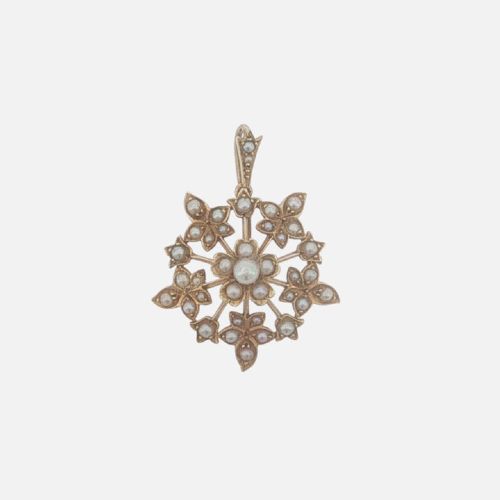
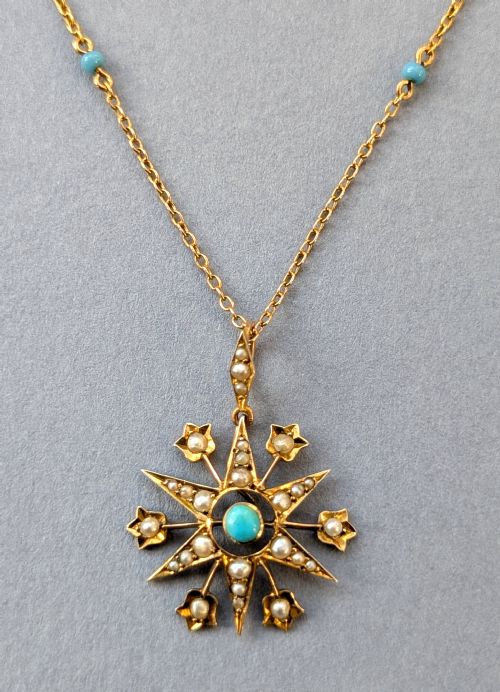
A victorian starburst necklace brings together celestial motifs and fine metalwork from the nineteenth century. These pieces primarily manifest as pendants and pendant brooches that suspend from chains or collars.
The objects frequently combine gold and silver settings with diamonds, seed pearls, and turquoise. Examples span from the Victorian period through to the Edwardian era, incorporating styles such as late Victorian and Edwardian.
Many variants double as brooches, offering dual functionality as neck ornaments and chest pieces. The central motif remains a starburst or celestial star, often accompanied by fringe drops or puffy hearts.
Materials and construction
Craftsmen utilised various purities of gold, including 9ct, 12ct, 15ct, and 18ct yellow gold, frequently pairing gold with silver to mount gemstones securely. Silver settings helped reflect light through old-cut and rose-cut diamonds.
Gemstones such as turquoise, seed pearls, garnets, amethysts, peridots, opals, and rubies were set into intricate star and floral configurations. Hallmarks appear on specific pieces, dating production precisely to years such as 1897.
Current listings feature items from the Victorian and Edwardian periods, utilising gold, silver, diamonds, seed pearls, turquoise, garnets, amethysts, peridots, opals, and rubies.
Distinctions in quality
The standard of materials dictates much of the distinction, particularly the weight and clarity of diamonds paired with substantial gold or silver mountings. Higher quality items demonstrate meticulous stone-setting that secures numerous small gems without obscuring the metalwork.
Design complexity also separates pieces, with multi-tiered starbursts, fringe drops, and convertible pendant-brooch mechanisms demanding greater technical skill from the maker.
The Victorian Starburst Necklace Glossary
- Starburst
- A decorative motif radiating outward from a central stone to mimic a twinkling star. This celestial design dominated late nineteenth-century jewellery.
- Pendant brooch
- An item equipped with both a suspension loop and a pin finding on the reverse. This dual purpose allowed wearers to pin the jewel to clothing or hang it from a chain.
- Seed pearl
- A very small natural or cultured pearl, often drilled and threaded onto fine wire or silk. These pearls frequently encircle central gemstones in Victorian clusters.
- Old-cut diamond
- A hand-faceted diamond shape popular before modern brilliant-cut techniques were standardised. These stones feature smaller tables and larger culets that produce a softer candlelit sparkle.
- Rose-cut diamond
- A gemstone cut with a flat base and a domed crown composed of triangular facets. The silhouette resembles an unopened rosebud.
Victorian Starburst Necklace: Frequently Asked Questions
How do I wear a pendant brooch?
A pendant brooch includes a hidden bail or loop alongside a pin mechanism on the reverse. You can thread a chain through the bail to wear it around the neck, or fasten the pin securely to garments.
Ensure the safety catch functions properly if you choose to wear the piece pinned to heavy fabric. This versatility allows you to adapt the jewellery to different necklines and outfits.
What metals were used?
Makers utilised yellow gold in various carat weights, including 9ct, 12ct, 15ct, and 18ct, alongside silver. Silver was frequently employed on the face of settings to make diamonds appear whiter and brighter.
Gold provided a durable framework for the reverse and chains. Hallmarks sometimes stamped onto the metal help confirm the specific gold purity and date of manufacture.
Are these pieces fragile?
Victorian jewellery requires careful handling due to its age and delicate components like seed pearls and claw-set stones. Avoid exposing seed pearls to water, perfumes, or harsh chemicals that can damage their organic nacre.
Store each necklace flat in a lined box to prevent chains from tangling and delicate rays from bending. Regular gentle cleaning by a specialist preserves the integrity of the silver and gold settings.
How are periods identified?
Periods are identified through a combination of hallmarks, mounting styles, gemstone cuts, and overall construction techniques. Victorian pieces often feature closed-back foils in earlier examples or open-back settings in later decades.
Transitioning into the Edwardian era brings lighter platinum or white gold accents and airy openwork. Comparing these characteristics against documented examples establishes the approximate date.