




Victorian Rosewood Paper Rack
These Victorian rosewood paper racks are handsome pieces designed to keep journals and correspondence tidy upon a desk or beside a chair.
Victorian Rosewood Paper Rack
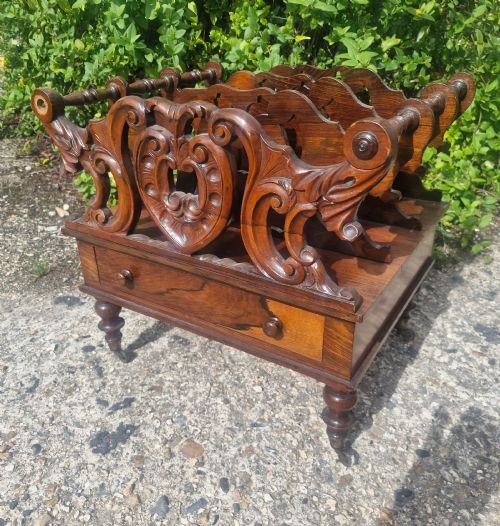
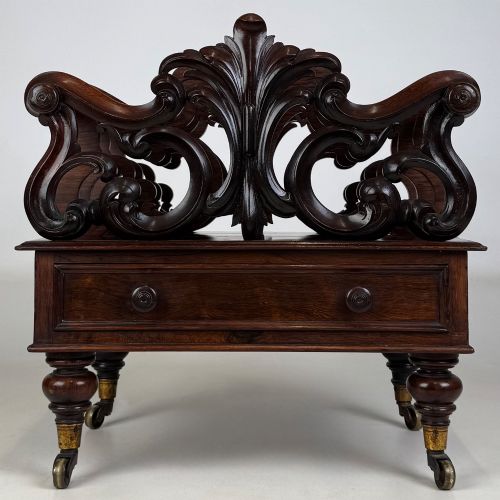
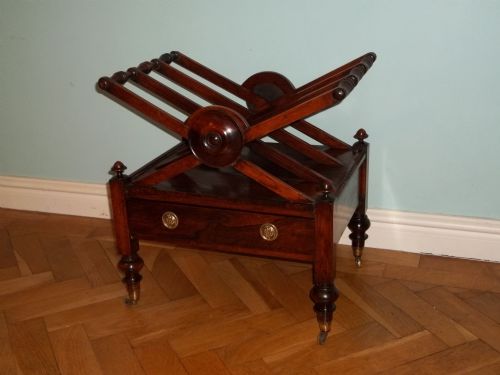
When searching for a Victorian rosewood paper rack, a buyer is primarily examining canterburys and desktop cartonnieres from the nineteenth century. These furnishings typically combine slatted compartments for holding periodicals, newspapers, or sheets of music with lower drawers and sturdy carrying handles.
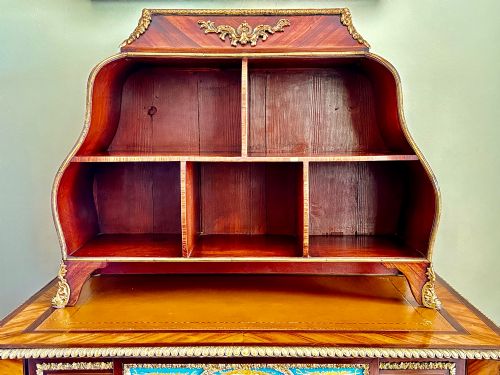
The versions most commonly met on this page belong to the Victorian and Regency periods, frequently executed in rich dark rosewood with turned supports and brass or ceramic castors. Some examples adhere strictly to English cabinet-making traditions, whilst others draw inspiration from French Louis XV revival styles.
Certain pieces span multiple tiers, functioning simultaneously as a small whatnot and a paper tidy, which suited the formal libraries and drawing rooms of the period. The form serves a practical purpose whilst displaying the distinct reddish-brown grain of rosewood timber.
How they were made
Cabinet-makers relied heavily on solid and veneered rosewood, selecting timber for its striking deep grain and figuring. This dense wood took a fine polish, which highlighted the natural contrasts in the material.
Metal mounts in brass and ormolu frequently appeared on these items, providing structural strength at the corners and decorative contrast against the dark timber. Ceramic components and turned wooden spindles formed the upright dividers and handle supports.
Carving was sometimes employed to add detail to the rails and plinths, alongside delicate fretwork panels on French-influenced pieces. Joinery standards remained high, ensuring the slatted divisions could withstand the daily weight of paper and folios.
Materials recorded across these items include rosewood, brass, ormolu, ceramic elements, and various metals.
What varies in quality
The distinction between standard examples and the finest pieces often lies in the crispness of the carving and the presence of decorative metal mounts. Superior items display well-defined foliate carving and heavy ormolu fittings rather than plain brass wire.
Proportion and the handling of the wood grain play a significant role in determining the merit of a piece. Well-balanced turnings on the uprights and symmetrical figure matching across the drawer fronts and panels elevate the overall appearance.
The integration of secondary functions, such as an incorporated drawer or a well-executed two-tier structure, marks out more ambitious workshops. Sound structural integrity in the slatted divisions indicates careful initial construction.
The Victorian Rosewood Paper Rack Glossary
- Canterbury
- A low stand with slatted divisions for holding sheet music, books, or newspapers, often fitted with a drawer below. It originated in the late eighteenth century and remained popular throughout the Victorian era.
- Cartonnier
- A desktop cabinet or stand fitted with compartments or drawers for holding papers, letters, and documents. These pieces were particularly favoured in nineteenth-century studies and libraries.
- Ormolu
- Gilded bronze or brass applied as a decorative mount on furniture. It provides a bright metallic contrast against dark timbers like rosewood.
- Rosewood
- A heavy, dense timber with a deep reddish-brown colour and dark figuring. It was widely used by nineteenth-century cabinet-makers for high-status occasional furniture.
- Whatnot
- An open set of freestanding shelves used for displaying ornaments or holding books and papers. Examples often combine this shelving with a lower canterbury section.
Victorian Rosewood Paper Rack: Frequently Asked Questions
What is a rosewood paper rack?
A rosewood paper rack is a nineteenth-century furnishing designed to hold periodicals, letters, and sheets of music. They typically feature slatted wooden divisions and occasionally include a small drawer.
These pieces were kept in libraries, drawing rooms, and studies to maintain order among daily correspondence and unbound publications.
How do I date a canterbury?
Dating relies on examining the timber, the style of the turnings, and any metal fittings. Pieces from the Regency period often display simpler classical lines, whilst Victorian examples may incorporate heavier carving or revival influences.
Castors, joinery methods, and the specific design lineage also offer clear indications of the decade of manufacture.
Were these used for music?
Many canterburys were constructed specifically to hold portfolios of sheet music near a piano or music stand. The vertical slatted partitions kept large, unbound pages upright and prevent them from bending.
They doubled as general paper tidies for newspapers and letters depending on the room they occupied.
Where should I place one?
These items suit placement beside an armchair, adjacent to a desk, or against a library wall where loose papers accumulate. Their compact footprint allows them to fit easily into smaller sitting areas.
They function well as practical stands for contemporary magazines and journals just as they did in the nineteenth century.