
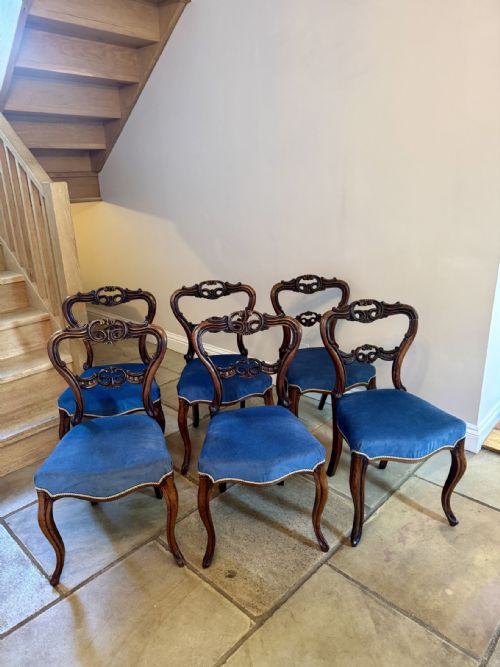

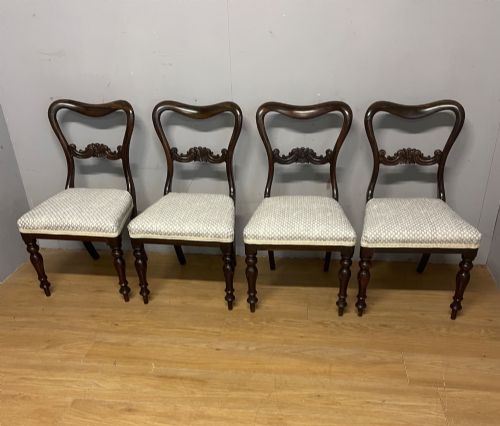
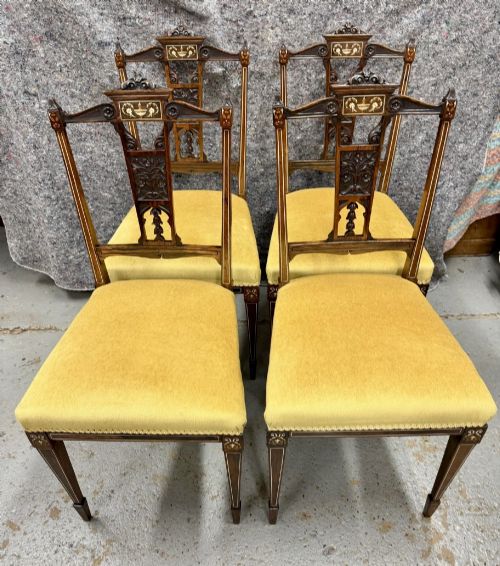


Victorian Rosewood Chairs Set
A victorian rosewood chairs set brings nineteenth-century warmth to a dining room through rich grain and sculptural timber framing.
Victorian Rosewood Chairs Set
When searching for a victorian rosewood chairs set, buyers encounter matched groupings designed for nineteenth-century dining and parlour use. The most common configuration on this page is a set of six dining chairs, though smaller groupings of four and larger sets of eight or ten appear frequently.
The aesthetic bridges several overlapping nineteenth-century movements, spanning strict Victorian classicism, ornate Rococo Revival curves, and occasional Regency or William IV influences. Dining chairs dominate the selection, accompanied occasionally by armchairs and parlour seating.
Originating largely from British workshops of the mid to late nineteenth century, these pieces reflect the era's preference for dark, dense exotic hardwoods in formal reception spaces. Sets often survive intact from the eighteen-fifties and sixties, maintaining their original uniformity through decades of domestic service.
Materials and Construction
Makers built these frames predominantly from solid rosewood, prized for its deep colour and pronounced grain, often reinforced with secondary timbers like mahogany. Selected pieces incorporate contrasting boxwood inlay or marquetry details to accentuate the back splats and rails.
Upholstery traditionally involves textile, velvet, or fabric seat pads, sometimes finished with buttoned backs or needlepoint details such as duck egg blue designs. Frames frequently utilise curved balloon back constructions, steam-bent or carved into flowing organic profiles.
Some nineteenth-century dining chairs feature removable backs, perhaps allowing Victorian guests to adjust their posture after a heavy roast.
Assessing Craftsmanship and Uniformity
The distinction between standard examples and the finest sets lies in the depth of the timber carving and the integrity of the timber selection. Superior sets exhibit crisp, hand-carved detailing along the balloon backs and robust, uncompromised frame joints across every chair in the grouping.
Uniformity across the set governs overall desirability, ensuring that grain patterns, colour matching, and height remain consistent from the first chair to the last. Sets that retain their matching proportions without replacement components command greater consistency for formal dining settings.
The Victorian Rosewood Chairs Set Glossary
- Balloon back
- A chair back shaped in a continuous curved loop resembling an inflated balloon. This ergonomic form became standard for dining seating during the mid nineteenth century.
- Marquetry
- Decorative veneer work forming pictorial or geometric patterns using various woods. Craftsmen applied this technique to the crest rails and splats of finer Victorian seating.
- Boxwood
- A pale, dense wood utilised for contrasting stringing and inlay lines. It stands out sharply against the darker tones of rosewood.
- William IV
- A transitional design period spanning the eighteen-thirties, bridging Regency elegance and early Victorian mass production. Pieces from this era often feature robust scrolling members.
- Needlepoint
- Hand-stitched canvas embroidery traditionally applied to seat covers. These textile pads introduce colour and texture to the timber frames.
Victorian Rosewood Chairs Set: Frequently Asked Questions
How many chairs usually come in a set?
Sets typically comprise four, six, or eight chairs, matching the formal dining requirements of nineteenth-century households. Larger groupings of ten pieces also exist for spacious dining halls.
Buyers should verify whether the count remains complete and uniform, as matching sets of six are standard while larger groupings are less common.
Were these chairs meant for everyday dining?
Nineteenth-century households utilised these rosewood suites primarily for formal dining and entertaining guests. The dense tropical hardwood provided the necessary durability for daily domestic service.
Today, placing them around a modern dining table brings historic character to daily meals while serving their original practical function.
How do I distinguish William IV from Victorian sets?
William IV sets generally date from the eighteen-thirties and display heavier, scroll-carved proportions influenced by late Regency aesthetics. Victorian sets, emerging after eighteen-thirty-seven, lean towards lighter balloon backs and more slender profiles.
Examining the turning on the front legs and the curvature of the top rail helps clarify the chronological shift.
Can I mix different upholstery fabrics?
While historic sets often share uniform fabric, velvet, or needlepoint pads, many owners reupholster seats to suit modern interiors. Selecting a complementary textile maintains the visual harmony across the entire grouping.
Needlepoint and velvet options remain faithful to period aesthetics if historical accuracy is desired.