



Victorian Rose Gold Fob
These Victorian rose gold fobs are pocket watch appendages and pendants that bring rich copper hues to a modern chain.
Victorian Rose Gold Fob
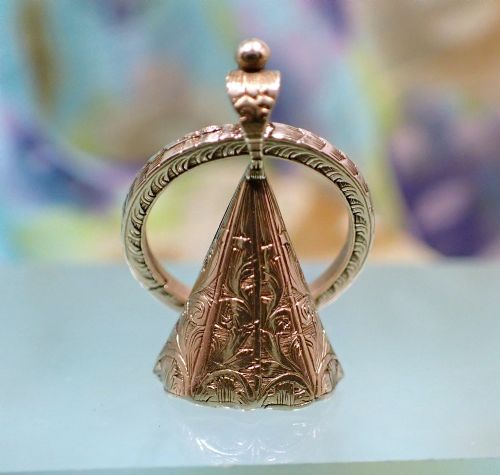
A Victorian rose gold fob is a traditional pendant once attached to a pocket watch chain, now worn as a distinctive charm or necklace pendant. Buyers searching for a Victorian rose gold fob encounter pieces that range from simple swivel seals to elaborate revolving pendants set with hardstones.
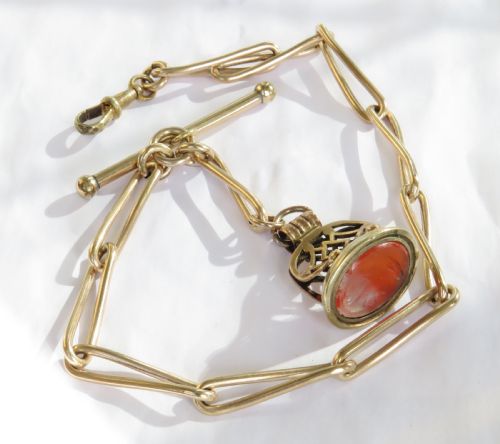
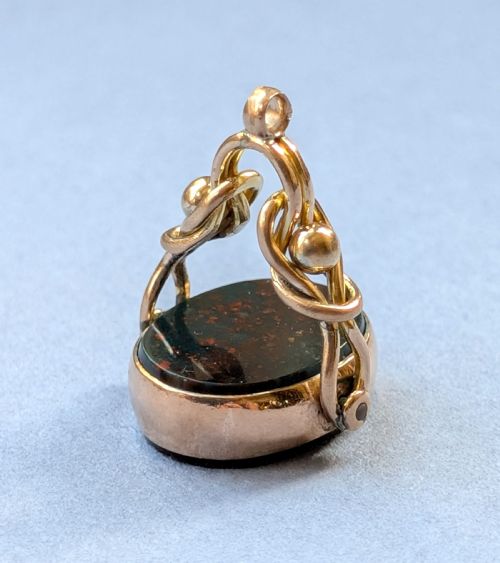
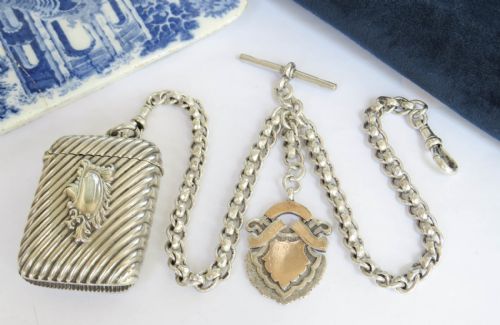
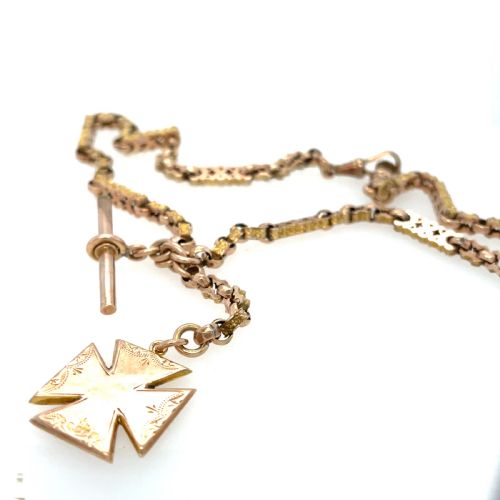
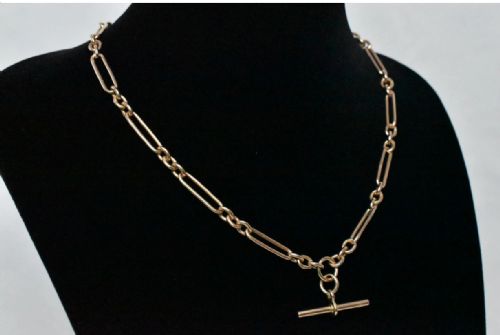
The versions most frequently found on this page include 9ct rose gold Albert chains fitted with T-bars and spinning fob pendants. These items survive from the 19th Century, Edwardian era and 1920s, reflecting the enduring popularity of warm gold tones.
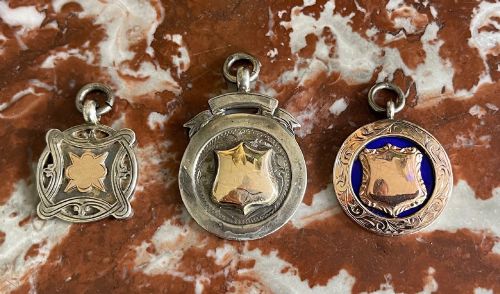
The forms encompass watch fobs, fob seals, photograph lockets and swivel pendants designed to secure pocket watches or decorate waistcoats. Each piece displays the substantial weight and character typical of nineteenth and early twentieth century jewellery.
Making and materials
The physical construction of these pieces relies on solid 9ct rose gold, rolled gold and occasional 15ct gold combined with natural hardstones like bloodstone and carnelian. Goldsmiths shaped the warm-toned metal into hollow or solid links for Albert chains and structured bezels for swivel seals.
Engraving and chasing techniques define the surface detail, particularly on seal matrices and heavy watch chains. Goldsmiths utilised seed pearls and enamel work to add texture and colour contrast to pendant lockets and rotating fob frames.
Materials appearing across these items include bloodstone, carnelian, sardonyx, enamel and seed pearls set into spinning fobs and photograph lockets.
Qualities of execution
The distinction between standard examples and finer pieces lies in the crispness of hand-engraving and the structural integrity of the swivel mechanism. Superior items feature deeply carved armorial or monogrammed seals in flawless bloodstone or sardonyx.
Weight and gauge set the better chains apart, where solid 9ct or 15ct gold links show minimal wear at the pivot points. Finer pieces retain secure jump rings and fully functional rotating axes that hold the stone firmly without wobble.
The Victorian Rose Gold Fob Glossary
- Albert chain
- A heavy watch chain designed to be worn across a waistcoat or attached to a buttonhole, named after Prince Albert. These chains frequently support a T-bar at one end and a swivel fob at the other.
- T-bar
- A short transverse bar of metal attached to the centre of an Albert chain, used to secure the chain through a buttonhole. It remains a hallmark of antique pocket watch jewellery.
- Fob seal
- A small pendant featuring an engraved stone matrix at the base, originally used to press into hot wax for sealing letters. They are often mounted on a swivel frame.
- Rolled gold
- A material formed by fusing a thin sheet of gold to a base metal core under heat and pressure. This technique provided the appearance of solid gold at a lower cost.
- Swivel fob
- A pendant mounted on a central axis that allows the central stone or seal to rotate. This mechanism enables the wearer to display either face of a double-sided stone.
Victorian Rose Gold Fob: Frequently Asked Questions
How do I wear a antique fob today?
These pieces transfer easily onto modern fine chains or charm bracelets using their original jump rings and swivels. The substantial weight of a rose gold pendant makes it suitable for daily wear as a standalone necklace feature.
Heavier Albert chains can be doubled around the wrist as a bracelet or worn across the neck. The secure fastenings built into the antique construction ensure the pendant stays anchored safely.
What is the difference between solid and rolled gold?
Solid gold pieces consist entirely of precious metal throughout their structure, marked by stamps indicating the gold carat. Rolled gold items feature a thick layer of gold mechanically bonded to a base metal core.
Solid gold retains its metal value and resists wear over generations of use. Rolled gold offers the same warm colouration and visual weight while remaining accessible.
How do I identify bloodstone and carnelian?
Bloodstone is a dark green chalcedony flecked with red spots of iron oxide, giving it a distinctive appearance. Carnelian is a translucent orange-red variety of quartz that glows brightly when held to the light.
Both stones were favoured for signet seals because they take a sharp, clean polish and resist scratching from wax seals. Their natural variations mean no two engraved fob centres look identical.
Were these pieces only made in the Victorian era?
While the style originates in the 19th Century, the design continued well into the Edwardian period, the 1920s and the 1930s. Workshops kept producing heavy Albert chains and rotating fobs as pocket watches remained common accessories.
Pieces from the later decades often incorporate subtle design shifts while retaining the traditional rose gold hue. Hallmarks and maker stamps help pinpoint the exact decade of manufacture.