



Victorian Poultry Art
Victorian poultry art captures farmyard life through oil paintings and prints celebrating chickens, cockerels, and rural scenes.
Victorian Poultry Art
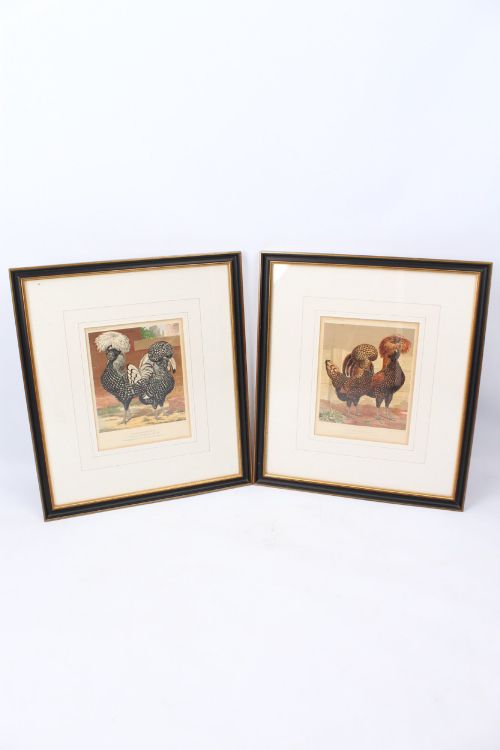
Victorian poultry art encompasses oil paintings, oil on board works, and framed prints focused on farmyard animals, most frequently featuring chickens, cockerels, and chicks. These pieces capture rural domestic scenes from the nineteenth and early twentieth centuries, reflecting a period fascinated by agricultural life and naturalism.
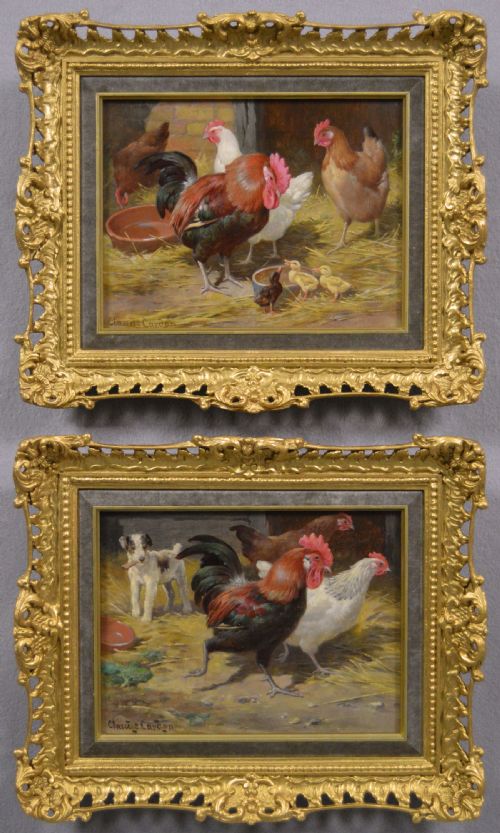
Visitors to this page will most commonly encounter oil paintings on canvas or board depicting detailed groups of hens and cockerels. Works span Victorian Realism, Edwardian Realism, and Victorian Animalier styles, often housed within original giltwood frames.
The objects range from intimate portrayals of single broods to expansive landscape animal oil paintings that include horses, pigs, goats, and cattle alongside the central poultry. Creators document farmyard existence with careful attention to feather texture and natural lighting.
How they were made
Artists painted primarily with oil paint upon prepared canvas or board, building up rich textures to render the plumage of cockerels and hens realistically. This medium allowed painters to achieve subtle gradations of colour and tone across rural backdrops.
Frames play a significant role in the presentation of these works, frequently constructed from wood and embellished with gold leaf to form ornate giltwood borders. These frames were tailored to complement the realism of the canvas within.
Listings feature works spanning from the Victorian era into the Edwardian period, utilising oil paint, canvas, board, and giltwood frames.
What varies in quality
The skill in anatomical rendering and feather detail distinguishes finer works from simpler decorative pieces. Master painters capture the distinct posture and alert expression of a cockerel with precision.
Compositional complexity also marks the range, separating modest studies of a single hen from expansive farmyard scenes integrating multiple animal species and detailed landscapes.
Edgar Hunt·Claude Cardon·Percival Glenfern·John Frederick Herring Jnr·J L VAN Leemputten
The Victorian Poultry Art Glossary
- Oil on Canvas
- Pigment mixed with drying oil applied to stretched woven fabric. This serves as the primary support for many nineteenth-century paintings.
- Giltwood
- Wood carved and coated with a thin layer of gold leaf or metallic powder. It provides the ornate framing typical of the period.
- Victorian Animalier
- An artistic style focusing on the realistic portrayal of animals. Artists working in this manner studied anatomy closely to depict farm creatures accurately.
- Oil on Board
- Pigment applied directly to a rigid wooden panel or stiff board rather than fabric. This method offers a solid surface favoured by certain painters.
Victorian Poultry Art: Frequently Asked Questions
What is victorian poultry art?
Victorian poultry art consists of paintings and prints depicting farmyard birds like chickens, cockerels, and chicks within rural settings.
These works reflect nineteenth-century naturalism and the artistic appreciation for agricultural life.
Who painted these farmyard scenes?
Works were produced by specialised animal and landscape painters of the nineteenth and early twentieth centuries.
Prominent artists focused heavily on the realistic textures of feathers and domestic animal behaviour.
How do I display these paintings?
These pieces suit traditional or rustic interiors, often hung as central focal points in living spaces or kitchens.
Their original giltwood frames complement classic decor and traditional wall treatments.
Are these works painted on canvas?
Many examples utilise oil paint on stretched canvas, while others are executed on wooden boards or presented as framed prints.
Support materials vary depending on the specific scale and period of the artwork.