


Victorian Porcelain Spill Vase
These Victorian porcelain spill vases are upright holders for taper candles or matches, offering a charming touch of nineteenth-century domestic life.
Victorian Porcelain Spill Vase
When you search for victorian porcelain spill vase, you encounter a focused selection of nineteenth-century vessels designed to hold wooden tapers for lighting fires, pipes, and lamps. These useful household items took various forms, including single cylinders, triple-lobed vessels, and sculptural figure groups.
The pieces appearing on this page span the Victorian era alongside related nineteenth-century ceramic traditions. Alongside standard porcelain, you find Staffordshire earthenware and Japanese Imari imports reflecting the period's diverse aesthetic tastes.
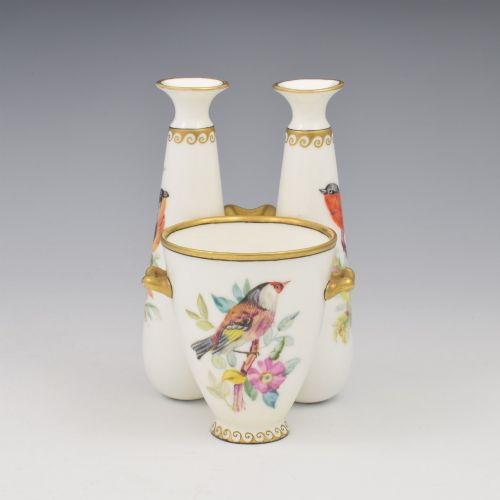
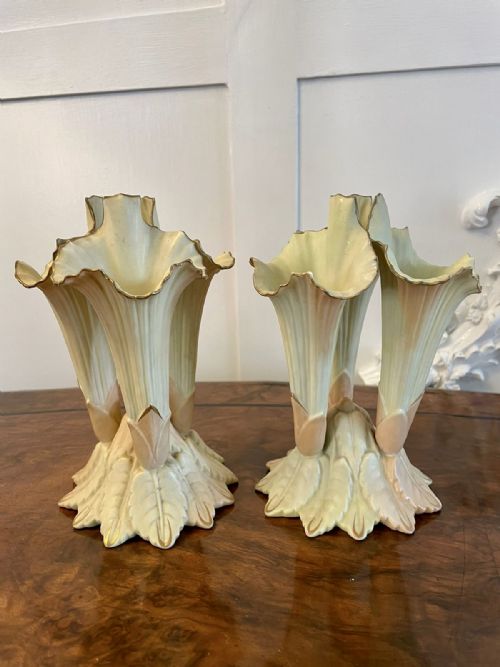
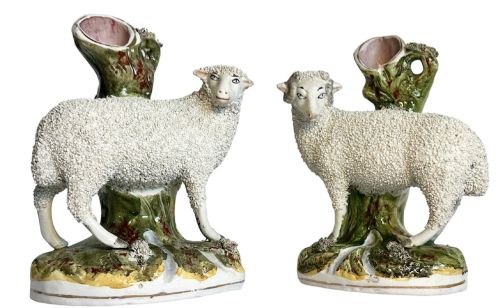
Makers and subjects vary widely, from Royal Worcester ornithological studies and blush ivory wares to Staffordshire sheep, deer, swans, and figural groups like Scots harvesters. Many function purely as decorative ornaments while retaining their central cylindrical aperture.
How they were made
Potters utilised porcelain, earthenware, and bisque ceramic bodies shaped through moulding or throwing. These substrates received detailed hand-painting in enamels and underglaze colours before firing.
Surface enrichment frequently involved gold leaf, intricate gilding, and glossy transparent glazes to catch the light. Some items combined plain lead glazes with vibrant enamel decoration to highlight birds, foliage, and figures.
Staffordshire potters routinely populated nineteenth-century hearths with cheerful flocks of ceramic sheep guarding empty candle tubes.
What varies in quality
Application of gilding and the smoothness of the glaze also divide everyday wares from exceptional cabinet pieces. Well-preserved gold leaf and uniform enamel coverage reflect greater care during manufacture.
John Hopewell·Locke And Co·Royal Worcester·Royal Crown Derby·Vion Et Baury
The Victorian Porcelain Spill Vase Glossary
- Spill vase
- A small upright vessel designed to hold taper spills for transferring a flame. They sat on mantelpieces near hearths for convenience.
- Bisque porcelain
- Unglazed white porcelain fired to a matte finish. It possesses a tactile, marble-like texture favoured for detailed figurative modelling.
- Blush ivory
- A softly shaded cream and pink porcelain ground popularised by late nineteenth-century makers. It mimics the warm tone of natural ivory.
- Staffordshire flatback
- A ceramic figure modelled fully in the round at the front with a flattened, unpainted reverse intended to face a wall.
Victorian Porcelain Spill Vase: Frequently Asked Questions
What is a spill vase used for?
These vessels held slender rolled paper or wooden spills used to transfer flames from a fireplace to candles or lamps.
Over time, they evolved into purely decorative mantelpiece ornaments while maintaining their characteristic vertical tube form.
How do I date a Victorian spill vase?
Dating relies on maker marks, ceramic bodies, and stylistic clues such as rococo revival scrolls or aesthetic movement motifs.
Pottery bodies shifted from creamier earthenwares to finer porcelains as manufacturing techniques progressed through the nineteenth century.
Are Staffordshire spill vases made of porcelain?
Traditional Staffordshire examples utilise earthenware rather than true porcelain, often featuring heavy press-moulded construction and vibrant hand-painted enamels.
Many bear flat backs because makers intended them to stand closely against cottage mantelpiece walls.
How should I clean antique porcelain?
Gentle dusting with a soft brush removes everyday particles without risking fragile gilt surfaces or enamel decoration.
Avoid submerging pieces with old repairs or unglazed bisque bodies in water to prevent permanent staining.