


Victorian Needlework Sampler
These nineteenth-century textile works record alphabets, religious figures, and family names stitched by young hands.
Victorian Needlework Sampler
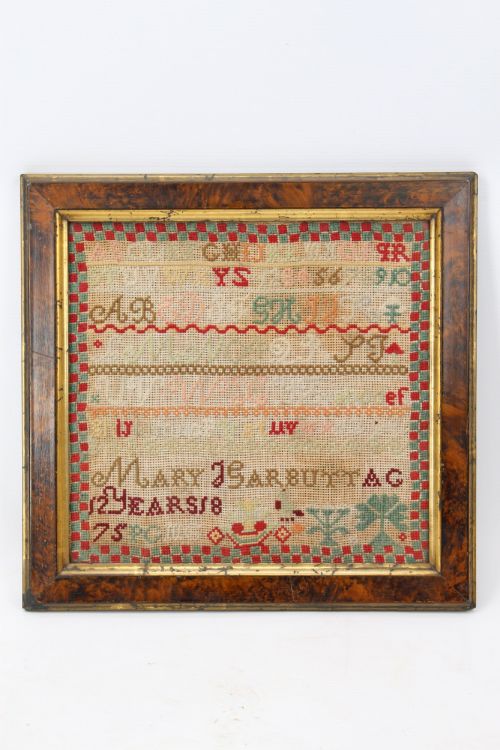
A victorian needlework sampler shows painstaking hand-stitching produced by girls and young women during the nineteenth century, often recording the maker's age alongside dates and verses. Many examples on this page date from the mid-nineteenth century, displaying structured rows of alphabets, numerals, and pictorial motifs.
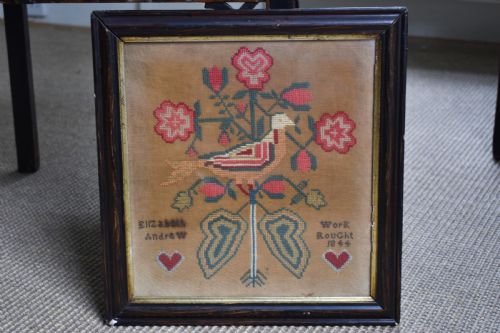
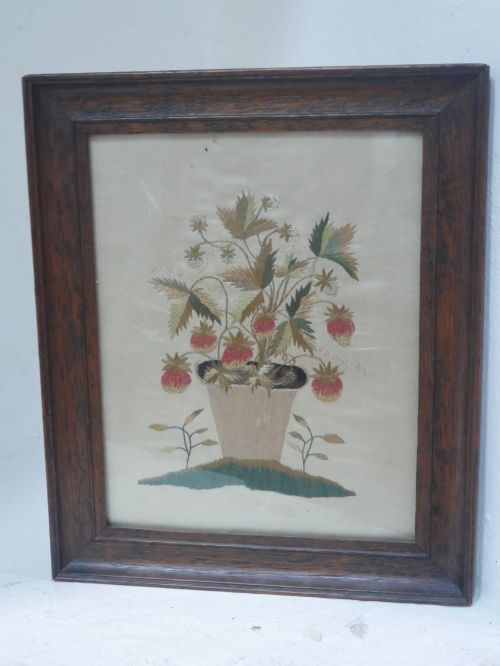
Beyond standard alphabets, the selection includes pictorial panels featuring religious iconography, botanical studies, and charming domestic scenes such as houses and animals. These works usually survive beneath glass within original wood or rosewood frames, preserving the delicate textiles from dust and handling.
Materials and construction
Makers worked primarily with linen and canvas grounds, employing silk and wool threads to build up dense, colourful compositions. These materials formed sturdy bases for counted-thread embroidery, allowing precise execution of various stitches.
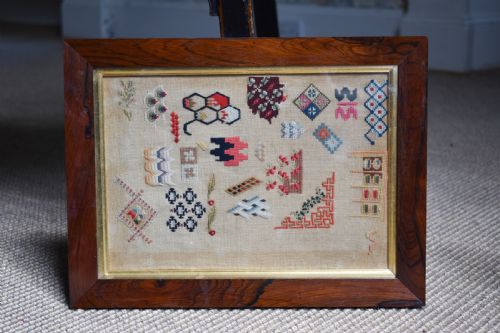
Makers utilised gros point and petit point techniques alongside traditional cross-stitch to create texture and detail within the embroidered pictures. Finished panels were subsequently mounted into timber surrounds, frequently utilising rosewood frames to complement the rich hues of the wool and silk work.
Listings feature linen, canvas, wool, silk thread, and rosewood frames across nineteenth-century Victorian periods.
Evaluating quality
Quality rests upon the precision of the stitching and the clarity of the design, where even tension and deliberate colour choices elevate a piece above simpler schoolroom exercises. The inclusion of named makers, precise dates, and youthful ages adds distinct historical interest to individual pieces.
The survival of the original frame, particularly rosewood variants, and the preservation of the textile beneath glass significantly influence the appeal of these works. Condition depends on the stability of the silk and wool threads and the absence of heavy fading or fibre loss across the linen ground.
The Victorian Needlework Sampler Glossary
- Sampler
- A piece of embroidered needlework demonstrating a maker's proficiency in various stitches, alphabets, and decorative motifs. These exercises were traditionally worked by young girls to prove their skill.
- Gros point
- A counted-thread embroidery stitch worked on canvas, larger and coarser than petit point. It creates a durable, textured surface often seen in nineteenth-century pictorial panels.
- Petit point
- A fine tent stitch worked on single-thread canvas allowing intricate detail and shading. It frequently appears alongside gros point in nineteenth-century needlework pictures.
- Alphabet sampler
- A specific type of needlework focusing on rows of letters and numerals. These taught literacy alongside technical stitching competence.
Victorian Needlework Sampler: Frequently Asked Questions
How old are these samplers?
Most examples date from the nineteenth century, specifically spanning the Victorian era with several pieces carrying explicit dates from the eighteen-forties and fifties.
Specific dates and makers' ages are frequently embroidered directly onto the canvas, providing a clear record of when the work was completed.
Were adults or children making these?
The recorded ages on the pieces indicate that young girls, often aged between eleven and thirteen, stitched many of these works as part of their education.
Schoolmistresses supervised these exercises to teach both needle skills and literacy through the inclusion of alphabets and pious verses.
How should I display a textile sampler?
These works require placement away from direct sunlight to prevent the silk and wool threads from fading against the linen ground.
Most pieces arrive framed under glass, which protects the fragile historical textiles from dust and atmospheric moisture in the home.
What frames come with these pieces?
Surviving examples frequently retain their period surrounds, including dark wood and polished rosewood frames appropriate to the nineteenth century.
These original housings complement the embroidered panels and contribute to the historical integrity of the framed textile art.