

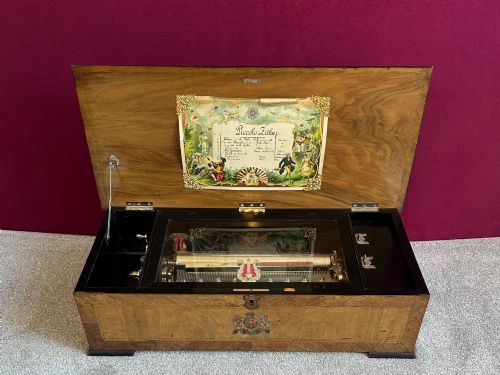


Victorian Musical Chest
These Victorian musical chest selections bring mechanical sound into the home through cylinders, steel combs, and bells.
Victorian Musical Chest
When you search for a victorian musical chest, you are looking at nineteenth-century mechanical music boxes housed in decorative wooden cases. These instruments utilise pinned metal cylinders to pluck tuned steel teeth, creating automated tunes that entertained nineteenth-century parlours.
The versions you are most likely to meet on this page date from the Victorian era around eighteen sixty to eighteen eighty. They appear primarily as rosewood, walnut, or ebonised wood boxes, frequently featuring marquetry or inlaid fruitwood details on the lid.
Some examples incorporate visible bells or multiple musical airs to expand their acoustic range. They survive as functional instruments that connect modern rooms to nineteenth-century domestic entertainment.
How they were made
Cabinet makers built the housing using dense hardwoods like rosewood and walnut, often applying burr walnut veneers or inlaid fruitwood. Internal mechanisms required precision engineering, mounting steel combs and pinned brass cylinders to metal baseplates.
Specialist workshops assembled the musical movements alongside glass dust covers to protect the delicate pins and teeth. Brass components and exterior brass handles finished the construction, balancing structural weight with acoustic resonance.
Victorian Musical Chest Retail Price Guide 2026
Typical asking prices for victorian musical chest among the pieces listed under this phrase on Sellingantiques today, from the lower quarter to the upper quarter. They describe what is for sale here now, not the wider market.
Some nineteenth-century listeners preferred their tunes accompanied by tiny moving mechanical butterflies fluttering inside the lid.
What varies in quality
Quality rests in the complexity of the musical movement and the crispness of the arrangement. Boxes with a greater number of airs or supplementary bells demand higher precision from the maker and deliver a richer sound.
Cabinet work distinguishes finer pieces through meticulous marquetry and well-figured burr walnut or rosewood veneers. The condition of the internal brass cylinder and the tuning of the steel comb determine the musical fidelity of each surviving instrument.
Nicole Freres
The Victorian Musical Chest Glossary
- Air
- A distinct musical tune or melody played by the pinned cylinder. Most standard boxes play a sequence of six, eight, or twelve separate airs.
- Comb
- The tuned steel plate with vibrating teeth that produce the notes when struck by cylinder pins. Each tooth is individually tuned to a specific pitch.
- Cylinder
- The rotating brass barrel set with tiny pins that dictate the rhythm and melody. As it turns, the pins lift the comb teeth to sound the notes.
- Marquetry
- Decorative veneer work using contrasting pieces of wood, such as fruitwood, to form pictorial designs on the box lid. It demonstrates the decorative skill of the cabinet maker.
- Bells
- Tuned acoustic bells mounted within the movement alongside the comb. Strikers hit these bells during playback to add a distinct harmonic chime to the music.
Victorian Musical Chest: Frequently Asked Questions
How do I wind the box?
Most mechanisms use a built-in crank or winding lever attached to the side or underside of the movement. Turning this key tensions the internal spring barrel that powers the cylinder.
Care should be taken not to overwind the spring mechanism, stopping as soon as resistance is felt to protect the historical components.
How many tunes do they play?
The musical repertoire is pinned onto the brass cylinder, typically ranging from six to twelve distinct airs. A small indicator lever lets the listener select a specific tune or allow the cylinder to cycle through the programme.
Each air repeats as the cylinder shifts laterally on its axis during rotation.
Where should I place it?
These wooden cases require stable domestic environments away from direct heat sources and dampness. Placing the box on a solid piece of furniture helps project the acoustic sound through the wooden case.
Glass dust covers should remain in place during playback to protect the delicate comb and cylinder from environmental dust.
Are the bells original?
Many Victorian boxes incorporated matching bells struck by little hammers to enhance the musical arrangement. You can inspect the interior layout to see if the bell strikers align correctly with the pinned cylinder.
Presence of visible bells often indicates a more elaborate specification from the period workshop.