


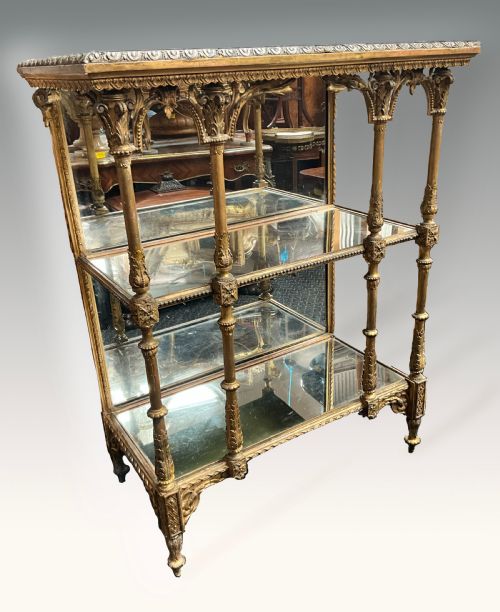


Victorian Mirrored Etagere
These Victorian mirrored etagere selections bring tiered display and reflected light into a room, offering the open shelving collectors seek.
Victorian Mirrored Etagere
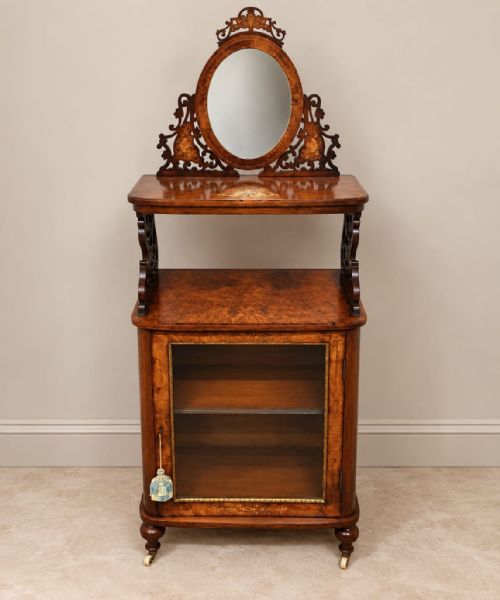
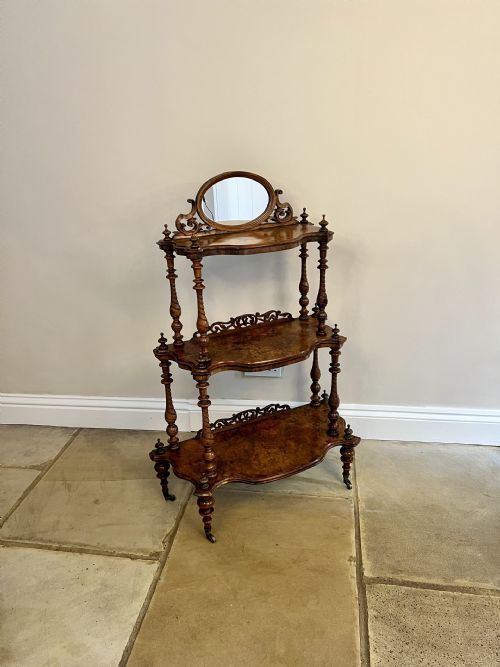
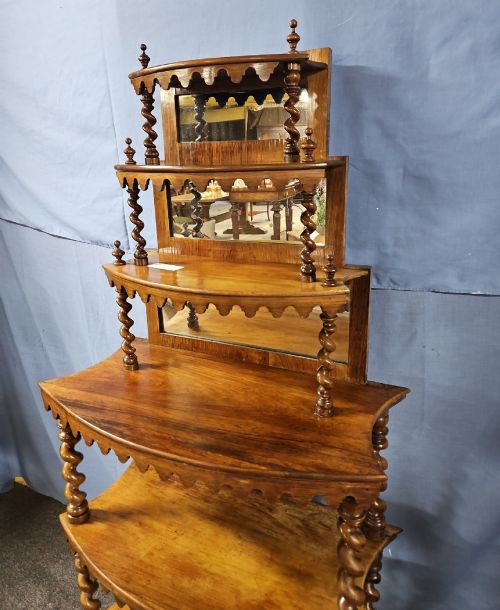
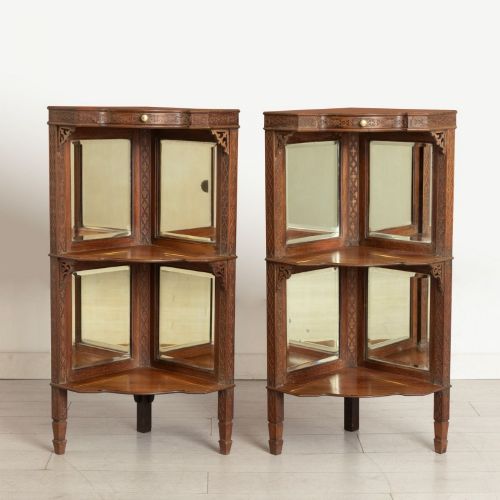
A victorian mirrored etagere combines multi-tiered open or enclosed shelving with integrated mirror glass, originating across the nineteenth century from eighteen-sixty to nineteen-hundred. Buyers encounter forms ranging from wall-hung shelves and corner display cabinets to freestanding three-tier, six-tier, and four-tier pieces featuring integrated mirrors and drawers.
The objects frequently overlap with whatnots and side cabinets within the Victorian, Aesthetic, Gothic Revival, and Louis XVI Revival styles. These pieces served primarily to display ornaments and decorative objects while using glass panels to brighten interior spaces.
Materials and construction methods
Cabinet makers utilised dense hardwoods including rosewood, mahogany, walnut, and burr walnut, alongside decorative veneers and marquetry inlay. Structural elements incorporate turned columns, barley twist supports, and carved details in oak, gilt wood, and gesso.
Mirrored glass components and brass hardware complete the construction, joined by specialised workshops such as Edwards & Roberts. Pieces display intricate grain patterns through burr walnut veneers and marquetry work embedded into the woodwork.
Listings feature walnut, rosewood, and mahogany across Victorian, Aesthetic, and Edwardian periods.
Assessing quality in execution
Quality separates through the choice of timber veneer and the precision of marquetry inlay, where burr walnut and figured rosewood command attention. Finer examples exhibit crisp carving on solid structural members, elaborate turning such as hollow barley twists, and substantial gilt wood or gesso enrichment.
Edwards & Roberts
The Victorian Mirrored Etagere Glossary
- Etagere
- A piece of furniture consisting of a set of open shelves for displaying small objects or ornaments. These tiers allow items to be viewed from multiple angles.
- Whatnot
- A multi-tiered piece of freestanding furniture used for the storage and display of bric-a-brac. The form evolved during the nineteenth century into elaborate display stands.
- Marquetry
- Decorative veneer applied to furniture in patterns using different coloured woods, metals, or other materials. This technique creates pictorial or geometric surface designs.
- Burr walnut
- Wood taken from a walnut tree growth featuring swirling, highly figured grain patterns. Cabinet makers prized this material for high-end decorative surfaces.
- Gesso
- A plaster-like mixture applied to wood surfaces as a base for gilding or painting. It allows intricate relief ornamentation on frames and display shelves.
Victorian Mirrored Etagere: Frequently Asked Questions
What is a victorian mirrored etagere?
A victorian mirrored etagere is a multi-tiered shelving unit featuring glass mirrors, designed for displaying ornaments during the nineteenth century. These pieces combine open shelves with reflective backing to showcase collections.
They appear in various forms including corner cabinets, wall shelves, and freestanding multi-tier whatnots. The inclusion of mirror glass separates them from standard display shelving by introducing light and depth to the furniture.
How were these etageres used originally?
Original nineteenth-century interiors utilised these tiered shelves to display porcelain, silver, and decorative objects. The open tiers kept small decorative items organised and visible.
Mirrored sections reflected candlelight or gaslight, brightening darker Victorian parlours and drawing rooms. Lower drawers provided additional concealed storage for smaller personal items.
Where should I place an etagere?
These pieces suit corners, blank walls, or spaces requiring vertical display height without heavy enclosed bulk. Corner variants fit unused angles while wall-hung versions utilise vertical wall space.
Freestanding etageres work well against living room walls where reflected light enhances the surrounding room decor. Their open structure prevents them from blocking natural light flow.
How do I date these furniture pieces?
Dating relies on stylistic markers such as Aesthetic Movement bamboo forms, heavily carved Gothic Revival motifs, or burr walnut veneers typical of eighteen-sixty to eighteen-eighty. Construction techniques and wood choices also indicate specific periods.
Nineteenth-century examples often display distinct revival styles, from Louis XVI to Victorian, alongside maker signatures or registry marks when present.