





Victorian Mechanical Box
These clever Victorian mechanical box examples bring together ingenious engineering and craftsmanship, offering moving parts and musical movements that fascinate collectors today.

Victorian Mechanical Box
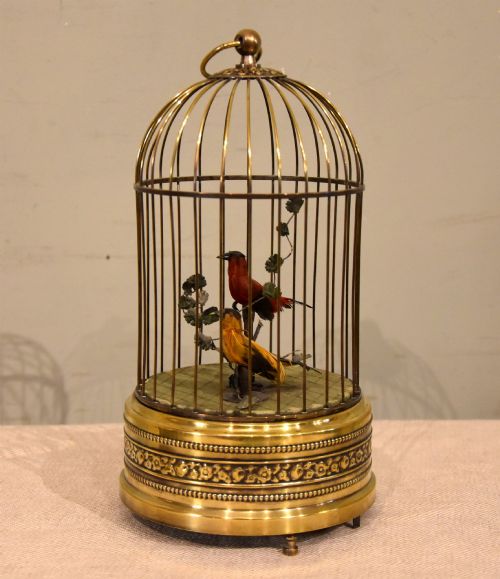
When you search for a victorian mechanical box, you encounter items designed to entertain, measure, or secure through clever internal mechanisms. The selection on this page leans heavily towards musical boxes, alongside automated figures, singing bird cages, and cash registers.
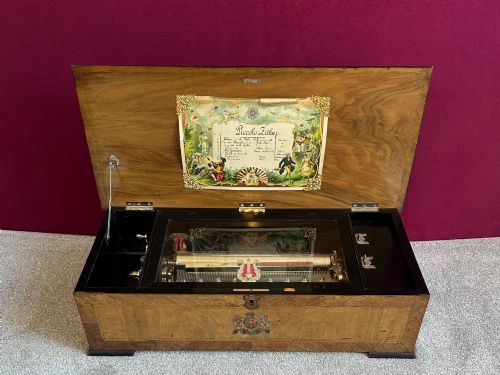
Most pieces date from the nineteenth century, with Swiss cylinder boxes and disc players appearing frequently alongside English shop tills and mechanical banks. These objects combine everyday utility or parlour entertainment with complex metalwork that still functions after more than a century.
Materials and Construction
Cases utilise dense timbers such as walnut, rosewood, and mahogany, often enhanced with marquetry inlay, ebonised details, or burr walnut veneers. These wooden housings protect the intricate inner assemblies.
Internal components combine brass, steel, and glass, relying on pinned cylinders, tuned steel combs, spring-driven motors, and cast iron structures. Complex mechanisms require precise alignment between the gear trains and the striking or sounding elements.
Victorian Mechanical Box Retail Price Guide 2026
Typical asking prices for victorian mechanical box among the pieces listed under this phrase on Sellingantiques today, from the lower quarter to the upper quarter. They describe what is for sale here now, not the wider market.
A cast iron football bank makes saving money a spectator sport.
Judging Quality
Quality rests upon the complexity of the mechanism and the fidelity of its output, whether that involves the tonal clarity of multiple air musical movements or the intricate choreography of automata. Maker attribution and the crisp execution of cast iron or brass elements elevate certain examples above standard production.
The integrity of the housing matches the complexity within, where fine marquetry, matched veneers, and original glass components indicate a higher tier of manufacture. Well-preserved signatures on movements or dials point to workshops of note.
Negretti & Zambra·G H Gledhill Halifax·Langdorff & Fils·Lochmanns·John Harper Co·B A Bremond·Nicole Freres
The Victorian Mechanical Box Glossary
- Cylinder
- A brass barrel set with pins that pluck the teeth of a tuned steel comb to play a specific tune on a music box.
- Airs
- The distinct musical tunes or tracks programmed onto a cylinder or disc within a mechanical musical box.
- Comb
- A tuned piece of steel with multiple teeth that vibrate to produce notes when struck by cylinder pins or rotated discs.
- Automaton
- A mechanical figure or device designed to perform a sequence of movements automatically through cams and levers.
- Marquetry
- Decorative woodwork where small pieces of veneer are fitted together to form pictorial patterns on box lids.
Victorian Mechanical Box: Frequently Asked Questions
How do cylinder music boxes work?
A wound spring turns a pinned brass cylinder, causing the projecting pins to pluck specific teeth on a tuned steel comb. This arrangement plays a set sequence of musical tunes known as airs.
Changing the tune involves shifting the cylinder laterally so that a different set of pins engages with the comb teeth.
What is the difference between a cylinder and a disc box?
Cylinder boxes use a pinned barrel that plays a fixed number of predetermined tunes, usually between six and twelve. Disc boxes utilise interchangeable metal discs to play a wider variety of music.
Disc players became popular later in the nineteenth century as a more versatile alternative to pinned cylinders.
How should I care for a mechanical box?
Keep these items away from direct sunlight, excessive heat, and damp environments to protect the wooden cases and internal metalwork. Wind the mechanisms gently and avoid forcing any levers or stops that resist normal movement.
Professional servicing by a specialist in antique horology or musical movements ensures the gears and springs remain properly lubricated and aligned.
How can I tell the date of a mechanical box?
Dating relies on style markers, patent dates, serial numbers, and maker signatures stamped onto the brass movements or paper tune sheets inside the lid. Cabinet styles also reflect broader period aesthetics, shifting from plain rosewood and mahogany to elaborate marquetry and cast iron elements.
Comparing serial numbers against known manufacturer records often provides a reliable decade of production.