





Victorian Marquise Diamond Ring
A victorian marquise diamond ring delivers an elongated boat shape that flatters the hand with old cut stones and fine metalwork.
Victorian Marquise Diamond Ring
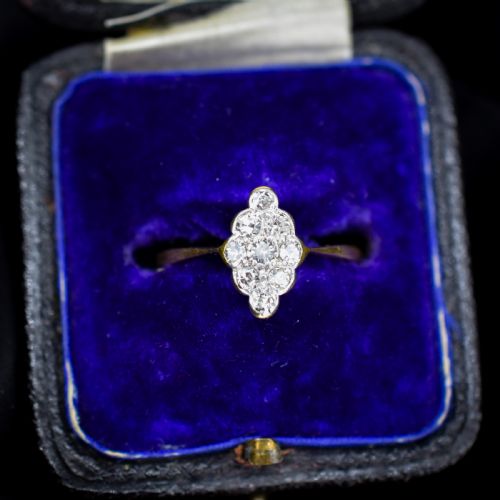
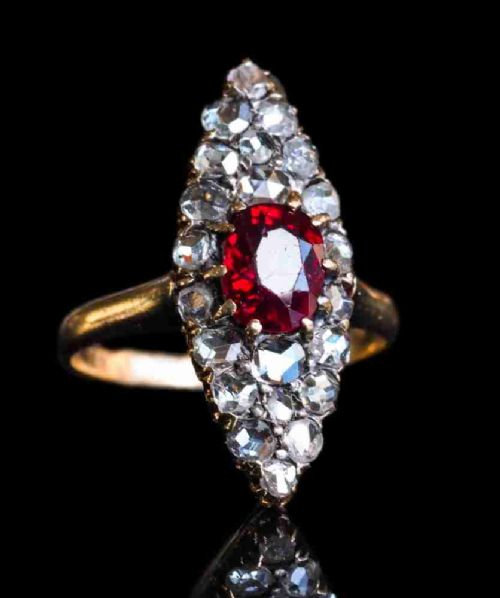
A victorian marquise diamond ring centres on a pointed, boat-shaped silhouette designed to stretch visually across the finger. These pieces frequently appear as cluster arrangements, framing central diamonds with smaller accent stones or coloured gems.
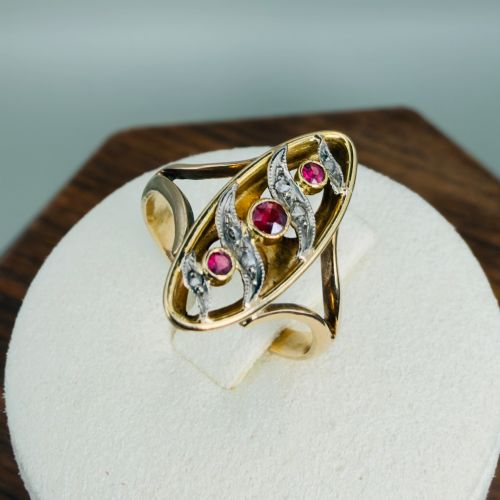
The selections span the late nineteenth century and edge into the Edwardian era, showing styles from austere geometric clusters to flowing Art Nouveau curves. Buyers find both classic yellow gold bands and combinations involving silver settings to enhance the brilliance of early diamond cuts.
How they were made
Goldsmiths utilised eighteen-carat yellow gold and platinum alongside silver, often mounting stones in combinations that maximised the play of light under candlelight. Early cut diamonds, including old mine and rose cuts, were hand-set into collets that followed the tapering contours of the navette outline.
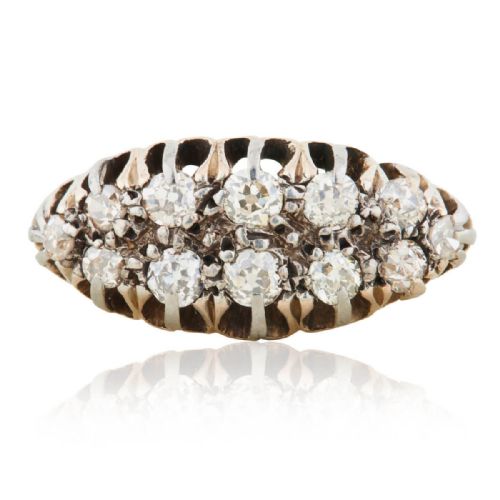
Construction methods rely on delicate hand fabrication rather than mass casting, visible in the fine gallery wirework and bezel or prong configurations. Many examples combine gold shanks with silver upper clusters, a technique common in period jewellery to keep white metal against the stones while retaining warm gold underneath.
Victorian Marquise Diamond Ring Retail Price Guide 2026
Typical asking prices for victorian marquise diamond ring among the pieces listed under this phrase on Sellingantiques today, from the lower quarter to the upper quarter. They describe what is for sale here now, not the wider market.
Some nineteenth-century makers packed extra sparkle into tight spaces by sneaking tiny rose cut diamond chips right into the shoulder scrolls.
What varies in quality
The distinction between ordinary and exceptional pieces rests on the crispness of the navette outline and the symmetry of the stone arrangement. Superior examples maintain intact original claw settings and crisp shoulder details without evidence of thinning from past resizing.
Proportion dictates visual success in these elongated clusters, where the balance between the central gems and the surrounding halo defines the overall harmony. The presence of matching, undisturbed old cut diamonds rather than later replacement stones elevates the integrity of the piece.
The Victorian Marquise Diamond Ring Glossary
- Marquise
- A pointed, elongated boat shape also known as a navette, designed to maximise finger coverage. This silhouette was named after the Marquise de Pompadour.
- Navette
- French for little ship, this term describes the same pointed boat-shaped cluster design as a marquise. It appears frequently in nineteenth-century and Edwardian jewellery descriptions.
- Old Cut
- A hand-faceted diamond style preceding modern brilliant cuts, characterised by high crowns, small tables and deep pavilions. These stones catch ambient light with a distinctive, softer glow.
- Rose Cut
- A vintage diamond cutting style with a flat base and a domed crown of triangular facets arranged in a symmetrical pattern. This cut produces a translucent sparkle rather than sharp brilliance.
- Cluster
- An arrangement where a central gemstone is surrounded by a group of smaller stones. In these rings, the cluster follows the tapered lines of the marquise outline.
Victorian Marquise Diamond Ring: Frequently Asked Questions
How do I care for an antique diamond ring?
These delicate settings require gentle handling and should be removed before manual work, swimming or applying harsh cosmetics. Regular professional checks ensure the old claws and thin shanks remain secure.
Cleaning is best done with warm soapy water and a soft brush, avoiding ultrasonic machines that can loosen older stones.
Are these stones natural?
The diamonds and coloured gems found in these pieces are earth-mined stones characteristic of the nineteenth century. Many feature unheated rubies or sapphires alongside hand-cut old European and rose cut diamonds.
Evaluation relies on microscopic examination to identify the hand-cut facets and natural inclusions typical of the period.
How can I tell the period?
Dating relies on mounting styles, metal combinations, and the specific geometry of the cut. Silver-topped gold settings and heavy yellow gold bands point towards the late Victorian decades.
Transition into the Edwardian period brings lighter platinum work and more delicate, lace-like open galleries surrounding the central stones.