



Victorian London Artwork
Victorian london artwork brings the capital's historic riverbanks, parks and bustling commerce straight into your interior through period oil paintings and delicate watercolours.
Victorian London Artwork
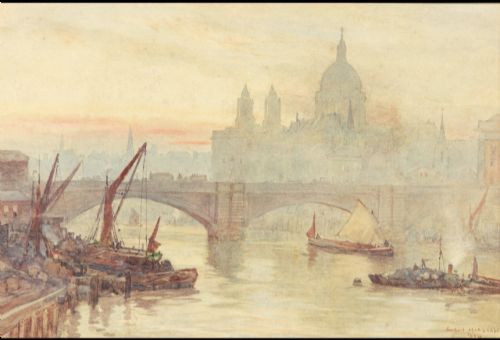
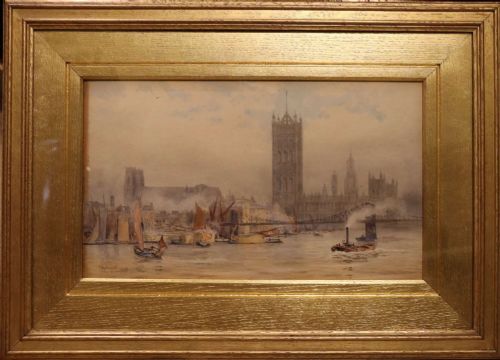
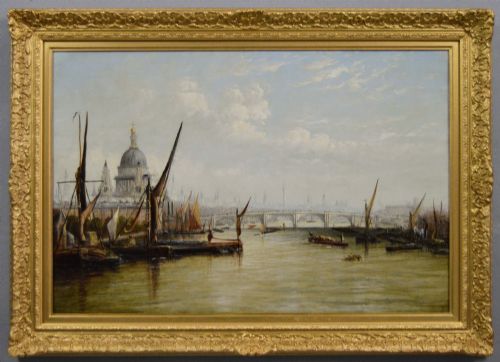
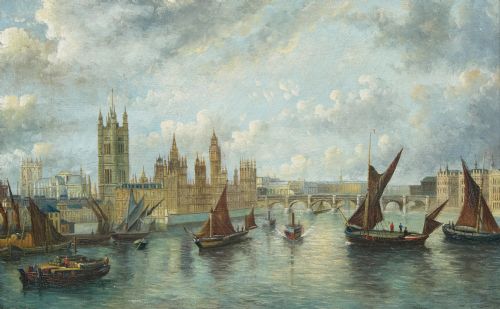
Victorian london artwork captures the capital through nineteenth-century paintings, watercolours, engravings and etchings. When searching this phrase, collectors encounter topographical views of the River Thames, maritime scenes near the docks, and familiar landmarks such as St Pauls Cathedral and the Houses of Parliament.
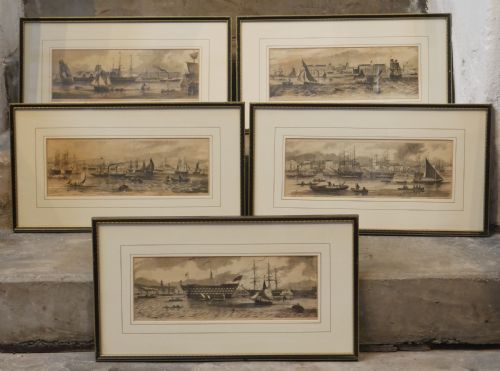
The selections on this page span the nineteenth century into the early twentieth century, featuring works by named artists alongside pieces by the English School. Subjects range from busy river traffic and naval engravings to quiet park scenes in Kew and Hyde Park.
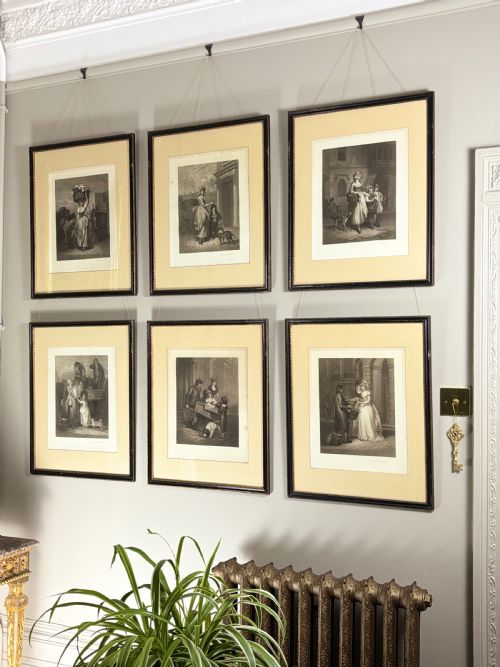
Buyers find diverse formats, including large framed oils on canvas, delicate cut paper silhouettes, hand-coloured etchings and sets of prints. These pieces record the changing urban landscape and river life of historical London.
Materials and techniques
Artists captured these cityscapes using oil paint on canvas, watercolour on paper, and ink, frequently accented with gold leaf. Engravings and etchings provide detailed monochrome or hand-coloured views of docks and prints.
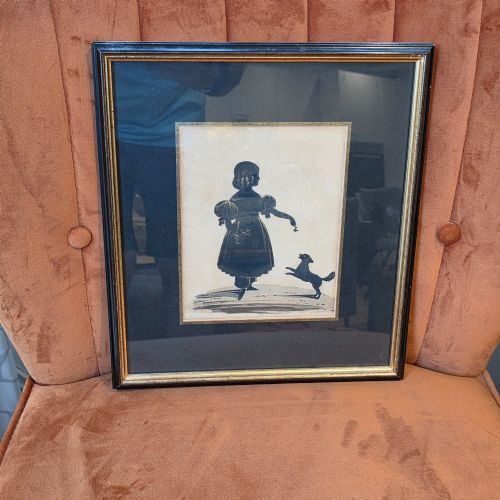
Framed works often incorporate wood and glass to protect the paper and canvas mediums. Cut paper silhouettes combined with watercolour demonstrate the intricate manual dexterity employed in nineteenth-century portraiture and topographical composition.
A solitary dog accompanies a young girl in a nineteenth-century silhouette cutting.
Evaluating quality and execution
Quality rests in the precision of topographical detail and the handling of light across water and stone. Works by accomplished artists demonstrate superior control of perspective, particularly in complex river scenes featuring shipping and bridges.
The preservation of the underlying paper or canvas influences desirability, alongside the integrity of the period framing. Stronger examples maintain vibrant pigment in watercolours and clear definition in engravings without excessive fading.
William James Hubard·Francis Moltino·Charles William Wyllie·Thomas G Appleton·Edward Fletcher·Herbert John Finn
The Victorian London Artwork Glossary
- Watercolour
- A painting method where fine pigment is suspended in a water-soluble binder on paper. It allows for translucent washes that suit atmospheric depictions of London fog and river mist.
- Etching
- A printmaking technique where lines are bitten into a metal plate with acid before being inked and pressed onto paper. This process creates sharp, fine details ideal for architectural views.
- Mezzotint
- A tonal printmaking method that achieves rich dark areas and subtle gradations without using line. It was frequently utilised for reproducing large paintings.
- Engraving
- A method of cutting design lines directly into a metal printing plate with a sharp tool. The resulting prints offer precise, enduring linear definition.
- Topographical
- Representing specific real-world locations accurately rather than composing imaginary landscapes. These views serve as historical records of London's past architecture.
Victorian London Artwork: Frequently Asked Questions
What subjects appear most often?
The River Thames dominates these works, showing bridges, shipping, and landmarks like St Pauls Cathedral and the Houses of Parliament. Parks and gardens also feature prominently.
Views extend from Greenwich down to the London Docks, capturing both commercial activity and scenic cityscapes.
How should I frame and display these pieces?
Paper works require conservation framing behind glass to protect against light damage and atmospheric moisture. Oils on canvas need stable humidity.
Keep pieces away from direct sunlight to preserve watercolours and coloured prints from fading over time.
How can I tell the period?
Stylistic clues include architectural details of London landmarks before modern rebuilding, costume in figures, and framing materials. Signatures and dates provide direct evidence.
Catalogues and artist lifespans help narrow the date of execution when a piece lacks an inscribed year.
Are these works original?
The selection includes original hand-painted oils and watercolours alongside period engravings, etchings and coloured prints. Each listing specifies the exact medium used.
Prints and engravings were often produced in sets, whereas paintings and drawings remain unique single items.