


Victorian Inlay Office Desk
A victorian inlay office desk brings warmth and finely detailed craftsmanship to a study through rich timbers and careful marquetry.
Victorian Inlay Office Desk
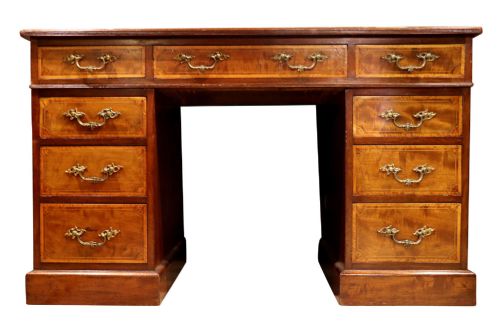
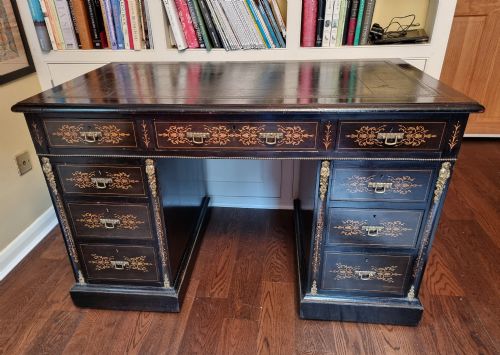
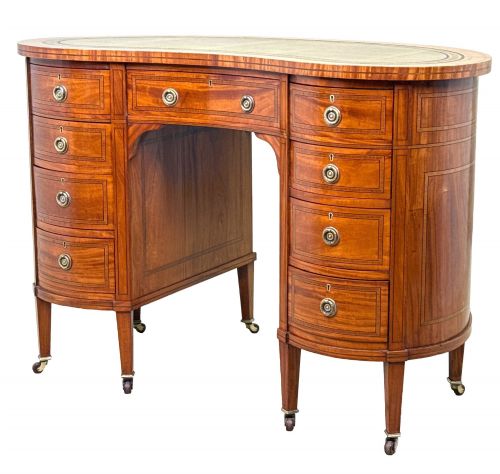
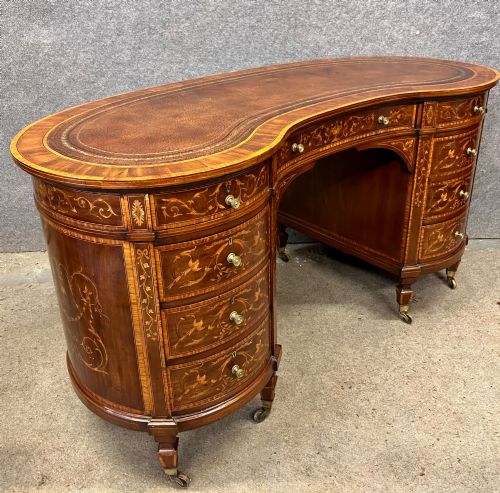
A victorian inlay office desk encompasses substantial pedestal forms, compact davenports, and serpentine kidney shapes designed for writing. These pieces span the nineteenth century into the early twentieth century, reflecting shifting tastes from formal mahogany pedestals to lighter satinwood and walnut designs.
Pedestal desks and kneehole writing tables dominate the selection, offering practical drawer arrangements alongside decorative brass handles. Smaller davenports and cylinder desks provide alternative workspace solutions suited to more intimate rooms.
Cabinetmakers utilised various historical revivals, creating sheraton revival, louis xvi revival, and arts and crafts interpretations. These stylistic variations determine whether a piece leans toward geometric neoclassical symmetry or more fluid organic lines.
Materials and construction
Makers constructed these desks using solid and veneered timbers including mahogany, burr walnut, satinwood, and rosewood. These primary woods often feature contrasting crossbanding and intricate marquetry inlay executed in lighter exotic species.
Writing surfaces typically incorporate inset leather panels framed by decorative wood borders and subtle blind tooling. Drawer interiors frequently utilise secondary timbers alongside original brass hardware and working locks.
Listings feature various desk forms spanning mahogany pedestal models to satinwood kidney shapes and compact walnut davenports.
Assessing craftsmanship
The distinction between standard production and top quality pieces rests in the crispness of the marquetry and the choice of veneer figures. Exceptional examples exhibit tight flame mahogany, rich burr walnut, or meticulously arranged satinwood without excessive restoration.
Structural integrity and hardware retention separate finer desks from simpler iterations. Retaining original handles, functional internal mechanisms, and well-fitted drawer dividers elevates the standing of an individual piece.
Edwards & Roberts·Wolfe & Hollander
The Victorian Inlay Office Desk Glossary
- Marquetry inlay
- Decorative patterns formed by fitting contrasting pieces of wood veneer into a prepared background surface. This technique allows for elaborate floral or geometric designs across the desktop and drawer fronts.
- Pedestal desk
- A large freestanding desk featuring two separate banks of drawers that support the main writing surface. They offer substantial storage and a finished back for placement in the middle of a room.
- Davenport
- A compact sloping desk fitted with a hinged writing surface and side drawers accessed from a pedestal base. Developed during the nineteenth century, it serves as a space-saving writing cabinet.
- Crossbanding
- A decorative border technique where strips of veneer are laid perpendicular to the main grain direction. This frames the primary timber and provides a neat visual boundary.
- Kneehole desk
- A writing table with a central recess for the user's legs, flanked by single or multiple columns of drawers. These desks provide a structured workspace while maintaining a compact footprint.
Victorian Inlay Office Desk: Frequently Asked Questions
How do I care for the leather top?
Maintain the leather writing surface by dusting it regularly with a dry cloth and applying specialist leather balm periodically to prevent drying. Avoid harsh cleaning agents that can strip the original colour and gold tooling.
Keep the desk away from direct sunlight and heat sources to protect both the leather insert and the polished wood veneers surrounding it.
Can these desks fit modern computers?
Many pedestal and kneehole desks offer adequate surface area for a laptop, though deeper pedestals require measuring knee clearance. Consider the height of the chair used alongside the desk to ensure a comfortable typing posture.
Compact davenports provide less surface depth, making them better suited for traditional writing tasks rather than extensive computer work.
Where should I place a freestanding desk?
Freestanding pedestal desks feature finished backs, allowing them to sit centrally within a room rather than against a wall. Ensure there is sufficient clearance around the desk to pull out chairs and access side drawers comfortably.
Positioning the desk to receive natural light from the side prevents glare on the leather writing surface and wooden top.